
Guide to Braided Packing Material and Selection
In the operation of industrial equipment, sealing failure is one of the primary causes of leakage, shutdowns, and safety incidents. Whether it is a high-pressure valve in a petrochemical plant or a standard pump in a water treatment system, reliable sealing materials are essential to ensure stable and safe operation. As a traditional yet still widely used sealing material, braided packing continues to play a vital role across various industrial applications due to its flexible structure, diverse material options, and controllable cost. However, faced with a wide range of braided packing products on the market, engineers and procurement personnel often find it difficult to make accurate selections. This article systematically introduces the core knowledge of braided packing from the perspectives of braided structure, material composition, performance characteristics, application fields, installation, and maintenance, helping readers select the most suitable sealing solution according to actual operating conditions.
Braided packing is a traditional sealing material widely used in industrial sealing systems and is also known as compression packing or rope packing. It is mainly applied in shaft sealing areas of pumps, valves, and various rotating equipment. Its core function is to prevent media leakage and maintain internal system pressure stability.
Braided packing is typically manufactured with a square or rectangular cross-section and produced by weaving different materials together through a braiding process. Due to the wide range of material combinations and braiding methods, compression packing exhibits significant performance variations, enabling it to meet different sealing requirements under various working conditions. From high-temperature and high-pressure equipment in large refineries to sanitary pumps and valves in the food processing industry, braided packing plays an irreplaceable role.
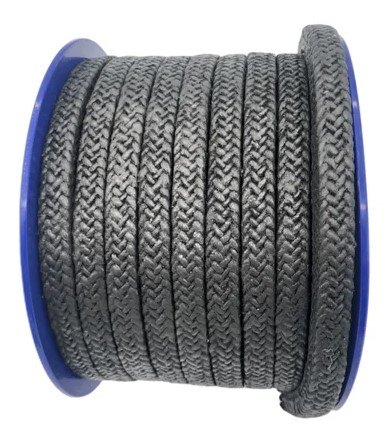
Braided packing is widely used across numerous industries. In the oil and gas sector, equipment often operates under high pressure, strong corrosive media, and complex conditions, requiring extremely high sealing reliability. Braided packing effectively prevents leakage and ensures safe system operation.
In the chemical industry, PTFE-based braided packing is widely used due to its excellent chemical inertness, ensuring safe transportation of corrosive media. In water treatment, food and beverage, and other general industrial systems, braided packing is also used to ensure sealing integrity and hygienic safety during fluid transport.
The braiding method directly determines radial expansion capability, sealing performance, and installation difficulty, making it a key factor in selection. Different structures are suitable for different equipment conditions and operating environments.
The square braided structure is the most commonly used form in industry. It features a relatively loose weaving pattern, allowing significant radial expansion when compressed.
This characteristic is particularly important for equipment that has experienced wear over long-term operation. For example, when gaps in a pump stuffing box or shaft sleeve increase due to wear, the softer square braided packing can expand to compensate for the clearance, achieving a more effective seal.
Therefore, when equipment tolerances are large or wear is significant, square braided packing is often the most suitable choice. It is also easier to install and adapt to complex operating conditions.
In contrast to square braiding, tighter structures include grid braiding, interlock braiding, Texlock braiding, and Interbraid braiding. These types have higher packing density and fewer gaps between fibers, resulting in fewer leakage paths and superior sealing performance.
However, due to their compact structure, their radial expansion capability after compression is weaker. They are more suitable for newer equipment or systems with higher machining precision and smaller clearances. When operating conditions are stable and gaps are minimal, tight braided packing provides reliable long-term sealing performance.
Additionally, these structures are less prone to loosening or fraying, offering excellent structural stability during long-term operation.
The braided jacketed core structure is a special design commonly used in valve packing or specialized industrial equipment. The core may consist of tightly braided material or extruded compounds, while the outer layer is reinforced with braided covering.
In high-pressure applications, metal wires may be incorporated into the outer braid to enhance pressure resistance. In mixers or agitators where shaft eccentricity is significant, the core is often made of rubber materials such as fluororubber or silicone to improve elastic recovery.
This structure can restore its shape after compression deformation, preventing sealing failure caused by uneven pressure. It also acts as a cushioning element similar to a bearing, extending sealing life.
Twisted braided packing is typically made from cotton fibers impregnated with mineral oil and graphite. It is a more traditional product with lower mechanical strength compared to interlocked structures and is mainly used in light-duty or low-demand applications.
Double-braided structures usually have a round cross-section and may include a metal wire core for reinforcement. The outer layer consists of multiple braided layers and may be impregnated with lubricants or graphite to reduce friction and improve sealing performance. These structures are generally used in more demanding industrial conditions requiring higher durability and reliability.
While the braided structure determines physical form and mechanical behavior, the material itself directly defines temperature resistance, corrosion resistance, and wear resistance. Even with identical braiding methods, different materials result in completely different performance characteristics.
Early compression packings were made from natural plant fibers such as jute, hemp, or cotton yarn. These materials were inexpensive but had limited thermal and chemical resistance.
Later, asbestos materials became widely used due to their superior temperature resistance and chemical compatibility. Asbestos significantly improved high-temperature performance and was extensively applied in industrial systems. However, after the 1980s, asbestos was gradually phased out in regions such as the United States due to health and regulatory concerns, although it is still used in some countries.
Modern braided packing materials are much more diverse and include PTFE (polytetrafluoroethylene), aramid fibers, glass fibers, synthetic yarns, carbon fiber, graphite fiber, flexible graphite, and PTFE-graphite composites.
PTFE braided packing offers outstanding chemical resistance and is widely used in corrosive chemical transport environments. Graphite packing provides excellent high-temperature resistance and thermal conductivity, making it suitable for refineries and power plants. Aramid fiber is known for its high tensile strength and wear resistance, making it ideal for mining and wastewater systems containing abrasive particles.
Different materials vary in temperature resistance, corrosion resistance, wear resistance, and friction coefficient, requiring careful selection based on media properties, temperature, pressure, and equipment conditions.
Braided packing is often constructed from multiple combined materials such as aramid fibers, PTFE, graphite, and flexible graphite. Therefore, both material composition and braiding structure significantly influence performance and suitability for different operating conditions.
Through rational material combinations, braided packing can cover a wide range of applications, from highly corrosive environments to high-temperature and high-pressure systems.
- Radial Expansion Capability: Different braiding methods significantly affect radial expansion. Generally, tighter structures such as grid or interlock braiding exhibit lower radial expansion capability. These are more suitable for new equipment with tight tolerances, where minimal deformation ensures stable sealing. As equipment ages, wear on shafts, stuffing boxes, or sleeves increases clearance. In such cases, looser structures like square braided packing are more appropriate, as they can expand to compensate for wear and maintain sealing effectiveness.
- Installation Difficulty Differences: Tighter braided structures tend to have lower flexibility, requiring higher installation precision and force. Looser structures are easier to install and better suited for complex operating conditions. Therefore, installation convenience is an important factor in selection.
- Flexible and Semi-Rigid Structures: Braided packing can generally be classified into flexible and semi-rigid structures. Flexible braided packing offers better adaptability and elasticity, making it suitable for high-pressure pumps and equipment with shaft misalignment or wear. Semi-rigid braided packing is more structurally stable and is better suited for static equipment or low-frequency motion systems, where long-term stable sealing is required. The selection of structure type essentially balances equipment operating conditions and sealing requirements.
- Selection Principles: Proper selection of braided structure helps balance equipment lifespan, sealing performance, installation difficulty, and operational stability. For new equipment, tight braided structures are preferred to achieve better initial sealing performance. For worn or aged equipment, square braided structures with higher expansion capability are more suitable.
- Oil and Gas Industry: In oil and gas operations, equipment is exposed to high pressure, high temperature, and highly corrosive environments. Braided packing ensures safe sealing and system integrity. Graphite-based or composite packing materials are commonly used.
- Chemical Processing Systems: The chemical industry involves a wide range of corrosive media. PTFE braided packing is widely used due to its excellent chemical inertness, resisting most acids, alkalis, and organic solvents, ensuring safe transportation and environmental protection.
- Water Treatment and General Industry: In water treatment, food and beverage, and general industrial systems, sealing and hygiene are critical. Certified braided packing materials ensure both sealing performance and compliance with hygiene standards.
- Mining and Wastewater Treatment: Mining and wastewater systems often contain abrasive particles that cause severe wear. Aramid fiber braided packing performs exceptionally well due to its high strength and wear resistance, extending service life and reducing maintenance frequency.
Proper installation is critical to performance. First, thoroughly clean the stuffing box to remove old packing residues. Then cut the packing into appropriate lengths and install it ring by ring, ensuring each layer is evenly compressed and properly positioned.
Avoid excessive compression at once, as this may lead to premature wear or affect shaft operation. A step-by-step tightening approach helps extend service life and improve stability. Each ring should be tightened before installing the next until the stuffing box is fully filled.
Common issues include leakage, wear, and reduced sealing performance. When high-pressure leakage occurs, check whether the packing is insufficiently tightened or incorrectly selected. Adjust gland bolts if necessary, or replace with a more suitable specification.
If severe wear occurs, replace the damaged packing promptly to prevent damage to the shaft sleeve or stuffing box. For long-term performance degradation, regular inspection and adjustment are required. A scheduled maintenance system significantly extends service life.
Overall, braided packing offers low cost, easy installation, wide applicability, and convenient maintenance. Even under high temperature, high pressure, or corrosive conditions, properly selected braided packing can maintain reliable performance.
Compared with mechanical seals, braided packing does not require complex auxiliary systems. Maintenance only requires replacement of packing, significantly reducing downtime and cost. For many small and medium-sized equipment applications, it remains a practical and economical sealing solution.
As a fundamental material in industrial sealing systems, braided packing offers diverse structures and rich material options, capable of meeting requirements from general applications to extreme conditions. By understanding structural characteristics, material differences, and proper installation and maintenance methods, users can select the most suitable braided packing for specific applications, ensuring safe and stable equipment operation while reducing maintenance costs and improving production efficiency.
