
A Guide to Cryogenic Valve Leak Prevention
In critical industrial sectors such as liquefied natural gas (LNG) storage and transportation, aerospace propellant supply systems, air separation units, and medical cryogenic applications, cryogenic valves play a central role in controlling fluid flow. These valves are required to operate reliably under extremely low temperatures, often below -150°C, for long periods of time. Any failure in sealing performance may lead to severe safety risks and significant economic losses. Therefore, leak prevention is the primary objective in the design and manufacturing of cryogenic valves, and it is also the most important performance indicator in selection, operation, and maintenance.
This article systematically introduces the characteristics of cryogenic operating conditions, the identification of external and internal leakage, key engineering design technologies for leak prevention, leakage detection and quality certification systems, as well as the root causes of leakage and selection recommendations, helping readers develop a comprehensive understanding of cryogenic valve leak prevention technology.
To understand why leak prevention is so critical for cryogenic valves, it is necessary to recognize that their operating environment is fundamentally different from that of conventional valves. When temperatures drop below -150°C, valves are no longer dealing with ordinary sealing challenges, but with drastic changes in material behavior caused by extreme cold.
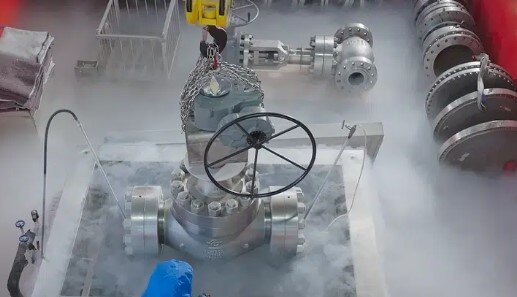
Cryogenic valve engineering is one of the most technically demanding fields in industrial valve manufacturing. These valves must operate in extremely low-temperature environments, typically below -150°C. In industries such as LNG, aerospace, petrochemicals, and medical systems, cryogenic processes are used to store and transport gases in liquid form under ultra-low temperature conditions.
At such low temperatures, material properties change significantly compared with room temperature. Conventional metallic materials become brittle and lose ductility. Sealing materials harden and lose elasticity. Different components also experience inconsistent thermal contraction. These changes create complex engineering challenges in design, manufacturing, and operation.
In any cryogenic system, valves perform essential functions such as flow regulation, equipment isolation, and system pressure maintenance. Since the media being handled are typically highly volatile and expand rapidly when heated, leak prevention is not only a technical requirement but also a critical safety guarantee.
Even minor leakage can lead to serious consequences. From an economic perspective, leakage results in direct resource loss and increased operating costs. From a safety perspective, it may cause fire, explosion, or oxygen-deficiency hazards. In applications involving liquid oxygen or liquid hydrogen, leakage may also allow air ingress into the system, triggering dangerous chemical reactions. For example, oxygen-enriched environments significantly increase the ignition risk of materials that are normally considered non-flammable.
Environmental concerns are equally important. Some cryogenic gases are potent greenhouse gases. Leakage can therefore contribute to atmospheric pollution, regulatory violations, and reputational damage for operators.
After recognizing the severity of leakage risks, it is essential to accurately identify leakage types. In cryogenic valve operation, leakage is generally classified into external leakage and internal leakage based on the flow path. These two types differ significantly in appearance, hazards, and detection methods.
External leakage refers to cryogenic media escaping from the interface between the valve body and the external environment. It typically occurs at the stem sealing area, bonnet-body connection, or micro-cracks caused by casting or welding defects.
In cryogenic conditions, external leakage often presents visible signs. The escaping medium rapidly absorbs heat from the surroundings, causing frost or ice formation. Abnormal icing or frosting on the stem, flange, or bonnet is often a key indicator of external leakage.
Detection methods include visual inspection, bubble testing, gas detectors, and ultrasonic detection equipment.
The hazards of external leakage are severe. It may lead to fire, explosion, or oxygen-deficiency incidents. It can also cause icing-induced mechanical jamming, structural damage, significant media loss, environmental pollution, and increased operating costs. Therefore, controlling external leakage is a fundamental requirement in cryogenic valve design and manufacturing.
Compared with external leakage, internal leakage is more concealed but persistent. It occurs inside the valve when, even in the fully closed position, the medium still passes through a small gap between the valve seat and disc, flowing from the high-pressure side to the low-pressure side. This results in an incomplete shut-off condition.
In daily use, internal leakage is similar to a faucet that continues dripping after being closed. Under cryogenic conditions, however, it leads to continuous energy loss and process instability. Since it cannot be directly observed, internal leakage is usually detected through pressure drop tests, temperature anomaly monitoring, and ultrasonic detection. A continuous downstream pressure drop or localized abnormal frosting are often important indicators.
The long-term impact of internal leakage is mainly reflected in economic losses and reduced system efficiency. It may also cause process instability, equipment overpressure, or damage to critical equipment such as compressors. Therefore, internal leakage control is a key performance indicator of cryogenic valves.
External leakage detection is relatively straightforward and can be performed through visual inspection of frosting, bubble testing, gas detection instruments, and ultrasonic devices. Internal leakage detection requires more specialized methods, including pressure decay testing, temperature anomaly monitoring, and ultrasonic techniques. In practice, combining multiple detection methods improves both accuracy and timeliness of leakage identification.
Accurate identification of leakage is diagnostic in nature, but true prevention must be achieved at the design and manufacturing stage. A reliable cryogenic valve capable of long-term operation in deep-cold environments depends on precise control of five key engineering elements, with material selection being the foundation.
Under cryogenic conditions, conventional carbon steel becomes brittle due to cold embrittlement and loses ductility. Therefore, engineers must select materials that maintain mechanical performance at low temperatures, such as austenitic stainless steel, Monel alloys, or Inconel nickel-based alloys. These materials not only provide required strength but also ensure compatibility with the media being transported.
In addition, thermal contraction compatibility between the stem, disc, and body must be ensured. If different components contract at significantly different rates, gaps or stress concentrations may occur at low temperatures, compromising sealing performance. Sealing materials must also retain elasticity and sealing capability under cryogenic conditions, making this a critical design consideration.
Traditional sealing structures may fail under cryogenic conditions due to differences in thermal expansion coefficients. Therefore, cryogenic valves often use metal-to-metal sealing or specially formulated low-temperature elastomer sealing materials.
Bellows-sealed structures are commonly used in cryogenic valves. They isolate the valve stem from the cryogenic medium, preventing leakage along the stem path. Extended bonnet designs are also typical, positioning the stem packing area in a relatively warmer zone to ensure proper functioning of the packing.
Soft seats made of PTFE are widely used, but they must undergo special treatment to maintain flexibility and sealing performance at low temperatures. Machining accuracy of sealing surfaces directly affects sealing effectiveness, and strict tolerances must be maintained to ensure precise alignment and contact.
Cryogenic systems experience significant thermal contraction during operation, which may create gaps at connection interfaces. Engineers must anticipate these changes during the design stage and provide appropriate tolerance compensation to ensure sealing integrity across the full operating temperature range.
Thermal compensation applies not only to the valve body but also to the connection between the valve and pipeline. Insufficient compensation design may lead to stress-induced sealing failure or structural deformation under low temperatures.
Leak prevention is not only a design issue but is deeply embedded in the entire manufacturing process. High-precision machining, surface treatment, and assembly quality directly affect sealing performance. All components must be manufactured within strict tolerances to ensure perfect alignment and contact of sealing surfaces.
Welding is a critical process in cryogenic valve manufacturing. Welds must achieve full penetration without any defects, as even minor flaws may become failure points under thermal cycling. Post-weld heat treatment may also be required to relieve stress and prevent deformation.
Cleanliness is a key requirement in cryogenic valve manufacturing. Even trace amounts of moisture or particulate matter can freeze under cryogenic conditions, causing blockage or damage that may lead to leakage. Therefore, cryogenic valves must be cleaned and assembled in controlled environments to ensure overall integrity.
Even with excellent design and manufacturing processes, every cryogenic valve must undergo strict testing to verify its leak-tight performance. These tests are not only essential for quality certification but also serve as a bridge of trust between manufacturing and application. Among them, helium leak detection is widely regarded as the industry gold standard due to its extremely high sensitivity.
With increasing safety regulations and performance requirements, leak detection technology has advanced significantly. Helium leak detection is now widely used in the valve industry. Helium atoms are small and highly mobile, making them ideal as tracer gases for detecting micro-leaks. This technology allows manufacturers to verify sealing performance before valves are put into service.
In addition to factory testing, advanced cryogenic systems are now equipped with real-time monitoring tools that detect leakage through pressure variation or abnormal gas composition. Predictive maintenance technologies integrated with sensors and artificial intelligence also help operators identify potential failures in advance and reduce unplanned downtime.
Due to the critical importance of cryogenic systems, multiple international standards have been established for design, testing, and certification, including API 598, BS EN 1626, and ISO 21011. Compliance with these standards ensures valve safety and performance, while also providing reliable assurance to end users and regulatory authorities.
Many industries also require third-party inspection and certification, especially for valves used in LNG export terminals or oxygen processing facilities. This additional verification reflects the industry's strong emphasis on leak prevention and reliability. Cryogenic valves must also undergo low-temperature testing, where the valve is cooled to actual operating temperature before pressure testing to ensure zero leakage.
After understanding strict design, manufacturing, and testing processes, leakage failures in real operation can be analyzed systematically. Most leakage events are not accidental; they can generally be traced to three interrelated levels of failure. The starting point is the fundamental stage of product creation: materials and design.
Whether external or internal leakage occurs, the root cause is often related to materials, design, manufacturing, installation, or maintenance. In terms of materials, improper selection or mismatch in thermal contraction between components can lead to gaps during operation.
From a design and manufacturing perspective, insufficient machining accuracy of sealing surfaces, poor seat-disc matching, unreasonable extended bonnet design, or contamination during assembly can all become potential leakage sources. Design miscalculations or structural flaws may gradually evolve into serious leakage issues during long-term operation.
During installation and operation, uneven pipeline stress, excessive operating impact, and damaged insulation layers may also lead to sealing failure or deformation. If installation procedures are not strictly followed, valves may be subjected to additional stress that compromises sealing precision.
Manufacturing defects such as welding flaws, improper surface treatment, or assembly errors are amplified under cryogenic conditions. The tolerance for defects in low-temperature environments is extremely low; minor issues that are acceptable at room temperature may become direct causes of leakage.
During long-term operation, loosening of bolt preload and delayed replacement of sealing components gradually increase leakage risk, turning minor issues into systemic failures. Cryogenic conditions may accelerate the aging of certain materials, making regular inspection and maintenance essential for maintaining sealing performance.
Based on the analysis of root causes, we can return to a practical question: how to select a truly reliable cryogenic valve for critical systems? Proper selection and procurement should begin with confirmation of key technical parameters.
A reliable cryogenic valve must meet multiple requirements, including material reliability, structural precision, installation compliance, and continuous maintenance management. Any missing link may become a system vulnerability.
During procurement, users should focus on key parameters such as medium type and minimum temperature, pressure rating, connection type, and actuation method. These parameters determine whether the valve can meet specific operating conditions. For example, LNG and liquid oxygen require different material compatibility, minimum temperature defines material selection limits, and pressure rating determines structural strength design.
After confirming basic parameters, users should further evaluate material certification, sealing class standards, bonnet design, factory low-temperature testing capability, and international certifications. Products that comply with API and ISO standards and have complete testing systems can better meet long-term cryogenic operation requirements.
The manufacturer's ability to perform low-temperature testing is particularly important. Only by cooling the valve to actual operating temperature before pressure testing can real sealing performance be verified. Quality management systems, welding certifications, and third-party inspection reports are also critical indicators of reliability.
In addition, technical support and after-sales service should not be overlooked. Long-term reliable operation depends not only on product quality but also on proper installation guidance and maintenance support. Choosing manufacturers with extensive cryogenic application experience can significantly reduce operational risks.
Cryogenic valve leak prevention is a systematic engineering discipline involving materials science, mechanical design, precision manufacturing, quality testing, and operational management. From material selection to structural design, from welding processes to cleanliness control, and from factory testing to field installation, every stage directly affects final sealing performance.
For users, understanding the differences between external and internal leakage and their detection methods helps identify and address issues during operation. During procurement, evaluating manufacturer capabilities and certifications, and selecting products that comply with international standards and undergo strict cryogenic testing, are fundamental to ensuring long-term system safety and stability. With continuous advances in leak detection technologies and predictive maintenance methods, the reliability of cryogenic valve systems will continue to improve, providing stronger technical support for industries such as LNG and aerospace.
