
Axial Flow Check Valve: Protecting Pump & Compressor System
In industrial production, pumps and compressors are the core equipment for transporting liquids and gases, widely used in petroleum, petrochemical, power generation, pharmaceuticals, food and beverage, and many other industries. The stable operation of these devices is directly related to the safety and efficiency of the entire production system. However, when equipment stops operating or when pressure fluctuations occur in the system, the medium inside the pipeline may flow in reverse, resulting in backflow. Backflow can not only damage equipment but also trigger serious problems such as water hammer and pressure pulsations, causing impact on pipelines and instrumentation systems.
To prevent these issues, check valves are essential protective components in pump and compressor systems. Although traditional check valves can prevent reverse flow, they often suffer from high opening and closing impact, significant water hammer risk, and installation space limitations in practical applications. As an improved type of check valve, the axial flow check valve has gradually become a preferred solution in industrial systems due to its rapid closing response, non-impact operation, and compact structure. This article starts from the limitations of traditional check valves and provides a detailed explanation of axial flow check valves, including their working principles, structural types, core advantages, and typical applications, helping readers fully understand this critical protective device.
Industrial transportation function: Pumps and compressors serve as fundamental equipment in various industrial systems. Pumps are mainly used to transport liquid media, while compressors are used to compress and convey gases. These devices transfer media from one location to another and play a vital role in industries such as pharmaceuticals, food and beverage, petrochemicals, natural gas, power generation, chemical engineering, and building facilities maintenance. Because these systems often operate continuously with large flow rates, stability and safety are key engineering requirements.
Safety risks caused by reverse flow: In pump and compressor systems, the medium is designed to flow in only one direction. When equipment stops or abnormal conditions occur, reverse flow may appear in the pipeline. Backflow can cause severe damage, including impact on pump casings, damage to compressor components, and abnormal pipeline pressure conditions. Therefore, installing a device that ensures one-way flow is essential to protect equipment, extend service life, and reduce maintenance costs. The check valve is the key component responsible for this function.
While traditional check valves are widely used, they present several limitations in real-world operation, which have driven the development of improved designs.
Traditional check valves often experience failure in pump and compressor applications. Dual-plate check valves, commonly used in air compressors, may become unstable under fluctuating flow conditions. Swing check valves and tilting disc check valves also frequently fail under varying operating conditions. Under dynamic flow, these valve types cannot maintain stable operation. Frequent opening and closing causes impact and wear, eventually leading to leakage or complete failure.
Water hammer occurs when a flowing fluid suddenly stops or reverses direction, generating a pressure surge. This pressure shock can severely damage pipelines, gaskets, instruments, and support structures. Swing, tilting disc, and dual-plate check valves often close slowly or inconsistently, which can intensify water hammer effects. Pressure waves propagate through the pipeline, causing vibration, loose connections, and in severe cases, pipeline rupture.
Pressure pulsations mainly originate from the reciprocating motion of piston compressors. Cyclic pressure variations generate shock waves in the system, accelerating wear on pipelines and valve components. Traditional check valves often contain swing-type internal parts, which are prone to vibration and impact under pulsating conditions, further reducing service life.
Pump systems are typically installed in dedicated rooms where space is limited due to noise and safety requirements. Traditional check valves are relatively large and require significant installation space, restricting pipeline layout. In space-constrained environments, installation and maintenance become difficult, increasing engineering complexity and cost.
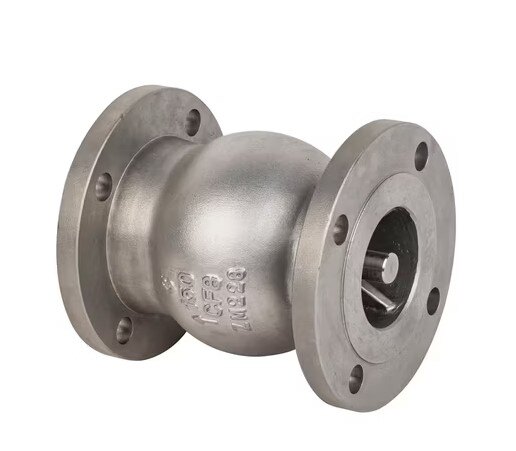
Axial flow check valves provide a new technical solution to overcome the limitations of traditional designs. Their performance advantages are based on streamlined structure, Venturi effect design, and spring-assisted rapid closure.
An axial flow check valve consists mainly of a valve body, valve seat, disc, spring, and guide sleeve. The opening and closing of the disc depend on pressure differential. When inlet pressure exceeds the sum of outlet pressure and spring force, the valve opens. When outlet pressure plus spring force exceeds inlet pressure, the valve closes, preventing reverse flow. This mechanism allows rapid response to flow changes.
The internal structure is streamlined, with the flow passage gradually narrowing toward the seat, forming a Venturi configuration. Under normal flow conditions, fluid velocity increases while static pressure decreases, keeping the disc in a stable open position with low resistance. When flow decreases or reverse flow begins, the spring quickly overcomes fluid forces and closes the valve. This ensures stable operation even at low flow rates.
Spring-assisted axial flow check valves feature non-impact closing behavior. As flow decreases, the spring force quickly closes the disc without shock. Compared with swing check valves, axial flow valves have faster response and lower inertia. Dual-disc spring-assisted designs further reduce delay and reverse flow velocity, significantly minimizing water hammer effects. The short stroke and lightweight disc design reduce seat impact and leakage risk.
Axial flow check valves are available in multiple types to suit different operating conditions.
- Spring-loaded type: Spring-loaded axial flow check valves rely on spring force for rapid closure and are commonly used at pump outlets where water hammer prevention is critical. They respond quickly to flow reduction and effectively prevent reverse flow impact.
- Dual-disc type: Dual-disc check valves are compact, lightweight, and suitable for high-pressure and high-temperature applications. The two discs work together to ensure fast closure while handling high system pressure, making them ideal for space-limited installations.
- Nozzle and piston types: Nozzle-type check valves use a nozzle and spring combination to control flow and are widely used in chemical and HVAC systems. Piston-type check valves use a piston mechanism for flow control and are suitable for high-pressure, high-temperature environments.
- Other types: Swing-type axial flow check valves use a hinged disc and are suitable for water treatment and low-pressure-drop systems. Stop-check valves combine shut-off and check functions. Inline spring check valves are widely used in HVAC, chemical, and water supply systems due to their strong anti-backflow performance.
Axial flow check valves offer significant performance improvements compared to traditional designs.
- Fast response and water hammer prevention: These valves close rapidly when reverse flow begins, preventing hydraulic shock waves and protecting the system. Their fast response makes them highly effective in dynamic flow systems.
- Low pressure drop and high flow efficiency: The axial flow design ensures smooth flow with reduced resistance. The valve remains fully open under normal conditions, reducing energy consumption and improving system efficiency.
- Compact structure and flexible installation: Axial flow check valves are compact, lightweight, and require minimal installation space. They can be installed in horizontal, vertical, or angled positions, offering excellent flexibility in system design.
- Long service life and low maintenance: With no swing-type moving parts, vibration and wear are significantly reduced. The tight sealing performance ensures minimal leakage, resulting in longer service life and reduced maintenance costs.
Axial flow check valves are widely used in demanding industrial environments.
Used in regasification, liquefaction, compressor discharge, firewater systems, oil and gas separation, steam and CO₂ injection, and gathering systems. These applications involve high pressure and flammable media, requiring high reliability and sealing performance.
Suitable for chlorine, phosgene, aromatics, polymers, acids, air separation systems, and alkaline media. These fluids are often corrosive or toxic, requiring excellent sealing and material compatibility.
Applied in steam systems, condensate systems, boiler feed pumps, cooling towers, and circulating water systems. Reliability is critical for continuous power plant operation.
Used in hydrogen systems, cracking units, steam systems, crude oil transportation, and ethylene and propylene systems. These environments involve high temperature, high pressure, and complex media compositions.
Selection based on operating conditions: Selection should consider medium type, temperature, pressure, flow range, and possible reverse flow velocity. For liquid systems, water hammer prevention is critical, and spring-assisted non-impact designs are preferred. For gas compression systems, especially reciprocating compressors, valves must handle pressure pulsations effectively. Material and sealing selection should match actual operating conditions.
Installation position and connection type: Axial flow check valves can be installed in horizontal or vertical pipelines. Installation direction should be determined based on pipeline layout. Most valves use flanged connections, and compact dual-disc or inline spring types are preferred in space-limited environments.
Axial flow check valves are essential protective components in pump and compressor systems. By ensuring one-way flow, they effectively prevent reverse flow and water hammer damage. Compared with traditional check valves, axial flow designs offer faster response, superior anti-impact performance, compact structure, flexible installation, and longer service life.
In industries such as oil and gas, chemical processing, power generation, and refining, axial flow check valves have become a reliable solution for ensuring safe system operation, reducing maintenance costs, and extending equipment life. For systems with high reverse flow risk, space limitations, or water hammer concerns, axial flow check valves provide an effective and highly reliable solution for improving overall system performance.
