In industrial piping systems, fluid control is a key link to ensure production safety and efficiency. As an important type of valve, three-way ball valves have been widely used in various industrial scenarios due to their unique structural design and flexible functional characteristics. This article will provide a detailed introduction to the basic structure, working principle, type distinctions, and practical application advantages of three-way ball valves, helping readers gain a comprehensive understanding of this important industrial equipment.
A three-way ball valve is a valve device with three connection ports, controlling the direction of fluid flow through the rotation of an internal ball. Unlike ordinary two-way valves that can only simply open or close, three-way ball valves can switch, divert, or mix flows among multiple paths, greatly enhancing the control flexibility of piping systems.
- Integrated Structural Design: Modern three-way ball valves generally adopt an integrated structural design. This design integrates the valve body into a single component rather than the traditional multi-part assembly. The direct benefit of the integrated structure is a significant reduction in connection points, thereby lowering potential leakage risks. At the same time, this structure makes the valve more compact overall, lighter in weight, and more convenient for installation and maintenance.
- Four-Face Seat Sealing System: Three-way ball valves adopt a four-face seat sealing type, which ensures reliable sealing at all ports. High-quality sealing performance not only prevents fluid leakage but also adapts to a variety of operating conditions ranging from high vacuum to high pressure. The four-face sealing design also achieves the goal of valve lightweighting, reducing the overall weight while maintaining high performance.
- Long Service Life and High Flow Capacity: The ball core of three-way ball valves is precision-machined, featuring long service life, high flow capacity, and low fluid resistance. These characteristics ensure stable and efficient performance under various working conditions. In actual use, users can clearly experience its smooth operation and reliable performance.
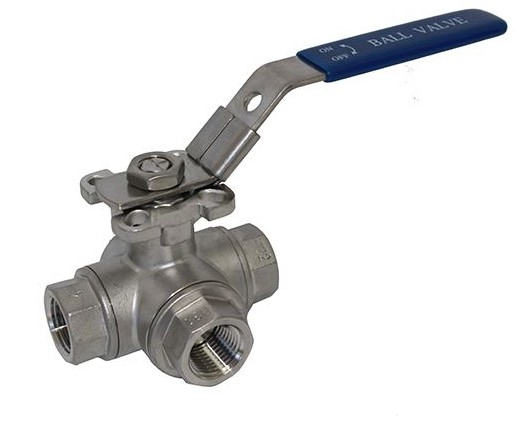
Two Main Types of Three-Way Ball Valves
According to the shape of the internal ball flow passage, three-way ball valves are mainly divided into L-type and T-type structures. These two types have different functional focuses and are suitable for different application scenarios.
The internal ball of an L-type three-way ball valve is machined with an L-shaped passage. This design allows the valve to connect one inlet to either of two outlets, but not both simultaneously. Specifically, the operating states of an L-type three-way ball valve include:
- Flow from the common port to the left outlet
- After 90-degree rotation, flow is directed to the right outlet
- Further rotation can achieve complete shut-off, blocking flow to all ports
The greatest advantage of the L-type three-way ball valve is its full shut-off capability. When it is necessary to completely stop fluid flow, this valve can simultaneously close all three ports, making it particularly suitable for applications with strict safety requirements. However, because the L-shaped passage cannot connect all three ports at the same time, this valve is not suitable for conditions that require mixing two flows or splitting one flow into two.
In practical applications, L-type three-way ball valves are mainly used for simple switching operations, such as switching between different raw material sources in industrial production processes, or switching water sources in irrigation systems. Its 90-degree flow control method is simple, direct, and reliable.
The internal ball of a T-type three-way ball valve is machined with a T-shaped passage, meaning that a third opening is added at a 90-degree direction on top of the straight-through path. This structure provides richer functional options than L-type valves. Depending on the rotation position of the ball, a T-type three-way ball valve can achieve:
- Diverting Function: Similar to L-type valves, it can direct flow to one outlet or the other
- Straight-Through Function: Connects both side ports directly, resulting in minimal fluid resistance and lowest pressure loss
- Mixing Function: Combines fluid from two inlets into a single outlet
- Distribution Function: Splits fluid from one inlet into two outlets
The greatest advantage of T-type three-way ball valves lies in their functional diversity. A single T-type valve can perform mixing, diverting, and switching operations, making it very suitable for systems that require complex flow control functions. However, standard T-type valves usually cannot completely close all ports, always keeping at least one flow path open. If the system requires full shut-off, a separate shut-off valve must be installed.
In applications involving mixing of different fluids, special attention must be paid to the pressure balance between the two inlets. If there is a significant pressure difference, fluid from the higher-pressure inlet may overpower the lower-pressure inlet, causing an imbalance in the mixing ratio.
Choosing a three-way ball valve instead of a traditional multi-valve combination scheme can bring multiple practical benefits to industrial systems:
- Significant Space Efficiency: Compared with the traditional solution using two two-way valves plus a three-way fitting, a three-way ball valve can save 50% to 65% of installation space. This compact design enables complex fluid control functions even in tight spaces or densely arranged piping layouts. This advantage is particularly prominent for retrofit projects or mobile equipment.
- Effective Cost Reduction: Although a single three-way ball valve usually costs more than a standard two-way valve, considering installation and long-term maintenance costs, the overall solution can reduce total costs by 20% to 35%. Cost savings come from multiple aspects: fewer three-way fittings and additional valves to purchase, shorter installation time, and reduced piping material consumption.
- Enhanced System Reliability: Every pipeline connection point is a potential source of leakage. Statistics show that about 65% of valve system failures occur at connection points rather than the valve body itself. Three-way ball valves significantly reduce the number of connection points, lowering the likelihood of system leaks and improving overall reliability. For systems handling corrosive, toxic, or high-pressure hazardous fluids, this safety improvement is particularly valuable.
- Simplified Automation Control: In automated operating systems, the advantages of three-way ball valves are even more evident. A single actuator can replace the work of 2 to 3 actuators, greatly reducing the complexity of the control system. Practical data shows that using three-way ball valves can lead to: programming time reduced by approximately 60%, electrical connections reduced by 40%, multi-path synchronous control accuracy increased by 90%, and system commissioning speed improved by 25% to 35%. These improvements not only accelerate project timelines but also reduce the technical difficulty of commissioning and maintenance.
The flexible functions of three-way ball valves make them widely used across multiple industrial fields:
- HVAC Systems: In building heating and cooling systems, T-type three-way ball valves are commonly used for precise temperature control of hot and cold water pipelines. By adjusting the mixing ratio of hot and cold water, precise control of supply water temperature can be achieved, improving energy efficiency and indoor comfort.
- Chemical Production Processes: The chemical industry often requires precise mixing of different chemicals or switching material flows between multiple reactors. The multifunctional characteristics of three-way ball valves make them ideal for such applications, ensuring process flexibility while maintaining system compactness.
- Water Treatment and Distribution: In water treatment plants and municipal water supply systems, three-way ball valves are used for source switching, process distribution, and emergency bypass control. The full shut-off capability of L-type valves is especially valuable in these applications, enabling reliable system isolation.
- Industrial Process Piping: Manufacturing production lines often need to switch between different raw materials, processes, or equipment. Three-way ball valves provide a simple and reliable solution, reducing valve count and operational complexity.
When selecting and using three-way ball valves, the following factors need to be considered comprehensively:
- Determine Flow Direction Requirements: First, clarify whether the system requires simple directional switching (suitable for L-type) or more complex functions such as mixing and diversion (suitable for T-type).
- Consider Shut-Off Requirements: If the system requires complete shut-off capability, L-type valves or special T-type designs with shut-off function are more appropriate.
- Evaluate Pressure Conditions: For mixing applications, ensure the fluids involved have similar pressures or use pressure-balancing measures.
- Calculate Flow Capacity: Select the valve diameter based on the system’s maximum flow demand to ensure adequate flow capacity.
- Match Operating Conditions: Consider the fluid’s corrosiveness, temperature, pressure, etc., and choose appropriate materials and sealing components.
- Focus on Maintenance Convenience: Choose products with reasonable structural design and easily replaceable components, such as sealing rings, to reduce long-term maintenance costs.
With its unique integrated structure, reliable sealing performance, and flexible functional configuration, the three-way ball valve has become an important component in modern industrial fluid control systems. Whether for simple directional switching or complex mixing and distribution, three-way ball valves provide efficient and reliable solutions. By reasonably selecting L-type or T-type structures and appropriate actuation methods, engineers can design piping systems that are both space-saving and cost-effective. As industrial automation continues to advance, the value of three-way ball valves in simplifying control systems and improving operational efficiency will become increasingly prominent, continuing to play a key role in various industrial applications.

