
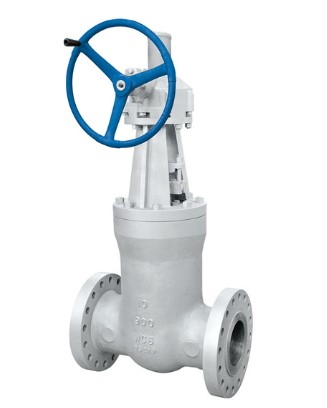
The pressure seal bonnet gate valve, also known as a self-tightening or self-sealing gate valve, is a specialized valve designed for extreme high-pressure and high-temperature environments. It plays a critical role in industries such as petrochemicals, power generation, and energy production, where reliable flow control and leak-free operation are essential. Unlike conventional gate valves that rely on bolted bonnets, the pressure seal bonnet gate valve employs a unique self-tightening sealing mechanism. Its defining feature is that the sealing performance improves as internal pressure increases, a phenomenon often described as the higher the pressure, the tighter the seal. This characteristic makes it the valve of choice for demanding service conditions where conventional valves would be inadequate.
The fundamental concept behind self-tightening sealing is the use of the medium’s own pressure to enhance sealing performance. In essence, as the internal pressure in the pipeline rises, it pushes the bonnet against the sealing gasket, increasing contact between the sealing surfaces. This pressure-activated behavior contrasts sharply with ordinary bolted-bonnet valves, which may leak more as pressure rises.
Before the system is pressurized, operators apply an initial preload on the bonnet via pre-tensioned bolts. This creates a preliminary sealing interface between the wedge-shaped gasket and the bonnet, as well as between the gasket and the valve body. The purpose of this initial stage is to establish a base seal, ensuring that low-pressure conditions do not result in leakage. The sealing pressure generated during this stage is often referred to as the preload sealing stress, and it forms the foundation for subsequent pressure-assisted sealing.
Once the medium enters the pipeline and pressure begins to rise, the bonnet is subjected to an upward force from the internal pressure. Consequently, the contact stress on the sealing surfaces between the bonnet and the wedge gasket, as well as between the gasket and valve body, increases in proportion to the internal pressure. The total operational sealing stress comprises two components:
Preload sealing stress from the initial bolt tension.
Pressure-induced sealing stress resulting from the internal medium pressure.
The defining characteristic of a self-tightening valve is that the pressure-induced component always augments the preloaded stress, thereby enhancing the seal. Simply put, the higher the internal pressure, the greater the working sealing stress, and the better the seal becomes. However, it is critical to ensure that the internal pressure does not exceed the maximum tolerable range of the gasket material, as excessive pressure can damage the sealing structure.
The ability of pressure seal bonnet gate valves to achieve increasingly tight seals under high-pressure conditions stems from their distinctive structural design. Unlike traditional bolted-bonnet valves that rely solely on mechanical preload, pressure seal valves convert internal pressure into a sealing force through the coordinated function of several key components. The primary structural elements and their roles are detailed below.
The pressure seal bonnet is the hallmark feature that differentiates these valves from conventional bolted-bonnet gate valves. While standard bolted bonnets seal via flange connections and gaskets, the risk of leakage increases as system pressure rises. In contrast, the pressure seal bonnet utilizes the internal pressure to form a tighter seal: as pressure increases, the bonnet gasket is compressed further, enhancing sealing performance.
Pressure seal bonnets typically include bonnet tightening bolts, which pull the bonnet upward to establish initial contact with the gasket. Additionally, thrust segments or retaining rings maintain the load distribution, ensuring that the seal remains reliable even as system pressure rises.
The gate is the core component controlling fluid flow, typically moving vertically relative to the flow direction. The design of the gate can vary based on operational requirements:
Wedge Gate: The most common design, suitable for most conventional applications, providing excellent self-tightening performance.
Flat Gate: Used where low flow resistance is critical, minimizing pressure drop across the valve.
Knife Gate: Designed for slurry or solid-laden media, providing shearing and cleaning action.
To improve durability, the sealing surfaces of the gate are often overlaid with wear-resistant materials such as iron-based alloys, cobalt-based alloys, or cemented carbides. CoCr-A alloys (e.g., Stellite) are commonly applied via arc or plasma welding.
The valve stem connects to the gate to control its motion, with two primary configurations:
Rising Stem: The stem moves axially with the gate, providing a clear visual indication of valve position, which aids operators in monitoring the valve’s open/closed status.
Non-Rising Stem: The stem rotates without axial movement, suitable for installations with limited vertical space and reducing the overall height of the valve.
The valve body is manufactured from high-strength materials such as carbon steel or stainless steel to withstand severe pressure and temperature conditions. End connections are usually flanged or butt-welded, depending on system pressure requirements and installation conditions.
For extreme high-temperature applications (above 500°C), materials such as F316H forged steel or compatible austenitic casting grades may be used to ensure sufficient strength and corrosion resistance under elevated temperatures.
High-temperature and high-pressure environments impose strict performance requirements on sealing surfaces. To improve hardness, corrosion resistance, and wear resistance, special overlay materials are typically deposited on contact areas between the valve body, bonnet, and wedge gasket.
Austenitic Stainless Steel: Suitable for general corrosive media, offering good corrosion resistance and moderate hardness.
Cemented Carbide/Hard Alloys: Ideal for media containing solids or under high-erosion conditions, providing extremely high hardness and excellent wear resistance.
Overlay thickness is generally controlled at approximately 2 mm, balancing performance enhancement with the preservation of base material strength. The main purposes of the overlay include:
Increasing the hardness of the sealing surfaces to resist erosion.
Enhancing corrosion resistance to extend service life.
Providing optimal contact geometry with the wedge gasket to improve sealing effectiveness.
The wedge gasket is a critical wear component in the self-tightening sealing system. Its material selection must satisfy two key requirements:
Surface hardness lower than the valve body and bonnet overlay: This ensures that the gasket can deform plastically under pressure, filling micro-irregularities and forming an effective seal.
Sufficient strength to withstand high pressures: The gasket must resist crushing or excessive deformation.
To meet these requirements, high-strength base materials are often coated with a soft layer or special surface treatment, creating an "outer soft, inner hard" structure.
Thanks to their unique working principle and structural design, pressure seal bonnet gate valves exhibit performance characteristics distinct from conventional gate valves. Understanding these features is crucial for proper selection and operation.
Pressure-Adaptive Sealing: Sealing improves as internal pressure rises, contrasting with conventional valves where higher pressure can increase leakage risk.
Compact Structure: Compared to bolted-bonnet valves of the same pressure rating, pressure seal valves are more compact, facilitating easier installation.
Lower Maintenance Costs: Despite higher initial investment, long-term maintenance requirements are reduced, resulting in lower total ownership costs.
Minor Flexibility: The sealing structure allows slight deformation to compensate for small machining deviations, enhancing process adaptability.
Low Flow Resistance: The full-open flow path is streamlined, minimizing pressure loss and improving energy efficiency.
Bidirectional Sealing: Many designs provide bidirectional sealing regardless of medium flow direction.
Increased Wear: Relative sliding of sealing surfaces during operation results in faster wear compared to some other valve types.
Larger Installation Dimensions: Compared to rotary valves like ball valves, gate valves have greater size and weight, requiring adequate space for installation.
Preload Requirement: Post-installation or maintenance requires proper bolt preloading, necessitating skilled maintenance personnel.
The advantages of pressure seal bonnet gate valves are particularly evident under high-pressure, high-temperature, or hazardous media conditions. These valves are commonly used in critical energy and chemical installations, including:
In refining units such as hydrocracking, hydrotreating, and residuum hydrodesulfurization, high-pressure valves often adopt self-tightening designs. These processes operate under high-temperature, high-pressure hydrogen environments, demanding uncompromising sealing integrity to prevent leaks that could have severe consequences.
Pressure seal bonnet gate valves are key components in fossil fuel power plants and combined-cycle power stations, applied in:
Main Steam Systems: Delivering high-temperature, high-pressure steam to turbines.
Feedwater Systems: Feeding high-pressure boiler water into the boiler.
Turbine Bypass Systems: Regulating turbine inlet parameters.
Boiler Circulation Systems: Controlling internal circulation of boiler media.
Heat Recovery Steam Generators (HRSG): Recovering waste heat from gas turbines to produce steam.
Steam Distribution Networks: Industrial steam pipelines.
Condensate Recovery Systems: Recovering high-temperature condensate.
Boiler Feedwater Control: Ensuring safe and reliable boiler operation.
Oil and Gas Extraction and Transport: Wellhead equipment and gathering pipelines.
The pressure seal bonnet gate valve cleverly converts internal pressure, traditionally a factor increasing leak risk, into a mechanism that enhances sealing performance, solving one of the most challenging problems in high-temperature, high-pressure valve technology. From early wedge-gasket designs to modern constant-force bolt systems with graphite gaskets, ongoing technological advancements have steadily improved reliability and ease of use.
In the context of global energy transition and increasingly large industrial installations, pressure seal bonnet gate valves are gaining prominence in supercritical power plants and large-scale petrochemical facilities. A thorough understanding of their working principles, structural features, and selection criteria is essential for engineers to ensure operational safety and system reliability. As materials science and manufacturing technologies continue to advance, pressure seal technology is poised to deliver unmatched performance under increasingly demanding conditions.

Copyright © 2026 China Topper Valve Packing Seal Kits Co., Ltd. All Rights Reserved.