
In industrial piping systems, globe valves are commonly used fluid control devices primarily designed to stop or regulate the flow of media through pipelines. Depending on the valve body structure, globe valves can be categorized into various types, with the most common being the standard globe valve (straight-through globe valve) and the angle globe valve. While both types share basic functionality, they differ significantly in terms of structural design, fluid characteristics, and applicable scenarios.
Understanding the distinctions between these two types of globe valves is essential for engineers and technical personnel to make correct decisions when designing piping systems and selecting valves. This article provides a detailed comparative analysis of standard and angle globe valves, examining their structural design, fluid performance, application scenarios, and operation and maintenance considerations.
The structural design of a valve not only determines its external appearance but also fundamentally affects the internal fluid path and force distribution. The following sections explore the engineering principles behind straight-through and angle globe valve layouts.
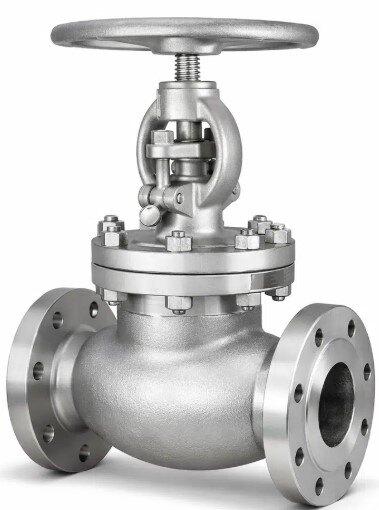
The body of a standard globe valve typically adopts a "spherical" or "casing" design, with internal flow paths forming a Z-shape or S-shape. As fluid enters the valve from the inlet, it must first turn upward, pass over the valve seat area, and then turn downward to exit through the outlet. This design causes the fluid to change direction twice, creating a characteristic Z-shaped flow path.
The valve seat is usually flat, while the plug (or disc) moves linearly along the valve stem to control flow. The valve stem is perpendicular to the pipeline axis, and the handwheel or actuator is installed on top of the valve body. This configuration is relatively easy to manufacture and maintain, with high component interchangeability.
Because the straight-through design requires sufficient space to accommodate the Z-shaped flow path, standard globe valves often have larger body dimensions. Materials commonly used for valve bodies include stainless steel, cast steel, and cast iron, selected according to the properties of the medium and operating conditions.
Angle globe valves feature an inlet and outlet arranged at a 90-degree angle, so fluid only needs to change direction once inside the valve body before exiting. This L-shaped flow path creates a more compact valve structure, often eliminating the need for an additional elbow in the pipeline.
The valve stem is usually aligned with one of the ports, and the bonnet is oriented outward. This structural feature gives angle globe valves a significant advantage in installations with limited space. Because the flow path is more direct, the internal volume of the valve can be smaller than that of a straight-through valve.
The valve seat and plug are similar to those of a standard globe valve, with linear motion along the valve stem controlling opening and closing. However, the angular flow path introduces a specific geometric relationship between plug movement and fluid direction, which can slightly influence the valve’s throttling characteristics.
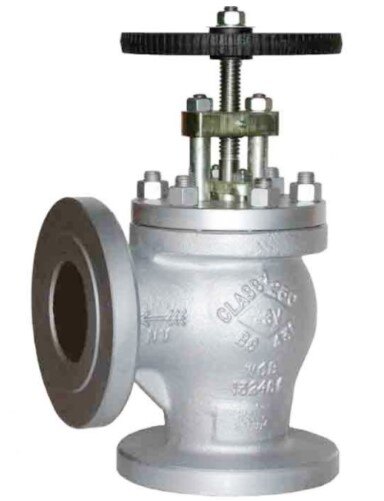
From a spatial perspective, angle globe valves are more compact. In pipeline systems that require a 90-degree directional change, angle globe valves can directly alter the flow path without the need for an additional elbow. This integrated design saves installation space and reduces the number of connection points in the pipeline.
In contrast, standard globe valves are better suited for straight pipeline segments. If a directional change is required, additional elbows must be installed before and after the valve, increasing the overall system size and complexity.
Differences in structural design directly impact the fluid path and the number of directional changes within the valve, which in turn affect fluid resistance, pressure loss, and flow control characteristics.
The Z-shaped flow path of a standard globe valve forces fluid to change direction twice. This complex path generates higher turbulence, resulting in significant pressure loss. When throttling, fluid must "climb over" the valve seat area, creating noticeable resistance.
Engineering data show that standard globe valves often exhibit higher pressure loss, meaning system pumps must work harder to maintain the same flow. Under high-pressure differential conditions, this pressure loss can directly impact operational energy consumption.
Moreover, the complex internal flow can accelerate erosion and wear, especially when handling high-velocity media or fluids containing solid particles. Valve plug and seat surfaces are prone to corrosion, which can compromise sealing performance and reduce service life.
The L-shaped flow path of an angle globe valve requires only a single direction change, resulting in a more direct and smoother fluid path. This design significantly reduces flow resistance and pressure loss. Technical references indicate that angle globe valves generally have much lower flow resistance than standard globe valves, resulting in higher flow efficiency.
In high-pressure steam systems or high-flow applications, the low resistance characteristic of angle globe valves is particularly advantageous. Lower pressure loss reduces pump energy consumption, lowering operating costs. Additionally, decreased turbulence reduces internal wear, prolonging valve service life.
It is important to note that while angle globe valves have lower resistance, the change in fluid direction still produces some pressure loss. This loss is predictable and manageable and is generally acceptable in engineering design.
Both types of globe valves can regulate flow, but their throttling characteristics differ. Standard globe valves, with their complex flow path, may experience significant pressure loss and flow instability at low openings. Angle globe valves, with a smoother flow path, maintain more stable flow during throttling.
In practical applications, both valve types can adjust flow gradually by small movements of the plug. The flow coefficient (Cv) is a key parameter for evaluating valve flow capacity and should be carefully considered during selection.
Differences in fluid behavior and pressure loss determine each valve type’s optimal application. Based on the analysis above, the following comparisons highlight typical usage scenarios.
Standard globe valves are versatile, suitable for general fluid control scenarios such as conventional pipelines and industrial facilities requiring on-off or throttling control. They are ideal for horizontal pipelines with ample operation space and offer an economical choice in such conditions.
Specific scenarios where standard globe valves excel include:
In steam systems, chemical plants, and water treatment facilities, standard globe valves are widely used due to their precise regulation and reliable sealing. Their robust construction allows them to withstand high pressures and complex operating conditions.
Angle globe valves are better suited for applications requiring high flow efficiency or limited space. Typical applications include:
Pipeline Direction Integration: In systems requiring a 90-degree turn, angle globe valves can replace an elbow, reducing one elbow and two welds. This integrated design is critical in high-pressure systems, where each additional connection is a potential leak risk.
Space-Constrained Installations: In compact layouts, such as modular units, offshore platforms, and ship engine rooms, angle globe valves maximize corner space and reduce overall system footprint.
High-Vibration or Pulsating Flow: Angle globe valves can better manage the impact of pulsating flow. Fewer pipe components reduce cumulative stress on the support system, improving operational stability.
Chemical Production Processes: In chemical systems requiring frequent flow adjustments with high flow efficiency, angle globe valves’ low resistance improves system energy efficiency.
Both valve types are widely applied across industries, including:
The choice of valve type depends on pipeline layout, space constraints, pressure rating, and maintenance requirements.
Valve selection must consider installation feasibility and operational convenience. The differing structures of standard and angle globe valves influence operation, required space, and maintenance.
Both types support manual, pneumatic, electric, and hydraulic actuation. Manual operation involves rotating the handwheel to raise or lower the valve stem, controlling valve opening. Automated operation uses electric, pneumatic, or hydraulic actuators for remote control.
The angled layout of angle globe valves may require different operation space and angles compared to straight-through valves, which must be considered during installation design.
Standard Globe Valve Installation:
Angle Globe Valve Installation:
From a maintenance perspective, each design has advantages. Standard globe valves are convenient in horizontal pipelines, allowing access from multiple directions. However, in constrained or vertical spaces, removal and servicing may be limited.
Angle globe valves excel in compact installations. With the bonnet facing outward, technicians can more easily access the valve stem and internals, minimizing interference with surrounding piping. This is especially valuable in offshore platforms and ship engine rooms.
Based on comparisons across structure, fluid characteristics, application scenarios, and installation/maintenance, the core differences between the two valve types can be summarized to guide selection.
When selecting valves, consider:
Comparison | Standard Globe Valve (Straight-Through) | Angle Globe Valve |
Structure | Inlet and outlet aligned 180° | Inlet and outlet at 90° angle |
Flow Path | Z-shaped or S-shaped, two turns | L-shaped, one turn |
Pressure Loss | Higher | Lower |
Size | Relatively large | More compact |
Installation Space | Requires straight segment | Suitable for corners/restricted space |
Pipeline Connections | Additional elbows required | Can replace elbow, fewer connections |
Applicability | Broad, general-purpose | Specific conditions, space-optimized |
Maintenance Convenience | Better in horizontal pipelines | Better in compact areas |
Both angle and standard globe valves are essential in industrial fluid control. Standard globe valves are versatile and widely applicable, making them the default choice for conventional pipelines. Angle globe valves optimize the flow path with angular design, offering unique advantages in space utilization, pressure loss reduction, and system integration.
There is no absolute "better" option. Proper selection depends on process conditions, system layout, and fluid control requirements. Understanding the structural characteristics and performance differences of these valves enables engineers to make informed decisions, enhancing pipeline system efficiency and reliability.

Copyright © 2026 China Topper Valve Packing Seal Kits Co., Ltd. All Rights Reserved.