
In modern industrial piping systems, valves play a critical role in ensuring the safe and efficient control of fluid flow. Among various types, concentric butterfly valves stand out for their simple structure, flexible operation, and cost-effectiveness. These valves have become essential in industries such as water treatment, HVAC, chemical processing, food and beverage production, and power generation. By rotating the valve disc within the valve body by 90 degrees, concentric butterfly valves can quickly start or stop the flow of fluids while also providing adjustable flow control for precise regulation. This article provides a comprehensive analysis of concentric butterfly valves, covering their working principles, structural components, application scenarios, selection criteria, and maintenance practices, offering engineers a practical reference for system optimization and component selection.
A concentric butterfly valve is a device designed to control the flow of fluid through a pipeline. Its primary function is to allow or prevent the passage of liquids, gases, or other media, while also enabling modulation of flow rates. The design of this valve is straightforward, without complex mechanical structures.
The working principle is simple. A circular flat component, known as the valve disc, is installed at the center of the valve. When fluid flow is required, the disc rotates to align parallel with the direction of flow, allowing the medium to pass through with minimal resistance. To stop the flow, the disc rotates 90 degrees to a position perpendicular to the flow, completely blocking the passage and achieving a sealed closure.
This quarter-turn rotation offers several advantages:
These features make concentric butterfly valves suitable for a wide range of industrial applications, including water treatment, HVAC, and chemical processing systems.
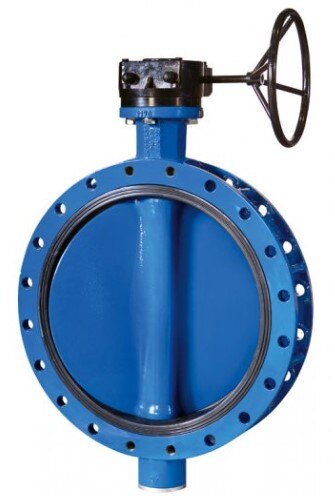
Concentric butterfly valves are composed of several key components, each with a specific function. Understanding these parts is essential for proper selection and maintenance.
The valve body serves as the outer shell, supporting and housing all internal components. Typically installed between two pipeline flanges, it connects the pipeline while accommodating the valve’s internal elements. Common materials include aluminum, ductile iron, cast iron, stainless steel, carbon steel, and aluminum bronze. Material selection depends on operating conditions—for example, ductile iron offers high strength and bending resistance, stainless steel provides excellent corrosion resistance for chemical environments, and aluminum bronze is suitable for seawater applications.
The disc is the core component, directly controlling fluid passage. It is connected to the valve stem and rotates along with it. When the disc aligns with the flow, the valve opens; when perpendicular, the valve closes. Discs are commonly made from stainless steel or lined with PTFE. The choice depends on the medium—for corrosive chemicals, corrosion-resistant materials are essential.
The stem connects the actuator to the valve disc, transmitting torque to rotate the disc. Passing through the center of both the valve body and disc, this concentric design ensures even force distribution on both sides, maintaining a reliable seal even at low pressures. Stainless steel is typically used for the stem to provide strength and corrosion resistance.
The seat is a sealing component installed within the inner circumference of the valve body, contacting the disc when the valve closes. Made from soft, elastic materials such as EPDM (ethylene propylene diene monomer rubber), NBR (nitrile rubber), or PTFE (polytetrafluoroethylene), the valve seat provides a nearly leak-proof seal. Material selection depends on the medium: EPDM suits water and steam, NBR suits oils, and PTFE is compatible with various chemicals.
The actuator provides the power to rotate the stem and disc. Depending on the application, actuators can be:
Due to their efficiency and versatility, concentric butterfly valves are widely used across multiple industries.
In water treatment, these valves regulate water and chemical flows. For example, during coagulation and sedimentation processes, they ensure precise dosing of flocculants and chemicals, maintaining proper mixing ratios. Since water treatment systems usually operate under low pressure with relatively clean media, concentric butterfly valves are ideal. Their low-maintenance design reduces downtime and operational costs.
In HVAC, butterfly valves control the flow of chilled and hot water or adjust airflow in duct systems. By varying the valve opening, optimal indoor temperatures are maintained. Their lightweight and compact design suits low-pressure systems where installation space is limited.
Chemical plants often handle corrosive media such as acids, alkalis, and solvents. When equipped with suitable lining materials like PTFE and stainless steel discs, concentric butterfly valves resist chemical corrosion effectively. Their quick operation makes them suitable for processes that require frequent flow adjustments. However, they are best suited for low- to medium-pressure chemical systems, with high-pressure applications requiring alternative valve types.
The food industry requires sanitary valve designs. The simple structure of concentric butterfly valves minimizes dead zones where residue can accumulate, facilitating cleaning. Food-grade EPDM or other certified sealing materials ensure compliance with hygiene standards. They are commonly used in beverage filling lines, dairy processing, and other liquid handling systems.
In power plants, these valves are used in low-pressure steam and cooling water systems. While high-pressure main steam lines are unsuitable, auxiliary systems such as cooling water loops and fire protection networks widely employ butterfly valves.
In municipal water treatment plants, concentric butterfly valves play a vital role. For a plant with a 100,000 m³/day capacity, they are employed across coagulation, sedimentation, filtration, and disinfection stages.
Continuous operation makes valve reliability critical. Butterfly valves require less maintenance than gate valves and are easier to repair due to their simple structure. Large-diameter pipelines (e.g., DN800 intake mains) are much easier to manage with butterfly valves, which weigh roughly one-third of equivalent gate valves. Choosing butterfly valves can reduce installation space by around 20% and lower equipment investment significantly.
When selecting a concentric butterfly valve, consider:
Concentric butterfly valves are simple, cost-effective, and easy-to-operate fluid control devices. Their operation relies on a 90-degree rotation of the valve disc inside the valve body, enabling rapid opening and closing. The primary components, including the valve body, disc, stem, seat, and actuator, each perform specific functions essential for reliable operation.
These valves are ideally suited for low-pressure, clean media systems in water treatment, HVAC, chemical processing, food and beverage, and power plant applications. Key advantages include low pressure drop, compact and lightweight design, fast operation, low cost, and minimal maintenance requirements. However, their limitations must be acknowledged: they are unsuitable for high-pressure, high-temperature, or particle-laden media, and they are not ideal where precise flow modulation or laminar flow is required.
Proper selection and maintenance maximize the benefits of concentric butterfly valves while avoiding failures in inappropriate conditions. For municipal water treatment plants and other large-scale, low-pressure, clean-medium systems, these valves represent a reliable and economical solution, balancing performance, cost, and ease of use.

Copyright © 2026 China Topper Valve Packing Seal Kits Co., Ltd. All Rights Reserved.