
In modern industrial piping and pressure vessel systems, sealing performance is directly related to the safety, stability, and operational efficiency of equipment. Metal jacketed gaskets and spiral wound gaskets, as the two most widely used semi-metallic sealing elements, have long played a critical role in high-temperature, high-pressure, and complex media applications. Although these two types of gaskets differ in material composition and structural form, both are designed to solve microscopic leakage problems in flange connections. However, in practical engineering applications, due to differences in sealing mechanisms, elastic characteristics, and adaptability to operating conditions, precise selection based on specific conditions is often required. This guide provides a systematic comparative analysis of the two types of gaskets from structural principles, performance characteristics, and engineering selection logic, helping achieve more reliable and economical sealing decisions.
A metal jacketed gasket (MJG) is a semi-metallic sealing gasket composed of a metal shell that encloses a flexible filler. Its core design concept is to use the metal outer shell to provide structural strength and stress distribution capability, while the internal flexible filler fills microscopic irregularities on the flange surface, thereby achieving reliable sealing performance.
This type of gasket belongs to the semi-metallic gasket category, the same classification as spiral wound gaskets (SWG). However, there are significant differences in structure, performance, and application scenarios. Metal jacketed gaskets were once a standard choice in industrial sealing. Even today, despite the widespread application of spiral wound gaskets, they still maintain an irreplaceable position in specific operating conditions.
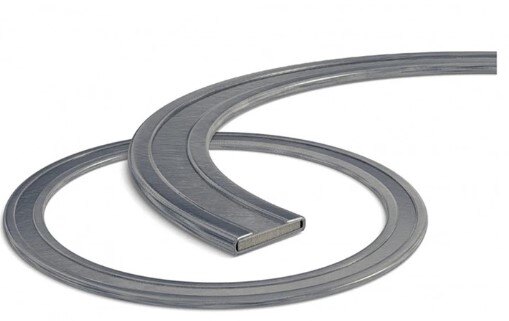
The structure of metal jacketed gaskets is relatively simple but ingeniously designed. The outer shell is typically made of stainless steel, carbon steel, brass, aluminum, soft iron, Monel alloy, or titanium, with a thickness generally ranging from 0.2 mm to 0.5 mm. It is manufactured using cold forming processes. The shell can be designed as flat-jacketed or corrugated, and may also be single-jacketed or double-jacketed.
The internal filler materials have a wide range of options, commonly including flexible graphite, polytetrafluoroethylene (PTFE), ceramic fiber, and mica. Each filler has its own characteristics: graphite performs well at high temperatures, PTFE offers strong chemical resistance, and ceramic fiber is suitable for extremely high-temperature environments. The filler is completely enclosed by the metal shell, which brings several important advantages: the filler does not directly contact the media or contaminate the flange surface, and it also provides excellent anti-adhesion and corrosion resistance properties.
The sealing principle of metal jacketed gaskets can be understood as “division of labor.” When bolt load is applied, the metal shell bears the main mechanical stress, preventing excessive compression of the gasket. At the same time, the flexible filler is compressed into microscopic cavities and surface irregularities on the flange, filling gaps that are not visible to the naked eye and forming a continuous sealing interface.
Due to the relatively rigid nature of the metal shell, the gasket has limited rebound capability after compression. This means that if bolt load changes significantly, sealing performance may be affected. Therefore, metal jacketed gaskets are more suitable for stable operating conditions with minimal temperature and pressure fluctuations.
Metal jacketed gaskets have maintained an important position in industrial sealing due to several unique technical characteristics. These characteristics define both their advantages and their application limitations.
A major advantage of metal jacketed gaskets is the high flexibility in material selection. Both shell and filler materials can be customized according to specific operating conditions.
Common shell materials include 304, 316L, and 321 stainless steels, carbon steel, copper, aluminum, soft iron, Monel alloy, and titanium. Among them, 316L stainless steel, due to its molybdenum content, offers better resistance to pitting and crevice corrosion than 304, making it suitable for chloride-containing environments. Monel alloy performs excellently in highly corrosive media such as hydrofluoric acid, while titanium is suitable for strong oxidizing acid environments.
For filler materials, graphite is suitable for high-temperature hydrocarbon media and can withstand temperatures above 500°C. PTFE is resistant to almost all chemical media but has a lower temperature limit, generally below 260°C. Ceramic fiber can withstand temperatures above 1000°C and is suitable for extreme high-temperature applications such as furnaces.
Compared to spiral wound gaskets, metal jacketed gaskets have a clear advantage in manufacturing non-standard shapes. Thanks to stamping or rolling forming processes, they can be produced in oval, rectangular, ribbed, and complex heat exchanger compartment shapes. This makes them widely used in heat exchanger channel covers, reactor manholes, and large vessel end covers.
For large-diameter flange connections, they can be manufactured in segments and assembled on-site, solving transportation and size limitations.
Under stable temperature and pressure conditions, metal jacketed gaskets offer long service life. The filler is fully protected by the metal shell and is not easily degraded or lost. The metal shell also provides excellent mechanical stability. For equipment that does not require frequent maintenance, such as fixed tube-sheet heat exchangers and large reactors, these gaskets can maintain reliable sealing throughout the maintenance cycle, reducing maintenance costs.
The limitations of metal jacketed gaskets are also evident. First, their rebound capability is limited. When temperature or pressure fluctuations cause changes in bolt load, the gasket cannot compensate through elastic deformation, potentially reducing sealing performance. Second, they require high flange surface quality; otherwise, effective sealing cannot be achieved. In addition, they may become brittle at extremely low temperatures, and in strongly corrosive media, improper material selection can lead to corrosion issues.
Metal jacketed gaskets and spiral wound gaskets both belong to semi-metallic gasket types. While both can provide effective sealing under high temperature, high pressure, and chemical media conditions, their sealing mechanisms and structural characteristics are fundamentally different.
If metal jacketed gaskets excel in static stability and shape customization, spiral wound gaskets are primarily valued for dynamic adaptability.
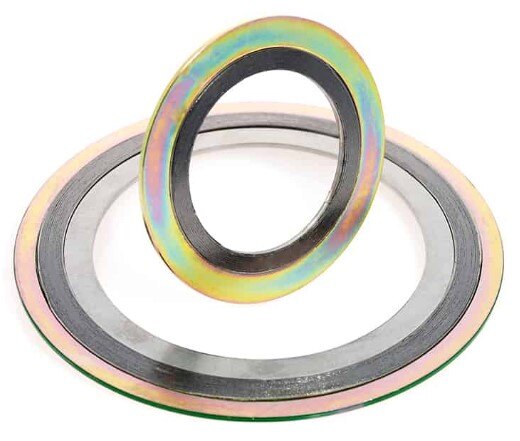
Spiral wound gaskets are made by alternately winding V-shaped or W-shaped metal strips with flexible filler. The metal strip provides structural support and elastic recovery, while the filler fills sealing gaps. This alternating structure gives the gasket excellent elasticity: under compression, the metal strip deforms elastically and recovers after unloading.
Spiral wound gaskets are usually equipped with inner rings, outer rings, or both. The outer ring is used for centering and installation alignment, while the inner ring prevents inward collapse under high pressure and protects the filler from direct media erosion. Gaskets with both inner and outer rings (CGI type) offer the best performance.
The most prominent advantage of spiral wound gaskets is their excellent elasticity and recovery capability. Under thermal cycling, pressure fluctuations, and bolt stress relaxation, they can maintain sealing performance through elastic rebound.
They also have good tolerance for flange surface quality. Their compressible structure allows adaptation to certain surface irregularities, making installation easier and less demanding in terms of precision.
If excessive compression occurs during installation, spiral wound gaskets may suffer plastic deformation of the metal strip and extrusion of filler, leading to loss of elasticity and reduced sealing performance. Therefore, installation must strictly follow torque or compression guidelines.
In terms of shape, they are mainly circular. Custom shapes are possible but costly and difficult. Their unit cost is generally higher due to complex manufacturing.
Metal jacketed gaskets and spiral wound gaskets are two important semi-metallic sealing solutions, each with distinct structural features and application ranges. Metal jacketed gaskets rely on a metal shell enclosing flexible filler, offering advantages in shape customization, long stable service life, and lower cost, making them suitable for heat exchangers, reactors, and complex sealing structures. Spiral wound gaskets use alternating metal strip and filler structures, providing excellent resilience and dynamic adaptability, making them suitable for cyclic and fluctuating conditions.
In engineering practice, there is no absolute superiority between the two. The key is to evaluate process conditions, flange parameters, structural requirements, and economic factors comprehensively. Understanding their principles and selecting appropriately ensures optimal sealing performance and cost balance. As a general guideline, metal jacketed gaskets are preferred for complex shapes and stable conditions, while spiral wound gaskets are preferred for standard flanges and dynamic environments.

Copyright © 2026 China Topper Valve Packing Seal Kits Co., Ltd. All Rights Reserved.