
Comprehensive Guide to Electric Control Valves
Electric control valves are essential devices used in automated industrial systems for regulating fluid flow. They are capable of precisely adjusting the flow and pressure of water, steam, or gas, ensuring efficient system operation while maintaining stable and reliable process control. This article provides a detailed overview of electric control valves from multiple perspectives, including their basic concept, working principle, main types, core components, control methods, selection criteria, and practical applications, helping readers gain a comprehensive understanding of this critical industrial equipment.
An electric control valve is a device that integrates valve technology with an electric actuator. It mainly consists of two parts: the valve body and the electric actuator.
The valve body forms the fluid passage and is typically made of stainless steel, cast iron, or similar materials. Inside the valve body, there is a valve core or ball structure responsible for opening, closing, and regulating fluid flow. The electric actuator receives electrical signals and converts electrical energy into mechanical motion, which drives the valve core or ball to move to a specified position, enabling precise control of fluid flow.
Compared with manual flow regulation methods, electric control valves provide high-precision automated control. They effectively eliminate human errors, reduce process fluctuations, and significantly improve system stability and operational efficiency.
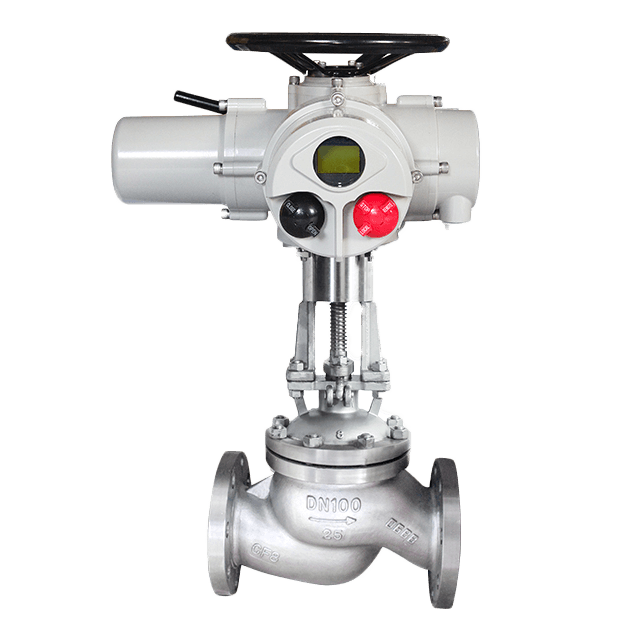
In industrial applications, electric control valves are fundamentally different from ordinary electric on-off valves.
Ordinary electric valves are mainly used for fully open or fully closed operations and belong to switching-type devices. In contrast, electric control valves are regulating devices that can operate at any opening position, such as 10%, 50%, or 80%, enabling continuous adjustment of flow to maintain system stability.
Therefore, in processes requiring precise flow control, regulating-type electric control valves must be used instead of simple on-off valves.
The working principle of electric control valves is based on the conversion of electrical energy into mechanical motion. The process includes several key steps:
First, the control system sends an electrical signal to the electric control valve, representing the desired flow setpoint or process parameter. Next, the electric actuator receives the signal and begins operation. The actuator, typically driven by an electric motor or electromagnetic component, converts electrical energy into mechanical motion.
This mechanical motion is then transmitted to the valve stem or internal mechanism, causing the valve to open, close, or adjust to a specific position. Finally, by changing the valve opening, the flow rate of the medium is controlled, achieving precise regulation of process variables.
Electric control valves come in various types, each suited to different working conditions and fluid characteristics.
Electric globe valves are particularly suitable for high-precision flow regulation due to their unique flow path structure. They offer excellent throttling performance and are widely used in HVAC systems and industrial processes requiring strict flow control accuracy. They provide stable and reliable flow regulation under continuous operation.
Electric ball valves use a spherical closure element and are mainly designed for fast opening and closing operations. They are suitable for both high-pressure and low-pressure on-off conditions and feature rapid response.
They also offer excellent sealing performance and are widely used in water treatment, chemical industries, and industrial automation systems.
Electric butterfly valves regulate flow through a rotating disc. They have a compact structure and low flow resistance, making them suitable for large-diameter pipeline systems and applications requiring rapid flow adjustment.
They are widely used in HVAC systems and municipal water supply systems due to their small installation space and easy operation.
Electric plug valves control fluid flow through the rotation of a conical or cylindrical plug inside the valve body. They can be used for both on-off control and multi-port flow switching.
These valves offer excellent sealing performance and are commonly used in petroleum, chemical, and refining industries where sealing requirements are strict.
A solenoid valve is a special type of electric control valve. Its core component is an electromagnetic coil. When energized, the coil generates a magnetic field that drives the valve core to move, enabling opening or closing of the valve.
Inside the valve, a movable plunger or piston is driven by electromagnetic force to control the flow passage. Seals and gaskets ensure tight sealing, prevent leakage, and maintain system stability.
The main components of electric control valves include the valve body, internal trim, actuator, and positioner.
The valve body carries the fluid passage and provides structural support. It is directly connected to the pipeline and comes into contact with the medium.
The internal components include the valve core and valve seat, which directly affect regulating and sealing performance. The shape and material of the valve core determine flow characteristics, while the valve seat ensures tight sealing with the core.
The actuator is an electrically driven unit mounted on the valve body. It receives commands from the control system and drives the valve core or ball to achieve precise positioning.
It typically includes an electric motor, such as a servo motor or stepper motor, and a gear reduction system. For rotary valves, the gear system converts motor output into a 90-degree rotation. For linear motion valves, rotational motion is converted into axial thrust to move the valve stem up and down.
This mechanical design allows compact actuators to reliably drive valves even under high-pressure conditions.
The positioner enables feedback control by comparing actual valve position with the setpoint. It automatically adjusts actuator behavior to ensure accurate positioning and stable operation.
It is a key component for achieving high-precision control and compensates for deviations caused by load changes or friction.
After understanding the hardware structure, another important question arises: how does the control system command valve operation? This involves signal transmission, system integration, and power conversion mechanisms.
Electric control valves are commonly controlled using the 4–20mA current signal, a widely used industrial communication method.
When the signal is 4mA, the valve is fully closed (0% opening). At 20mA, the valve is fully open (100%). At 12mA, the valve is approximately 50% open.
The actuator continuously receives and interprets the current signal, enabling smooth and continuous flow regulation to maintain stable process operation.
Electric control valves typically operate within a closed-loop control system consisting of sensors, controllers, and actuators.
Sensors measure process variables such as flow, pressure, or temperature and send feedback to the controller. The controller compares actual values with setpoints and generates correction signals. The actuator then adjusts the valve position accordingly.
This closed-loop system automatically corrects deviations and maintains process variables within the desired range.
Inside the actuator, the motor converts electrical energy into mechanical motion. A gear system provides speed reduction and torque amplification.
Depending on the valve type, this system converts motor output into rotary or linear motion, ensuring sufficient driving force for reliable valve operation under various conditions.
Selection is one of the most critical steps in engineering applications. Incorrect material or parameter selection can lead to premature failure or poor control performance.
Valve body materials are selected based on medium characteristics, corrosion resistance, mechanical strength, and operating conditions.
Common materials include stainless steel, carbon steel, cast iron, and alloy steels. Internal components such as valve cores, seats, and seals are made from stainless steel, brass, bronze, or engineering plastics to ensure wear resistance, corrosion resistance, and sealing performance.
Actuator housings are typically made of aluminum alloy, stainless steel, or thermoplastic materials. They protect internal electrical and mechanical components and ensure stable operation in harsh industrial environments.
Material selection depends on protection level, corrosion resistance, and heat dissipation requirements.
Several important factors must be considered during selection:
First, the type of medium, such as water, air, chemicals, or food-grade fluids, determines material compatibility.
Second, the flow coefficient (Cv value) must be calculated accurately. Valve selection should not be based only on pipeline diameter, as this may lead to unstable control or insufficient flow.
Third, pressure differential must be considered to determine actuator torque requirements.
Fourth, power supply compatibility (such as 24V DC or 220V AC) must match site conditions.
Finally, fail-safe modes (fail-open, fail-closed, or fail-in-place) must be defined to ensure system safety.
Based on their principles, structure, and selection methods, electric control valves offer several distinct advantages over other types such as pneumatic valves.
Electric control valves offer high control precision, typically up to around 1% positioning accuracy. They maintain stable positioning even under pressure fluctuations.
They are easy to install, requiring only electrical power without compressed air systems, reducing infrastructure costs.
They also avoid air leakage issues and are therefore well suited for clean environments such as food and pharmaceutical industries.
Electric control valves are widely used in HVAC systems, water treatment systems, chemical process control, and food and beverage industries.
In HVAC systems, they regulate chilled and hot water flow to maintain stable indoor temperatures. In water treatment, they precisely control chemical dosing to ensure water quality. In chemical industries, they regulate raw material ratios for stable reactions. In food processing, they control liquid media while ensuring hygienic and safe production processes.
Although electric control valves have significant advantages, they are not suitable for all applications.
One limitation is relatively slower response compared to pneumatic valves, due to motor drive and gear transmission.
In frequent operation conditions, motors may generate heat, affecting service life and stability. Therefore, high-frequency applications require actuators with sufficient cooling capacity or specialized designs.
For high-frequency applications, actuator thermal capacity and heat dissipation design should be prioritized.
For processes requiring extremely fast response, pneumatic valves or alternative systems may be more suitable.
Regular maintenance, inspection, and lubrication of mechanical components help extend service life and ensure long-term stable operation.
Electric control valves, with their high-precision control capability, strong automation adaptability, and wide applicability, have become indispensable components in modern industrial automation systems.
From HVAC to chemical production, from water treatment to food processing, they play a crucial role in fluid control and process optimization.
By properly understanding their working principles, types, selection criteria, and operational considerations, users can choose the most suitable electric control valve for specific conditions, improving system efficiency and ensuring stable and reliable process control. With the continuous development of industrial automation technology, electric control valves will continue to expand their application scope and provide more precise and efficient fluid control solutions for modern industry.
