
ISO 15848-1 Valve Testing Guide for Fugitive Emissions
In the oil and gas, petrochemical, chemical processing, and high-purity gas industries, controlling external valve leakage is directly related to operational safety, environmental protection, and media purity. ISO 15848-1 is an international type-testing standard specifically developed to evaluate the external leakage performance of industrial valves. By using tracer gases such as helium or methane to detect leakage from stem seals and body seals, the standard can identify microscopic leakage paths that conventional hydrostatic testing cannot detect.
Before analyzing the leakage classes and testing methods in detail, it is important to first understand what ISO 15848-1 is, which valves and operating conditions it applies to, and how it fundamentally differs from traditional valve testing methods such as hydrostatic testing. Only with this basic understanding can the Class A, B, and C leakage classifications be properly interpreted according to the intent of the standard.
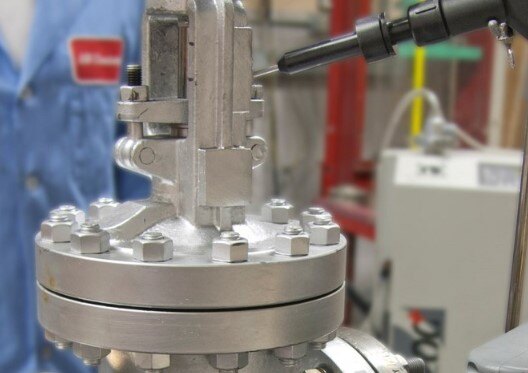
ISO 15848-1 is a fugitive emission testing standard issued by the International Organization for Standardization. The standard mainly focuses on detecting external leakage from valve stem seals (packing areas) and body seals (gasket areas). It is widely used for low-emission valve certification in industries such as oil and gas, petrochemicals, chemical processing, and high-purity gas transportation systems.
Valves certified according to this standard are commonly referred to as low-emission valves or low-leakage valves. The purpose of the standard is not only to verify sealing performance at the time of testing, but also to evaluate the long-term sealing stability of valves under realistic operating conditions.
Traditional valve testing usually relies on hydrostatic pressure testing. This method mainly determines whether visible leakage or obvious sealing failure occurs under water pressure conditions. However, hydrostatic testing cannot effectively identify microscopic gas leakage paths.
ISO 15848-1 uses helium or methane as tracer gases and employs highly sensitive leak detection equipment capable of identifying extremely small gas molecules escaping through microscopic leakage channels. This method provides a far more accurate evaluation of valve sealing performance during long-term operation.
As a result, ISO 15848-1 is particularly suitable for applications involving hazardous gases, volatile organic compounds, toxic chemicals, or expensive high-purity gases where even extremely small emissions may create environmental, safety, or economic risks.
ISO 15848-1 evaluates valve performance through three key classification categories.
The first is the tightness class, which specifies the maximum allowable leakage rate.
The second is the endurance class, which defines the number of mechanical operating cycles the valve must complete while maintaining its sealing performance.
The third is the temperature class, which defines the applicable testing temperature range, such as from minus 46 degrees Celsius to plus 200 degrees Celsius.
Together, these three parameters create a comprehensive evaluation system for both low-emission capability and long-term operational reliability.
After understanding the structure of the standard, the next practical question for engineers is usually how to select the appropriate leakage class. The differences between Class A, B, and C are significant in terms of allowable leakage rates, valve design requirements, manufacturing difficulty, and application scenarios.
Class A is the most stringent tightness class defined in ISO 15848-1 and is commonly referred to as the zero-leakage level.
This class uses helium as the testing medium and permits a leakage rate no greater than 10^-6 mg/s/m, calculated according to stem diameter.
Class A is intended for extremely demanding applications involving toxic media, lethal gases, hazardous chemicals, or ultra-high-purity process systems.
To achieve Class A certification, valves generally require bellows-sealed designs or highly advanced live-loaded PTFE packing systems. Standard graphite packing materials are usually unable to meet such strict leakage limitations because of their inherent material properties.
For conventional ball valves without bellows sealing structures, achieving true Class A performance is generally considered extremely difficult and often impractical.
Class B is the most widely used high-performance leakage classification in industrial applications. It has become the mainstream low-emission valve standard in the oil and gas and petrochemical industries.
This class also uses helium testing and allows a leakage rate of 10^-4 mg/s/m.
This performance level is generally considered roughly equivalent to the requirement for methane leakage below 100 ppmv in low-emission valve applications.
To achieve Class B certification, valves commonly use high-quality low-emission graphite packing combined with Inconel wire reinforcement and live-loading compensation systems such as Belleville spring washers. These features help maintain stable sealing stress even after long-term service and repeated thermal cycling.
For most industrial ball valve manufacturers, Class B represents the most practical, economical, and technically achievable target performance level.
Class C has relatively lower requirements compared with Class A and Class B, but it still belongs to the category of controlled leakage standards.
The testing medium may be helium or methane, and the allowable leakage rate is 10^-2 mg/s/m.
This class is commonly applied in steam systems, water systems, and general industrial applications where fugitive emission requirements are less demanding.
In many cases, standard graphite packing systems are sufficient to satisfy Class C requirements.
After determining the required leakage class, the next critical issue becomes how to accurately measure extremely small leakage rates. ISO 15848-1 specifies two primary testing methods: the vacuum method and the sniffing method. These methods differ significantly in terms of accuracy, application scenarios, and equipment requirements.
Only by selecting the correct testing method can the results achieve valid certification value.
The vacuum method is the highest-precision detection technique defined in ISO 15848-1 and is primarily used for Class A and Class B testing.
During the test, the stem sealing area is enclosed within a vacuum chamber connected to a helium mass spectrometer. After helium is introduced into the valve interior, any helium molecules escaping through the packing system are captured and measured by the mass spectrometer.
This method can effectively trace individual helium molecules and provides extremely high detection sensitivity. It is currently regarded as one of the most reliable leakage detection methods available for industrial valve testing.
The sniffing method uses a handheld probe to detect gases escaping around the stuffing box area.
This approach is simpler to operate but provides lower detection accuracy than the vacuum method. Therefore, it is more commonly used for production-stage quality screening according to ISO 15848-2 rather than strict type testing under ISO 15848-1.
In low-emission testing, the helium leak detector is the core testing device.
Bench-type mass spectrometer leak detection systems generally offer detection sensitivity ranging from 10^-12 to 10^-8 mbar·L/s, with measurement accuracy typically reaching ±1% to ±3%.
In comparison, portable handheld leak detectors usually provide accuracy levels of only ±5% to ±15%, with minimum detectable leakage rates around 5 × 10^-8 mbar·L/s.
Such equipment is generally insufficient for the strict accuracy requirements of formal type testing.
As a result, official ISO 15848-1 certification testing normally requires the use of bench-type mass spectrometer leak detection systems.
Testing methods only verify leakage results. The actual ability of a valve to pass certification depends heavily on detailed design factors.
From stem surface finish quality to packing structure selection and live-loading compensation systems, every design element directly affects the final sealing performance.
The machining quality of the valve stem directly affects sealing performance.
For Class A applications, stem surface roughness is typically required to be below Ra < 0.4 μm. Mirror polishing is usually necessary to achieve this level of surface finish.
A smoother surface reduces microscopic leakage paths and minimizes the possibility of gas permeation along the stem surface.
Live-loading structures are critical for maintaining long-term sealing performance.
By installing Belleville springs on the packing gland bolts, the system can automatically compensate for load loss caused by packing compression and relaxation during long-term operation.
This design functions similarly to a mechanical buffering system, continuously applying stable compression force to the packing set. It reduces the need for frequent gland retightening and helps maintain leakage performance during repeated thermal cycles.
V-type packing achieves sealing by converting axial compression force into radial sealing pressure acting on the valve stem surface.
This structure allows the packing to accommodate minor stem movement while maintaining continuous contact pressure under stable loading conditions.
When evaluating valve designs, engineers should carefully consider the following factors:
Number and arrangement direction of packing rings
Presence of anti-extrusion rings or adapter rings
Compatibility between packing structure and stem finish
These details strongly influence the long-term stability of low-emission performance.
In practical engineering procurement, technical personnel often encounter another important question: both ISO 15848-1 and API 624 are low-emission valve standards, so what is the relationship between them, and can they replace each other?
The answer lies in the significant differences in testing philosophy, classification systems, and applicable valve types.
API 624 mainly applies to rising-stem valves such as gate valves and globe valves using graphite packing systems.
It generally follows a fixed pass-or-fail testing method, typically requiring methane leakage below 100 ppmv after 310 operating cycles.
ISO 15848-1 is much more flexible. In addition to multiple tightness classes such as A, B, and C, it also defines different endurance classes. For example:
CO1 corresponds to 500 cycles
CO2 corresponds to 1500 cycles
This structure allows engineers to select performance levels that better match actual service conditions.
In many engineering applications, valves certified to ISO 15848-1 Class B are generally considered to provide performance equal to or better than API 624 requirements.
As a result, ISO 15848-1 has gradually become the preferred international standard replacing API 624 in many advanced low-emission valve projects, especially in high-end industrial applications.
ISO 15848-1 provides a systematic evaluation framework for the low-leakage performance of industrial valves.
From the extremely strict zero-leakage requirements of Class A to the more general controlled leakage standards of Class C, the standard covers a wide range of industrial operating conditions and application requirements.
Understanding the meaning of tightness classes, endurance classes, and temperature classifications, mastering the differences between vacuum and sniffing detection methods, and paying close attention to valve stem surface finish, live-loading structures, and packing material selection are all essential for ensuring long-term sealing stability in actual service conditions.
