Comprehensive Guide to Globe Valve Selection
In industrial piping systems, the globe valve is one of the most commonly used flow control devices. Whether in chemical production, HVAC systems, or oil and gas transmission, selecting the right globe valve directly affects system safety and economic performance. This article systematically introduces the key factors in globe valve selection to help you choose the most suitable product based on actual operating conditions.
Globe valves are not a single product but a family of valves with various structural configurations. Understanding the characteristics of each type is the first step in selection.
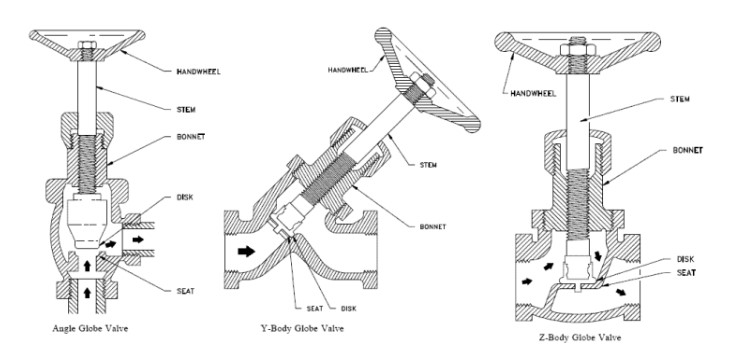
The angle-type globe valve is characterized by a flow path that requires the fluid to change direction only once. This design results in significantly lower pressure loss compared to conventional structures, making it particularly suitable for applications that are sensitive to pressure drop but still require globe valve throttling capability.
The straight-through or Y-type globe valve features a valve body flow passage arranged at an oblique angle relative to the main pipeline. Compared with traditional right-angle globe valves, this design causes less disturbance to the fluid flow pattern, resulting in lower pressure loss. In operating conditions where both regulating performance and low pressure drop are required, Y-type globe valves are often the ideal choice.
The piston-type globe valve is a modified version of the conventional globe valve. Its disc is precisely machined into a piston shape, and sealing is achieved through two elastic sealing rings installed on the piston. The advantage of this structure is that sealing ring materials can be flexibly selected according to operating conditions and are easy to replace during maintenance. Although mainly used for fully open or fully closed service, special piston or sleeve designs can also enable flow regulation.
There is no universal solution for globe valve selection. Comprehensive evaluation based on specific application scenarios is essential. The following core factors should be carefully considered.
Matching valve size and pressure rating is critical. Oversized valves not only increase procurement costs but may also reduce control accuracy, while undersized valves can generate excessive pressure drop, increase energy consumption, and potentially cause system failure. The maximum operating pressure, temperature range, and flow demand of the system must be used to determine the valve pressure class and nominal diameter.
Valve material directly determines service life and reliability. Different materials have specific application limits:
Carbon steel is the most economical and practical choice for industrial applications, offering moderate strength and suitability for medium-to-high temperature and pressure environments. It can typically withstand temperatures up to about 427°C and pressures up to 136 bar but has poor resistance to corrosive media.
Cast iron is a low-cost option suitable for low-pressure and low-temperature conditions (below 232°C and 17.2 bar). It is commonly used in cost-sensitive systems with mild operating conditions.
Stainless steel offers excellent corrosion resistance and can operate at temperatures up to approximately 538°C and pressures up to 207 bar, making it the preferred choice in industries such as food processing and pharmaceuticals where hygiene requirements are high.
Forged steel achieves a denser material structure through forging processes, significantly improving mechanical properties. It can withstand temperatures above 566°C and pressures exceeding 414 bar, making it a reliable option for extreme service conditions.
The valve-to-pipeline connection method affects installation convenience and sealing reliability:
Flanged connections are suitable for large-diameter valves and high-pressure systems, allowing easy disassembly and maintenance.
Threaded connections are mainly used in small-diameter, low-pressure applications due to their simple installation but limited pressure-bearing capacity.
Socket-welded and butt-welded connections perform well in high-temperature and high-pressure systems, providing leak-tight and robust sealing.
The performance of a globe valve depends not only on the valve body material but also on the selection of trim materials.
The valve stem is the motion transmission component connecting the actuator to the valve disc and must simultaneously provide corrosion resistance and wear resistance. Stainless steel is the standard stem material because it resists media corrosion while maintaining surface integrity during long-term friction with packing, preventing galling and sticking.
The disc-seat sealing pair is directly exposed to fluid erosion, and material selection must consider corrosion and abrasion resistance:
Polytetrafluoroethylene (PTFE) offers excellent chemical inertness and a very low friction coefficient. It is suitable for non-abrasive fluids and provides superior sealing performance, especially in low-temperature applications requiring tight shutoff.
Reinforced PTFE (RTFE) improves wear resistance by adding reinforcing materials, making it suitable for mildly abrasive media.
Metal materials such as stainless steel and bronze perform better under high-temperature and severe abrasion conditions. For high-velocity fluids or media containing solid particles, hardfacing treatments such as Stellite alloy overlay welding are commonly used to significantly enhance erosion resistance.
Disc structural design also influences material selection:
Plug-shaped discs are long and conical, offering strong erosion resistance and are typically made of stainless steel.
Composite disc structures use flat sealing surfaces and are suitable for medium throttling control, commonly made from brass or bronze.
Spherical discs have small contact areas and excellent sealing performance, with ceramic materials often used in such designs.
Steam Systems: High-speed steam flow can cause severe internal erosion. For steam applications, valves with hardened disc and seat surfaces (such as Stellite alloy overlay) or specially designed high-erosion-resistant materials such as nickel-based alloys should be prioritized to extend service life.
Corrosive Media: When handling strong corrosive media such as sulfuric acid, carbon steel valves are not suitable. Stainless steel or higher-grade corrosion-resistant alloys must be selected. Detailed chemical compatibility guidelines should be consulted, and material engineers should be involved when necessary.
Environmentally Strict Applications: For applications requiring control of fugitive emissions, attention should be given to whether the valve complies with international standards such as ISO 15848 or API 622. Certain specialized materials and structural designs can effectively reduce packing leakage and meet increasingly stringent environmental regulations.
Modern industrial systems are increasingly adopting automated control. Globe valve driving methods are divided into manual and automatic types.
Manual valves are operated through a handwheel or lever. They have simple structures and lower costs, making them suitable for applications that do not require frequent adjustment or remote control.
Automatic valves are equipped with electric, pneumatic, or hydraulic actuators, enabling remote operation and automatic regulation. In large industrial systems, they significantly improve operational efficiency and safety.
Maintenance requirements should also be considered during selection. Valves operating in corrosive environments or handling media prone to crystallization or sedimentation require more frequent inspection and cleaning. Choosing valve designs that are simple and easy to disassemble can help reduce long-term maintenance costs.
To navigate the wide range of options, the following systematic selection procedure is recommended:
- First, determine process parameters, including fluid properties (temperature, pressure, corrosiveness, abrasiveness), flow range, and allowable pressure drop. Globe valves exhibit linear flow characteristics suitable for precise control applications, but pressure drop must remain within acceptable limits.
- Second, determine valve specifications based on pipeline diameter and flow demand to avoid excessive turbulence and energy loss. Pressure rating must also be defined to ensure that the valve can withstand maximum system operating pressure with sufficient safety margin.
- Third, select structural type. Choose between conventional globe valves or Y-type globe valves based on pressure drop requirements, and select standard or special disc structures based on regulation needs.
- Fourth, determine material configuration. Starting from the valve body to internal components, select appropriate material grades to ensure that all fluid-contacting parts can withstand operating conditions.
- Fifth, select connection and driving methods to match existing piping systems and determine manual or automated control solutions.
- Sixth, verify compliance with relevant industry standards and quality certifications to ensure safety and reliability.
Several common engineering mistakes should be avoided in practical applications.
- Mistake 1: Ignoring pressure drop effects. Although globe valves offer good regulating performance, their pressure drop is higher than that of gate valves and other straight-through valves. In pressure-sensitive systems, Y-type globe valves or alternative valve types should be considered.
- Mistake 2: Overly conservative material selection. Not every application requires the highest-grade materials. Selecting material grades rationally while meeting operating requirements can effectively control costs.
- Mistake 3: Ignoring future maintenance space. Some selections focus only on initial performance without considering long-term maintenance accessibility, leading to difficult servicing and extended downtime.
- Mistake 4: Confusing pressure ratings across standards. Pressure class definitions may differ among standards such as ANSI, DIN, and JIS, so consistency of the selected standard system must be confirmed.
Globe valve selection is a technical task that requires comprehensive consideration of multiple factors. From understanding the structural characteristics of different globe valve types to analyzing material requirements under specific operating conditions, every stage influences the final performance.
Successful selection begins with accurate understanding of application requirements and is achieved through rigorous technical analysis. For critical or complex applications, it is advisable to communicate fully with professional valve suppliers or engineers, and conduct on-site condition assessments when necessary to ensure that the selected valve operates safely, efficiently, and economically throughout its lifecycle.
With the advancement of material science and manufacturing technology, globe valve products continue to evolve. Keeping track of new industry standards, materials, and structural designs will help you make more optimized decisions and improve the overall performance and reliability of fluid control systems.