
Differences Between Wafer and Lug Butterfly Valves
In industrial production, the flow control of liquids, gases, and slurries relies on various types of valve equipment. There are many types of valves, and selecting a suitable type requires understanding the structural characteristics and applicable conditions of different valves. Butterfly valves are a widely used type of valve. Their working principle is to achieve opening or closing by rotating a circular disc, thereby completing the isolation and regulation of medium flow. Butterfly valves have the characteristics of simple structure and convenient operation, and are widely used in various industrial environments. Among the many types of butterfly valves, wafer butterfly valves and lug butterfly valves are the two most common structures. These two types of butterfly valves are very common in industrial applications, but their design concepts and applicable scenarios have obvious differences. This article will explain in detail the differences between these two types of butterfly valves from aspects such as structural characteristics, installation methods, sealing performance, pressure application range, and cost, and provide selection references.
Although wafer butterfly valves and lug butterfly valves have different structures, their basic working principles are the same. Both types of valves control the flow of the medium through the rotation of the valve disc between 0 degrees and 90 degrees. When the valve disc rotates to 90 degrees, it is in a fully open state, and when it is at 0 degrees, it is in a fully closed state. This structure determines that butterfly valves have the characteristics of simple operation and rapid opening and closing.
In terms of structural dimensions, the structural length of the two types of butterfly valves is basically the same. Both adopt a thin design, occupy relatively small space, and are suitable for pipeline systems with limited space. In terms of design standards, both usually follow EN593 and API609 specifications. The structural length complies with EN558, ISO5752, and API608 standards. The flange connection is compatible with ISO5211 and various international flange standards. The pressure rating and sealing tests meet industrial requirements such as ISO5208 and API598. Therefore, both types of butterfly valves can be well connected with standard flange systems and are convenient for replacement and installation in existing industrial systems.
Wafer butterfly valves usually adopt a compact and lightweight design and achieve rapid opening and closing through handles or actuators. Some products use corrosion-resistant coatings and different materials for valve discs and valve seats to adapt to different industrial media environments.
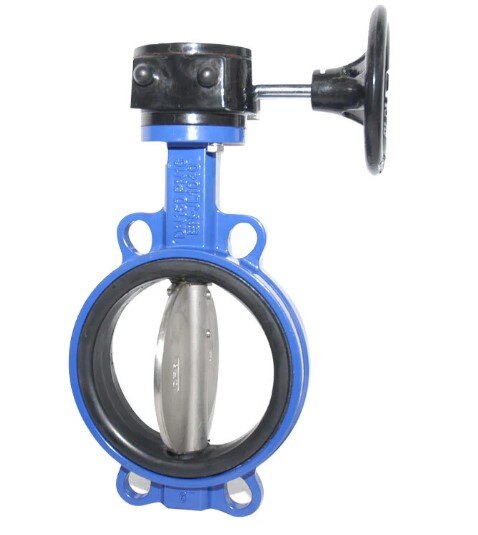
The biggest feature of wafer butterfly valves is their compact structure and light weight, which make them convenient for installation and use in pipeline systems with limited space. In terms of installation method, wafer butterfly valves are clamped between two flanges and are fastened by long bolts passing through the flanges. There is no need for complex sealing structures, and the installation process is simple and efficient. This type of valve adopts a 90-degree rotation opening and closing method, with fast operation speed, and can achieve rapid flow control.
When fully open, wafer butterfly valves have relatively small flow resistance and low pressure loss, which helps improve the overall operating efficiency of the system. Due to their simple structure and fewer components, their maintenance cost is relatively low, and daily maintenance requirements are also relatively small. At the same time, wafer butterfly valves use less material and have a relatively simple manufacturing process, so the overall cost is low, with high economic efficiency, making them very suitable for large-scale industrial applications.
Wafer butterfly valves are usually suitable for diameters below DN600, with pressure ratings generally not exceeding PN16, and are suitable for medium and low pressure conditions. Since the structure relies on flange clamping force to achieve sealing, it has relatively high requirements for installation coaxiality. If alignment is poor, leakage problems are likely to occur. In addition, wafer butterfly valves cannot be used as end valves; otherwise, there may be a risk of detachment at the end of the pipeline. During installation, they should be installed in systems with minimal vibration as much as possible to ensure operational stability.
Wafer butterfly valves are commonly used in general water systems, gas transmission systems, and low-pressure working environments. They have good bidirectional flow capability and are very common in conventional industrial applications, especially suitable for systems with limited budgets and low pressure requirements.
Lug butterfly valves adopt a structural design with threaded lugs, and the valve is firmly connected to the pipeline flange through bolts, giving it stronger mechanical fixing capability.
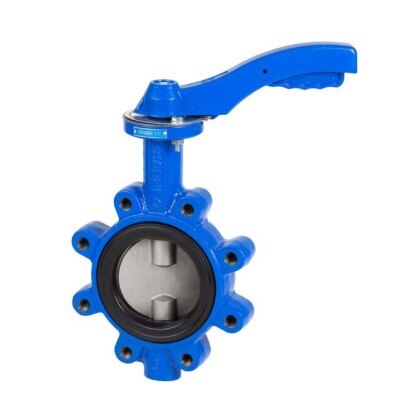
Lug butterfly valves are designed with threaded lug structures on both sides of the valve body. These lugs are used for direct bolt fixing without relying on nuts on both sides. This design makes the valve connection more secure and provides higher mechanical connection strength. At the same time, lug butterfly valves can be disassembled and maintained from one side without removing the entire pipeline, making them very suitable for systems that require sectional isolation or frequent maintenance. In addition, lug butterfly valves can be used as end-of-line valves.
Lug butterfly valves have a more robust overall structure and perform more stably in high-pressure environments, with higher structural strength, making them suitable for industrial scenarios with high requirements for safety and reliability. Due to the use of threaded connections and double-sided fixing structures, the overall sealing performance is stronger, which can effectively prevent leakage and improve system safety. Lug butterfly valves can be used for larger diameters and can withstand higher pressure ratings, up to PN25 or Class 250, making them more suitable for medium and high pressure conditions.
Although the manufacturing cost of lug butterfly valves is relatively high, under long-term operation and harsh working conditions, their stability and durability give them higher overall economic value. Similarly, lug butterfly valves also adopt a 90-degree rotation structure, with fast opening and closing capability, and can meet efficient fluid control requirements.
Lug butterfly valves are commonly found in water treatment plants, HVAC systems, and industrial pipelines that require sectional isolation. They are especially suitable for scenarios requiring regular maintenance or local repair. In high-pressure environments, their stability and safety are more advantageous, so they are widely used in critical industrial systems.
Although wafer butterfly valves and lug butterfly valves have the same basic functions, there are significant differences in many aspects.
Wafer butterfly valves are installed between two flanges and are fastened by bolts passing through the flanges. Their fixation relies on flange clamping force. The installation process is relatively simple and suitable for systems with compact space and no need for frequent disassembly. During installation, special attention should be paid to matching flange standards to avoid deformation of the valve body caused by excessive bolt tightening.
Lug butterfly valves are directly connected to pipeline flanges through threaded lugs on both sides of the valve body. During installation, it is necessary to ensure that the lugs are precisely aligned with flange bolts, and gaskets should be used properly to avoid leakage. At the same time, bolts must be tightened evenly to ensure balanced force. This installation method makes them suitable for working conditions that require regular maintenance or sectional disassembly.
Wafer butterfly valves require overall flange disassembly for maintenance and are not suitable for systems requiring frequent maintenance. Lug butterfly valves, on the other hand, can be disassembled and maintained from one side without removing the entire pipeline, enabling sectional maintenance and system isolation.
Due to the use of threaded connections and double-sided fixing structures, lug butterfly valves have stronger overall sealing performance. Wafer butterfly valves rely on flange clamping to achieve sealing and therefore have higher requirements for installation coaxiality.
Wafer butterfly valves are usually suitable for diameters below DN600, with pressure ratings generally not exceeding PN16. Lug butterfly valves, due to their more robust structure, can be used for larger diameters and can withstand higher pressure ratings, up to PN25, making them more suitable for medium and high pressure conditions.
Wafer butterfly valves have a more compact and lightweight structure and occupy less space. Lug butterfly valves, due to the presence of lug structures, require more installation space.
Wafer butterfly valves have lower overall costs due to their simple structure, fewer machining processes, and less material usage, making them suitable for projects with high economic requirements. Lug butterfly valves require threaded machining and have more complex structural designs, resulting in relatively higher manufacturing costs.
Wafer butterfly valves and lug butterfly valves are both commonly used flow control equipment in industrial pipeline systems. The two have the same basic working principle, but there are obvious differences in structural design, installation methods, sealing performance, pressure adaptability, and cost.
Wafer butterfly valves have a compact structure, light weight, low cost, and simple installation, making them suitable for industrial systems with limited space, cost sensitivity, and medium to low pressure conditions. Lug butterfly valves have a robust structure, high connection strength, capability for single-side disassembly and maintenance, and strong pressure resistance, making them suitable for complex industrial environments requiring high-strength connections, sectional maintenance, and high-pressure operation.
A correct understanding of the differences between the two types of butterfly valves helps in making reasonable choices based on specific working conditions in industrial applications, thereby achieving more stable, efficient, and economical fluid control. During selection, it is recommended to comprehensively consider system pressure rating, maintenance frequency, installation space, and budget constraints to choose the most suitable butterfly valve type for project requirements.
