
Plug Valve vs. Ball Valve: Differences and Selection Guide
In industrial piping systems, valves are critical equipment used to control the flow of media. Plug valves and ball valves, as two common types of quarter-turn rotary valves, are widely used in industries such as petroleum, chemical processing, water treatment, and energy. Due to similarities in appearance and operation, engineers often face confusion when selecting between them. This article provides a systematic comparison of plug valves and ball valves from the perspectives of structural principles, performance characteristics, maintenance requirements, and application scenarios, helping readers make informed engineering decisions.
A plug valve is a relatively traditional type of valve and belongs to the category of quarter-turn rotary valves. Its core component is a cylindrical or tapered plug with a through passage inside. By rotating the operating handle, the plug is turned 90 degrees. When the internal passage of the plug aligns with the pipeline direction, the medium can pass through freely and the valve is in the open position. When the plug is rotated so that the passage is perpendicular to the pipeline, flow is blocked and the valve is closed.
The plug valve has a relatively simple structure, compact size, and small footprint, making it suitable for installations in space-constrained environments.
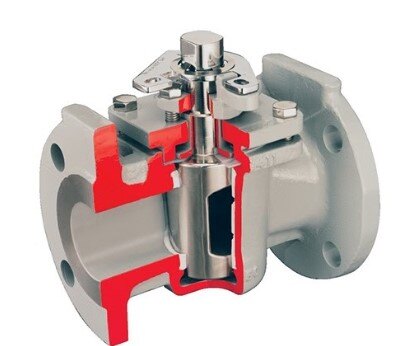
According to flow passage configuration, plug valves can be divided into straight-through, three-way, and four-way types. Straight-through plug valves are mainly used for shut-off applications. Three-way and four-way plug valves can distribute or redirect flow, making them suitable for complex piping systems requiring directional switching.
Plug valves can be categorized into three main sealing structures:
- Lubricated (fixed) plug valves: These use a nut or tightening mechanism beneath the plug to secure sealing between plug and body.
- Sleeve or packing-type plug valves: Sealing is achieved by compressing packing material to ensure tight contact between plug and body.
- Self-sealing plug valves: These rely on system pressure for sealing. Medium enters through a small inlet hole in the plug and flows into the lower chamber, pushing the plug upward to create tight sealing. A spring at the bottom provides preload force. This design is commonly used for gas applications.
To reduce friction between plug and valve body, some plug valves adopt a lubricated design where a film of lubricant separates the contact surfaces, ensuring smoother operation. However, lubricant selection must be compatible with medium temperature and chemical properties. For heavy oil or high-viscosity media that vary significantly with temperature, jacketed plug valves are often used. These valves utilize steam or hot water heating to maintain fluidity and prevent solidification.
Advantages:
- Simple structure
- Fast opening and closing
- Low flow resistance
Disadvantages:
- High operating torque due to large sealing contact area
- Seal surfaces are prone to wear
- Possible sticking under high temperature and pressure conditions
- Limited suitability for throttling applications
- Difficult to manufacture in large diameters due to structural constraints
A ball valve is an improved design developed from the plug valve and also belongs to the quarter-turn rotary valve category. Its closing element is a spherical ball with a through-hole. When the hole aligns with the pipeline, the valve is open; rotating the ball 90 degrees fully blocks the flow, achieving shut-off.
Ball valves feature a compact structure and simple operation. They are suitable for water, natural gas, acids, solvents, and other media, and can also be used in demanding applications involving hydrogen, methane, ethylene, and oxygen. Some advanced ball valves also provide flow regulation and throttling capabilities.
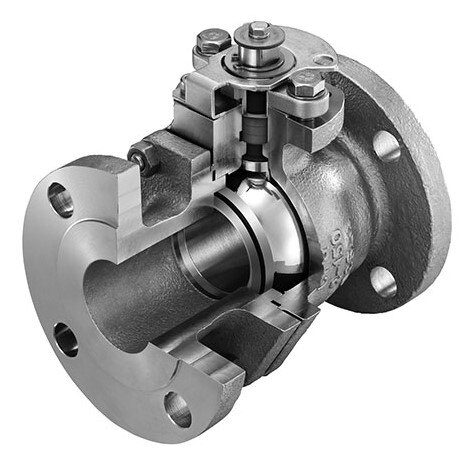
Ball valves can be classified into four main types:
- Full bore ball valves: The internal diameter matches the pipeline diameter, resulting in minimal pressure drop. Suitable for pigging operations.
- Reduced bore ball valves: The flow passage is smaller than the pipeline diameter, increasing velocity but also flow resistance.
- V-port ball valves: Featuring a V-shaped opening for precise flow control, ideal for throttling and regulation applications.
- Trunnion-mounted ball valves: The ball is supported by bearings, making them suitable for high-pressure and large-diameter applications.
Ball valves offer smoother flow paths, resulting in lower resistance and higher flow efficiency. Although the sealing area is smaller compared to plug valves, advanced seat materials and injection sealing technologies significantly improve sealing performance, meeting stringent industrial requirements.
Compared to plug valves, ball valves require lower operating torque and provide smoother operation, making them suitable for manual or automated actuation systems. Additionally, ball valves are easier to scale to large diameters, and large-diameter designs are already well established in the industry.
Although both are quarter-turn rotary valves and operate via 90-degree rotation, they differ significantly in structure, flow behavior, operating performance, and manufacturability.
Plug valves use a tapered or cylindrical plug that seals through direct surface contact with the valve body. Ball valves use a spherical ball and seat sealing system.
Plug valves have a larger sealing contact area, resulting in stronger sealing capability but higher operating torque. Ball valves have a smaller sealing area, but modern materials and sealing technologies allow them to meet most industrial requirements effectively.
Ball valves provide a smoother flow path, resulting in lower pressure loss and higher flow capacity. Plug valves may generate higher flow resistance due to greater contact area. In high-pressure systems, the flow efficiency advantage of ball valves becomes more pronounced.
Plug valves generally require higher operating force due to higher friction, resulting in less flexibility. Ball valves operate more smoothly with lower torque requirements and are easier to automate. For frequent on-off operations, ball valves offer significant advantages.
Plug valves are limited in large-diameter applications due to structural constraints. Ball valves, however, can be manufactured in large sizes and are widely used in oil and gas transmission pipelines.
Sealing performance is a key factor in valve selection.
Plug valves offer strong theoretical sealing performance due to large sealing surfaces, making them suitable for small-diameter applications requiring tight shut-off. However, in high-pressure or abrasive conditions, sealing surfaces are more prone to wear, increasing leakage risk over time.
Ball valves achieve sealing through tightly matched seats and advanced sealing materials such as PTFE and metal seals. Injection sealing technology further enhances performance. In high-pressure, high-temperature, and corrosive environments, ball valves generally provide more reliable sealing.
- Plug Valve Maintenance: Plug valves have a relatively simple internal structure with fewer moving parts. The plug can be disassembled for cleaning, and maintenance is straightforward. Replacement of sleeves or sealing components can restore performance at relatively low cost. However, when handling abrasive or particle-laden media, sealing surfaces may wear more quickly, requiring more frequent maintenance.
- Ball Valve Maintenance: Ball valves are more complex to maintain due to internal positioning of the ball. Cleaning and inspection are less convenient. In long-term operation, debris accumulation may increase maintenance difficulty. However, under normal conditions, ball valves exhibit lower wear rates and longer service life, resulting in lower maintenance frequency.
- Lifecycle Cost: From a lifecycle cost perspective, ball valves typically have higher initial investment but lower long-term maintenance costs, making them more economical overall. Plug valves are cheaper initially but may incur higher maintenance expenses over time.
Typical Applications of Plug Valves: Plug valves are suitable for slurry, wastewater, and media containing solid particles due to their large flow passages and strong passage capability. They perform well in corrosive or highly contaminated media applications. Their simple structure and strong corrosion resistance make them suitable for shut-off applications in challenging environments. Plug valves are also used in some high-temperature applications.
Typical Applications of Ball Valves: Ball valves are widely used in automated control systems, including natural gas pipelines, crude oil and gas processing systems, LNG facilities, compressor systems, storage tanks, and refinery processes.
In water treatment, pharmaceutical, and food industries, stainless steel ball valves are commonly used for clean water and hygienic media transport. High-pressure ball valves are used in deep-sea, underground, and cryogenic applications. V-port ball valves are widely used in processes requiring precise flow regulation.
- Based on Operating Conditions: For high-pressure or extreme temperature systems, ball valves are generally preferred due to better sealing and structural strength. They are also suitable for frequent operation due to low torque requirements. Plug valves are less suitable for frequent cycling due to higher operating force requirements.
- Based on Medium Characteristics: For media containing solids, sludge, or high viscosity fluids, plug valves may be more suitable due to better resistance to clogging. For applications prioritizing long-term reliability and low maintenance, ball valves are more advantageous.
- Based on Economic and Space Considerations: When budget is limited or installation space is restricted, plug valves may offer advantages due to simple structure and lower cost. For large-diameter pipelines, ball valves are generally preferred due to easier manufacturing scalability and better performance.
Plug valves and ball valves are both important control devices in industrial piping systems. While they share similar rotary operation principles, their performance characteristics and application ranges differ significantly.
Plug valves offer simple structure, low cost, and good performance in particle-laden media, but are limited by high operating torque and difficulty in large-scale manufacturing.
Ball valves provide smooth flow, easy operation, reliable sealing, and broad applicability, making them suitable for high-pressure, large-diameter, and automated systems, though at higher initial cost and slightly more complex maintenance.
Proper valve selection requires comprehensive consideration of process conditions, media characteristics, pressure and temperature ratings, operation frequency, maintenance capability, and budget constraints. Whether in petrochemical, natural gas, water treatment, or food industries, understanding the technical differences between plug valves and ball valves is essential for ensuring system safety, reliability, and economic efficiency.
