
Everything You Need to Know About Tilting Disc Check Valves
The tilting disc check valve is a valve device that automatically opens and closes by relying on changes in fluid pressure. Its core function is to allow the medium to flow in one direction while preventing reverse flow, playing the role of a “one-way passage” in industrial fluid transmission systems. This valve is an important member of the check valve family and is widely used in multiple industries such as water treatment, petrochemical, power generation, and food and beverage. Compared with other types of check valves, the tilting disc check valve has obvious advantages in response speed, flow resistance, and compact structure. Therefore, it has received increasing attention in modern industrial pipeline design.
The structure of the tilting disc check valve is relatively simple and mainly consists of four core components:
- Valve Body: The valve body is the outer shell of the entire valve, performing both pressure-bearing and pipeline connection functions. It is usually manufactured by casting or forging. Materials can be selected according to operating conditions, such as carbon steel, stainless steel, or bronze. The internal flow passage is designed to ensure smooth fluid flow. Both ends are typically connected by flanges, making installation and pipeline integration convenient.
- Disc: The disc is the main moving component of the tilting disc check valve. It is usually a flat or slightly curved circular plate. It is installed inside the valve body through a hinge connection at one end and can freely rotate around the hinge axis. Its design directly affects the opening angle, flow resistance, and sealing performance. During forward flow, the disc tilts open; during reverse flow, it returns and tightly contacts the valve seat to achieve sealing.
- Hinge Shaft (Hinge Pin): The hinge shaft supports the rotational movement of the disc and connects the disc to the valve body. It is typically made of high-strength alloy steel with surface hardening treatment to improve wear resistance. Its design ensures smooth disc movement while maintaining stability during long-term operation and preventing failure caused by wear.
- Valve Seat: The valve seat is a precision-machined sealing surface, usually installed inside the valve body. When the valve closes, the disc tightly contacts the valve seat to form a reliable sealing barrier. The material and machining accuracy of the valve seat directly determine sealing performance. Common materials include rubber, polytetrafluoroethylene (PTFE), and hard metal alloys, selected according to different media and temperature conditions.
- Auxiliary Components: Some tilting disc check valve models are equipped with spring mechanisms. The spring is installed between the disc and the valve body to assist rapid disc return, improving closing speed and reliability. This is especially important in applications requiring fast backflow prevention.
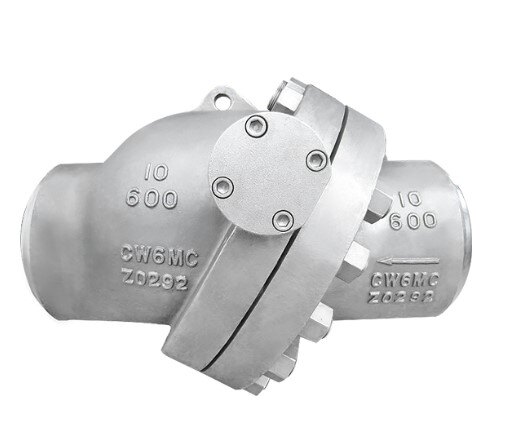
The working process of the tilting disc check valve is completely based on changes in fluid pressure and does not require external power drive. It is a typical automatic valve.
When the medium flows from the inlet to the outlet of the valve, the fluid pressure acts on the disc. This pressure pushes the disc to swing around the hinge axis toward the opening direction, gradually moving away from the valve seat position. As the disc opens, a fluid channel is formed, allowing the medium to pass smoothly through the valve.
The opening angle of the disc is not fixed but automatically adjusts according to flow rate and pressure changes:
- Low flow condition: The disc opens only slightly, just enough to allow fluid passage
- High flow condition: The disc opens further, providing a larger flow area
This adaptive characteristic enables the tilting disc check valve to accommodate a wide range of flow variations while maintaining stable operation under different working conditions.
Because the disc almost does not obstruct the flow passage in the open state, the energy loss during fluid passage is small, and the flow resistance is significantly lower than many other types of check valves.
When reverse flow occurs in the pipeline system, the flow direction of the medium changes. At this time, reverse pressure acts on the disc, pushing it to quickly rotate back toward the valve seat.
Under the action of reverse fluid pressure, the disc rapidly contacts the sealing surface and cuts off the backflow channel. Due to reasonable structural design, this closing process can be completed in a very short time, minimizing backflow volume.
The rapid closing ability brings several important effects:
- Prevention of water hammer: Quickly cuts off backflow and avoids pressure fluctuations impacting the pipeline system
- Prevention of medium contamination: Prevents downstream medium from flowing back into the upstream system
- Protection of downstream equipment: Prevents reverse flow from damaging pumps, turbines, and other key equipment
- Low Flow Resistance: After the tilting disc check valve is opened, the disc is located on one side of the flow passage and does not form a significant throttling effect. The fluid can pass through the valve almost in a straight line, with small energy loss and low system pressure drop. This feature helps improve overall transmission efficiency and reduce pumping energy consumption, providing significant economic benefits in large transmission systems.
- Reliable Sealing Performance: With properly designed matching between valve seat and disc, the tilting disc check valve can achieve reliable sealing even under relatively high pressure or large flow conditions. The contact surfaces between disc and seat are precisely machined, forming an effective sealing barrier when closed and preventing leakage problems.
- Fast Response Speed: The disc can quickly respond when the flow direction changes and complete the closing action rapidly. This fast response capability is important for preventing water hammer and protecting equipment, especially in systems with frequent pressure fluctuations.
- Simple Structure and Easy Maintenance: Compared with some complex valve structures, the tilting disc check valve has fewer moving parts and a simple overall structure. This not only reduces manufacturing cost but also reduces failure points, making daily maintenance and repair more convenient.
- Flexible Installation Method: The tilting disc check valve is suitable for horizontal pipelines, slightly inclined pipelines, and some vertical upward flow systems. This installation flexibility allows it to adapt to various site conditions and provides good applicability in both retrofit projects and new installations.
- Compact Structure and Small Space Occupation: The valve body design is compact, with relatively small overall dimensions, making it particularly suitable for installation environments with limited space. This advantage is especially significant in densely arranged pipeline areas or equipment rooms.
Understanding the differences between tilting disc check valves and other types of check valves helps in making reasonable selection decisions in practical engineering applications.
Traditional swing check valves have a disc that swings with a large angle at the top of the valve body, resulting in a longer opening and closing stroke. In contrast, the disc of a tilting disc check valve opens with a smaller angle around the central axis, resulting in faster and smoother closing and better water hammer suppression.
Lift check valves move the disc vertically up and down and have strict installation direction requirements, usually only applicable to horizontal pipelines. The tilting disc check valve is not limited by this and can adapt to multiple installation methods. In addition, lift check valves usually have higher flow resistance, while tilting disc check valves perform better in this regard.
Dual-plate check valves use two symmetrical semicircular discs and have a relatively complex structure. The tilting disc check valve has a simpler structure and fewer moving parts, but in some large-diameter conditions, dual-plate check valves may have better flow characteristics.
Axial flow check valves (non-slam check valves) are specially designed to reduce water hammer and noise and perform excellently in high-pressure and large-flow systems. Although tilting disc check valves can also effectively suppress water hammer, axial flow check valves may provide smoother closing characteristics under extreme conditions.
Piston check valves control fluid through a piston structure and are suitable for high-pressure applications, but their structure is relatively complex. Tilting disc check valves are more suitable for medium and low-pressure systems, with simple structure and lower cost.
Wafer single disc check valves are compact and lightweight, suitable for space-limited installations. Tilting disc check valves are slightly larger in size, but generally have better flow capacity and sealing performance.
The tilting disc check valve is widely used in many industrial fields due to its performance advantages.
In municipal water supply systems and wastewater treatment plants, tilting disc check valves are used to prevent pipeline backflow and ensure correct flow direction. Preventing sewage from flowing back into clean water systems and avoiding contamination spread is an important measure to ensure water quality safety.
In oil and gas transmission pipelines, refining units, and offshore platforms, tilting disc check valves prevent oil and gas backflow and protect key equipment such as compressors and pumps. In high-pressure, flammable, and explosive environments, valve reliability and fast response capability are crucial.
In thermal and nuclear power plants’ steam and water circulation systems, tilting disc check valves prevent backflow from impacting turbines and feedwater pumps. Suppression of water hammer is essential for protecting expensive power generation equipment.
In chemical production processes, many operations require strict one-way flow control. Tilting disc check valves can maintain reliable performance under corrosive media, high temperature, and high pressure conditions.
In food and beverage processing, preventing cross-contamination is a key quality control requirement. Tilting disc check valves ensure one-way flow and prevent contamination caused by backflow.
In seawater desalination, ship ballast systems, and other marine applications, tilting disc check valves made of bronze or duplex stainless steel can resist seawater corrosion and operate stably for long periods.
Proper installation directly affects the performance and service life of the tilting disc check valve.
Before installation, the flow direction marking on the valve body must be checked to ensure that the fluid direction matches the valve design direction. Reverse installation may prevent normal operation or cause damage.
- Installation Position: Usually installed in horizontal or slightly inclined pipelines; Some models can be used in vertical upward flow systems; It is generally recommended to install near the pump outlet to minimize backflow risk; Avoid installation in areas with severe vibration.
- Flange Connection: During installation, ensure flange faces are parallel and bolts are evenly tightened. Uneven force may cause valve body deformation, affecting disc movement and sealing performance. Bolts should be tightened in a diagonal sequence gradually.
- Pipeline Support: The valve should not bear pipeline weight. Independent supports should be installed on both sides of the valve to avoid additional stress and deformation on the valve body.
Regular maintenance is key to ensuring long-term reliable operation of the tilting disc check valve.
- Regular Inspection: The internal condition of the valve should be regularly checked for debris, deposits, or scaling. These substances may hinder disc movement and affect opening and closing performance. In media with high impurity content, inspection intervals should be shortened.
- Lubrication Maintenance: Regular lubrication of the hinge shaft and moving parts reduces friction and wear. The type of lubricant should be selected according to operating temperature and medium characteristics to avoid adverse reactions.
- Replacement of Wear Parts: Seals, gaskets, springs, and other wear parts should be inspected regularly. They should be replaced immediately if aging, deformation, or damage is found. Preventive maintenance is recommended rather than waiting for failures.
- Functional Testing: After maintenance, water flow testing should be conducted to ensure normal valve operation, no sticking, and no leakage on sealing surfaces. For critical systems, regular testing procedures should be established.
The tilting disc check valve is a simple and reliable automatic valve widely used in industrial fluid systems. It operates through disc tilting without external power, allowing low-resistance forward flow and rapid shutoff of reverse flow, effectively preventing water hammer and equipment damage.
With low pressure loss, fast response, reliable sealing, compact design, and flexible installation, it is widely applied in water treatment, petrochemical, power generation, chemical, and food industries. Compared with other check valves, it offers advantages in flow efficiency, installation flexibility, and structural simplicity.
Proper selection, correct installation, and regular maintenance are essential for long-term stable operation. Key factors such as pipe size, flow range, pressure, medium, and temperature must be considered to ensure safe system performance.
As industrial automation advances, the tilting disc check valve continues to evolve toward higher efficiency, longer service life, and smarter operation, maintaining its role as a dependable solution for backflow prevention in modern fluid systems.
