
Expanded PTFE Packing: Properties, Types & Manufacturing
In the field of industrial sealing, the selection of an appropriate sealing material has a direct impact on the safety and operational stability of equipment. Different types of sealing materials are suitable for different pressure, temperature, and media conditions. Expanded polytetrafluoroethylene (ePTFE), as a high-performance sealing material, makes ePTFE packing a popular packing enjoyed by many enginners across industries. This article systematically introduces ePTFE packing from the perspectives of its basic characteristics, classification, performance advantages, manufacturing process, and comparison with traditional PTFE, helping readers make informed decisions in practical applications.
Expanded polytetrafluoroethylene (ePTFE) is a continuously evolving high-performance material. It originally developed from simple unidirectional (uniaxial) gasket tapes and has since evolved into various product forms, including ePTFE membranes, biaxial tapes, sheets, and rope-like materials. Today, ePTFE packing is increasingly used in industrial sealing applications due to its excellent sealing performance and ease of installation.
To understand the characteristics of ePTFE, it is essential to first understand its base material—polytetrafluoroethylene (PTFE). PTFE is a dense synthetic fluoropolymer known for its non-stick properties, low friction coefficient, and outstanding chemical resistance. It can operate continuously at temperatures above 260°C and also provides excellent electrical insulation and chemical inertness. As a result, it is widely used in industries such as food processing, medical equipment, electronics, and chemical engineering.
ePTFE is a high-performance modified form of PTFE. It is made from 100% pure PTFE and processed through mechanical restructuring to form a micro-porous structure and a multidirectional fibrous network. Although its chemical composition remains unchanged, the physical transformation significantly enhances its sealing and insulation performance, making it superior to conventional PTFE in many applications.
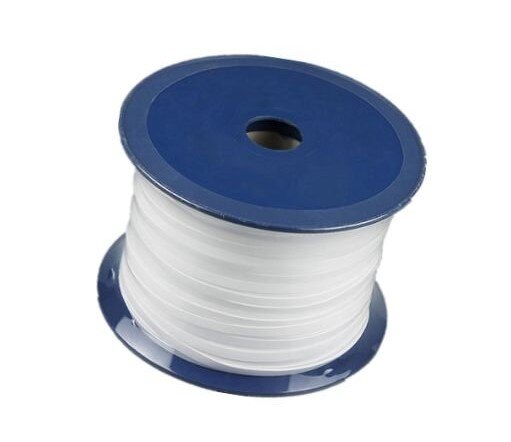
In industrial sealing applications, ePTFE packing is generally divided into two main types: braided ePTFE packing and pure ePTFE packing. Each type has distinct properties and is suitable for different working conditions.
Braided packing is manufactured by weaving elongated PTFE or ePTFE fibers into a square cross-sectional sealing material. This structure retains the chemical stability and corrosion resistance of PTFE while enhancing overall mechanical strength through the braided configuration.
The main advantage of braided ePTFE packing is its high mechanical strength, allowing it to withstand significant tensile and compressive forces. However, its compressibility is relatively low, meaning effective sealing typically requires higher compression force or higher system pressure. Therefore, braided packing is more suitable for applications where strong mechanical stability is required and sufficient tightening force can be applied.
Pure ePTFE packing, also known as PTFE rope or round ePTFE cord, is produced through a unidirectional stretching process that forms a microporous internal structure, giving it excellent compressibility.
Unlike braided packing, pure ePTFE packing can achieve effective sealing under relatively low compression force or even low system pressure. This makes it especially suitable for equipment that cannot tolerate excessive tightening, such as glass equipment or systems made of fragile materials. During manufacturing, it is important to ensure a smooth outer surface and avoid elliptical deformation of the cross-section to maintain stable sealing performance.
In addition to the two basic types, ePTFE packing can also be modified by adding fillers such as glass fiber or graphite. The purpose of modification is to further improve creep resistance, compressive strength, and thermal stability. Modified ePTFE packing can therefore meet more demanding industrial conditions, including higher temperatures, higher pressures, or more aggressive chemical environments.
The microporous structure of ePTFE provides several key performance advantages that make it highly valuable in sealing applications.
One of the most significant characteristics of ePTFE is its softness and excellent deformability. It can adapt to complex or irregular sealing surfaces under relatively low pressure. This allows it to effectively fill microscopic defects and uneven gaps on flange surfaces. Even when the sealing surface is slightly damaged, it can still form a reliable seal and prevent leakage.
In practical selection, when the priority is sealing irregular or damaged surfaces, ePTFE is often the preferred choice due to its high compressibility and adaptability. Compared with traditional sealing materials, which often require higher pre-tightening forces, ePTFE can achieve sealing without damaging equipment structures.
ePTFE maintains stable performance across an extremely wide temperature range, approximately from -250°C to +250°C. This makes it one of the few sealing materials that combine high sealing capability with broad thermal adaptability. Conventional rubber materials typically fail at around 150°C to 180°C, while some silicone materials, although heat-resistant, often lack sufficient sealing performance under low-pressure conditions. These limitations make them difficult to replace ePTFE.
In low-temperature and cryogenic applications, ePTFE performs exceptionally well. Due to its stable structure, it does not become brittle or significantly degrade in performance, making it highly valuable in cryogenic engineering and liquefied gas systems.
In chemically aggressive environments, ePTFE exhibits strong inertness and excellent resistance to a wide range of acids, alkalis, and organic solvents. Although it has a microporous structure, the pore size is extremely small, preventing the absorption of moisture or media. This eliminates risks of medium retention or contamination, which is particularly important in chemical and pharmaceutical industries.
ePTFE packing also performs well under high-pressure conditions. Its key advantage is that it can achieve reliable sealing at relatively low compression force, which is essential for systems that cannot tolerate excessive tightening. In such systems, conventional sealing materials often require high pre-load force, whereas ePTFE provides stable sealing without damaging equipment structures.
ePTFE packing is widely used in food-grade and sterile applications. Since PTFE itself complies with FDA food-grade standards, ePTFE is suitable for food processing, pharmaceutical manufacturing, and precision chemical industries where cleanliness is critical. Its inert nature helps prevent contamination of final products.
Understanding the manufacturing process of ePTFE helps clarify its performance characteristics. The production process consists of four key stages.
- Preform Preparation: First, PTFE fine powder is mixed with processing additives and compressed into cylindrical preforms. This step establishes the initial shape for further processing.
- Extrusion Molding: The preform is then processed through extrusion to form initial shapes such as tapes or tubes. At this stage, the material has not yet developed expanded characteristics and still retains a dense PTFE structure.
- Expansion and Stretching: This is the core step in the entire manufacturing process. Under conditions above room temperature but below the melting point, the material is rapidly and precisely stretched in one or two directions. This process pulls apart PTFE molecular chains and forms a stable fibrous network with a porous structure. This structure is often described as a “dense sponge-like or cotton-like network.”
- Sintering and Stabilization: Finally, the material undergoes sintering treatment, where further heating locks the structure in place. This stabilizes the porous fibrous configuration and ensures long-term mechanical reliability. After this process, the material remains 100% PTFE, but its physical structure is fundamentally transformed.
In engineering applications, correctly distinguishing between PTFE and ePTFE is essential for material selection.
PTFE is a dense synthetic fluoropolymer with a smooth surface and relatively rigid structure. In contrast, ePTFE has a porous structure with a soft, sponge-like or fibrous texture. The key difference lies in controlled mechanical stretching, which transforms the dense PTFE into a flexible, compressible material with a fibrous network and microvoids.
PTFE is suitable for applications requiring structural rigidity, low friction, and long-term chemical resistance. Its smooth surface makes it ideal for pipe flange sealing and mechanical components requiring reduced wear.
ePTFE, on the other hand, is more suitable for applications requiring high compressibility, conformability, and sealing of irregular surfaces. It can deform significantly under pressure, filling uneven gaps and reducing leakage risk. Its microporous structure also provides excellent thermal and electrical insulation.
PTFE is commonly used in food processing equipment, pharmaceutical systems, electrical insulation, and chemical corrosion-resistant systems. ePTFE is more widely used in high-demand sealing applications such as medical devices, electronic insulation structures, oil and gas systems, pipeline and flange sealing, and filtration systems. In medical fields, ePTFE is even used in implantable materials such as vascular grafts due to its porous structure, which allows tissue integration.
Overall, both PTFE and ePTFE are high-performance fluoropolymer materials, but their focus differs. PTFE emphasizes rigidity, low friction, and chemical resistance, while ePTFE emphasizes flexibility, sealing adaptability, and reliability under complex conditions.
If the application requires rigid structural components or low-friction support parts, PTFE is more suitable. If the application involves sealing, electrical insulation, or complex surface conditions, ePTFE is often the better choice. Selection should be based on pressure, temperature, media, and sealing structure requirements.
ePTFE packing is typically supplied in coil form, with diameters commonly ranging from 3 mm to 20 mm. Users can select appropriate sizes based on actual sealing gap requirements.
This material has an extremely long storage life and does not degrade significantly over time. This makes it suitable for long-term inventory storage as well as maintenance applications. For industrial users, this means bulk purchasing and long-term storage are feasible without concerns about material deterioration.
The expansion process physically restructures PTFE, unlocking its latent performance and transforming it from a relatively rigid engineering plastic into a highly flexible functional material. ePTFE packing provides a sealing solution that combines chemical stability, wide temperature adaptability, high compressibility, and excellent pressure resistance.
When sealing applications require performance across varying temperature and pressure conditions, ePTFE packing is increasingly becoming the preferred choice for engineers due to its ability to achieve reliable sealing under relatively low compression force. As industrial equipment continues to demand higher sealing performance, the application scope of ePTFE will continue to expand. In particularly complex operating environments where traditional sealing materials fall short, ePTFE will play an increasingly important role.
