
Molded Graphite Packing Ring in Valve Sealing Applications
In industrial production, the sealing performance of equipment is directly related to operational safety, production efficiency, and environmental protection. Although sealing components are small, they play a critical role in preventing media leakage and ensuring system stability. The molded graphite packing ring is a widely used sealing material in modern industry. It is primarily made from graphite and formed through a die-pressing molding process. It can maintain reliable sealing performance under high temperature, high pressure, and corrosive environments. This article provides a systematic introduction to molded graphite packing rings, covering their definition, manufacturing process, performance characteristics, application advantages, and selection considerations.
A molded graphite packing ring is a sealing component manufactured through a molding process using precision dies, primarily used in industrial equipment to prevent the leakage of fluids or gases, especially in dynamic sealing systems such as valves and pumps. It is made from flexible graphite as the base material and is pressed under high pressure in steel molds into ring-shaped packing elements with specific dimensions and geometries.
The working principle of this packing ring is based on the inherent physical properties of graphite. Graphite has excellent compressibility and resilience. When installed inside a stuffing box or sealing chamber, it deforms under axial compression and fills microscopic gaps between the shaft and housing, forming an effective sealing barrier. In addition, the molding process pre-compresses the graphite structure during production, resulting in higher density and improved structural uniformity. This significantly enhances sealing reliability and long-term stability.
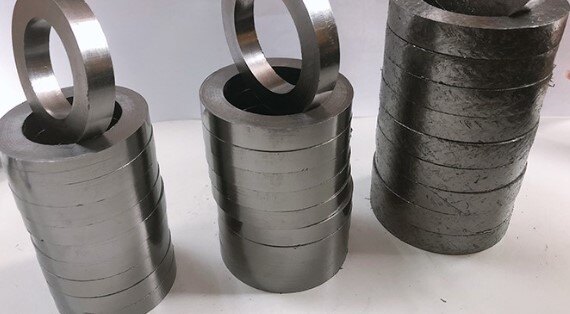
The excellent performance of molded graphite packing rings originates from their unique manufacturing process and the intrinsic properties of graphite materials. Both process technology and material purity determine their final performance.
The manufacturing process typically begins with high-purity expanded flexible graphite flakes or strips. These raw materials are placed into precision steel molds designed according to the final product’s inner and outer diameters. Under high pressure—often hundreds of tons—the graphite is compressed into a dense and stable ring structure. In some cases, thermal pressing is applied to improve interlayer bonding and enhance structural integrity.
This cold or hot pressing process produces packing rings with precise dimensions, smooth surfaces, and uniform density. Compared with traditional braided packing or manually cut materials, molded graphite packing rings exhibit isotropic performance characteristics. This means their sealing behavior is consistent in all directions, ensuring stable performance under radial and axial stress conditions.
Molded graphite packing rings are made from high-purity flexible graphite materials with minimal impurities. After high-pressure molding, the internal structure becomes highly uniform without weak interfaces or layered separation. This uniformity significantly improves chemical resistance and thermal stability.
Structurally, the advantages of molding are reflected in three key aspects. First, high dimensional accuracy ensures excellent fit within stuffing boxes, improving sealing consistency. Second, uniform internal density eliminates performance variation commonly found in braided or manually assembled packing. Third, the high-density structure provides strong mechanical strength and compression resistance, allowing the packing ring to maintain stability under high-load conditions and continuous operation.
The manufacturing process and material characteristics directly define the performance advantages of molded graphite packing rings. Their key properties include temperature resistance, chemical stability, and excellent self-lubrication and anti-creep behavior.
Molded graphite packing rings offer an extremely wide operating temperature range. In general, they can function reliably from approximately -240°C to 430°C. In steam applications, they perform exceptionally well, withstanding temperatures up to around 650°C. In inert gas environments, graphite materials can even tolerate extreme temperatures approaching 1650°C.
In terms of pressure resistance, molded graphite packing rings can withstand significant pressure fluctuations due to their dense and compact structure. They maintain dimensional stability under high compressive loads and dynamic operating conditions. For enhanced performance in extreme pressure systems, metal reinforcement or end rings may be added to improve structural strength and prevent deformation.
Graphite is chemically inert and highly resistant to acids, alkalis, solvents, and a wide range of aggressive media. This makes molded graphite packing rings suitable for harsh chemical environments where conventional sealing materials fail.
Unlike braided packing that may include metallic components susceptible to corrosion, molded graphite packing rings contain no exposed metallic fibers in their sealing body. This ensures higher reliability in corrosive applications such as petrochemical processing, acid handling systems, and chemical reactors.
They are widely compatible with hydrocarbons, steam, acidic and alkaline solutions, and industrial chemical fluids. Their chemical stability ensures long-term sealing performance without degradation caused by media exposure.
Graphite inherently provides excellent self-lubricating properties, making molded graphite packing rings ideal for dynamic sealing applications such as valve stems and pump shafts. This reduces friction between moving components, lowers wear, and improves operational efficiency.
In addition, molded graphite packing rings exhibit strong anti-creep and anti-stress relaxation properties. Many traditional sealing materials lose sealing force over time due to compression set or thermal cycling. In contrast, graphite packing maintains stable sealing load under prolonged high-temperature and high-pressure conditions, significantly reducing leakage risk during long-term operation.
The performance advantages of molded graphite packing rings translate into significant industrial value. High sealing efficiency, long service life, and wide adaptability make them a preferred choice in demanding environments.
Molded graphite packing rings provide excellent sealing performance with minimal leakage. Their compressibility and resilience allow them to adapt to shaft movement and surface irregularities, ensuring tight sealing even under severe operating conditions.
This is particularly important in industries with strict environmental regulations. Reduced leakage not only minimizes product loss but also helps reduce fugitive emissions, supporting compliance with environmental and safety standards.
Due to their thermal stability and chemical resistance, molded graphite packing rings offer significantly longer service life compared to conventional packing materials. Although initial costs may be higher, their durability and low maintenance requirements result in lower total lifecycle costs.
In industrial systems, replacing packing components often requires shutdowns. By extending maintenance intervals, molded graphite packing rings reduce downtime, improve operational efficiency, and lower overall maintenance expenses.
Molded graphite packing rings are widely used across industries such as petrochemical, power generation, metallurgy, pharmaceuticals, food processing, and marine engineering. They can be customized in terms of size, density, shape, and reinforcement structure to meet specific equipment requirements.
Because graphite is a clean and non-toxic material, it also complies with modern environmental and safety standards. This makes it suitable for applications with strict hygiene requirements, such as food and pharmaceutical processing systems.
Molded graphite packing rings are widely used in dynamic and static sealing applications across multiple industrial sectors.
In valves, molded graphite packing rings are commonly used in stuffing box assemblies for gate valves, globe valves, and ball valves. They provide effective stem sealing while reducing friction during valve operation. Their self-lubricating properties ensure smooth movement and prevent leakage along the valve stem.
In pumps, they are used as shaft packing elements in centrifugal and rotary pumps. They effectively prevent leakage between rotating shafts and pump housings, while maintaining stable performance under continuous rotational motion and varying pressure conditions.
Although primarily used as packing materials, molded graphite rings are also applied in static sealing scenarios where applicable structural designs exist. In pressure vessels, heat exchangers, and pipeline systems, they contribute to reliable sealing under bolt compression.
In static equipment such as compressors and hydraulic systems, they provide long-term sealing stability without significant stress relaxation, ensuring continuous sealing performance over extended periods.
Molded graphite packing rings are particularly effective in high-pressure systems due to their structural density and compressibility. They are widely used in hydraulic systems, high-pressure pumps, and pneumatic equipment.
In environments with frequent temperature and pressure fluctuations, their isotropic structure allows them to adapt to changing conditions while maintaining sealing integrity. This makes them suitable for demanding industrial applications with unstable operating parameters.
Proper selection and installation are essential to maximize the performance of molded graphite packing rings. Key considerations include operating conditions, environmental factors, product configuration, and handling practices.
Selection should be based on operating temperature, pressure levels, media type, shaft speed, and system design. Molded graphite packing rings are especially suitable for high-temperature and corrosive environments where conventional sealing materials such as rubber or PTFE may fail.
Different applications require different performance priorities. Low-temperature systems require flexibility, high-temperature systems require oxidation resistance, and corrosive environments require high-purity graphite materials.
In oxidizing environments, especially high-temperature air or oxygen-rich conditions, graphite may gradually oxidize, reducing service life. In such cases, oxidation-resistant grades or protective additives should be selected.
For long-term high-temperature air exposure, it is important to consult manufacturers for specially treated anti-oxidation graphite materials to ensure durability and performance stability.
Molded graphite packing rings may be used with or without anti-extrusion rings depending on application requirements. Reinforced designs are preferred in high-pressure systems, while standard designs are suitable for general applications.
Proper installation is critical. Sealing surfaces must be clean and free of debris. Correct compression force must be applied—insufficient pressure may cause leakage, while excessive compression may damage the packing or shaft.
Packing rings should remain in original packaging until use to prevent contamination or mechanical damage. Storage environments should be dry, clean, and free from direct sunlight or UV exposure.
They should also be protected from moisture and liquids to prevent structural changes. During handling, care must be taken to avoid bending, compression, or impact damage to ensure structural integrity and sealing performance.
Molded graphite packing rings, with their outstanding temperature resistance, pressure resistance, chemical stability, and reliable sealing performance, have become essential components in modern industrial sealing systems. From petrochemical processing to power generation, and from pharmaceuticals to heavy machinery, they provide reliable performance in demanding environments.
Thanks to their high density, uniform structure, and excellent dimensional accuracy, molded graphite packing rings offer superior sealing efficiency, long service life, and strong economic value. For engineers and maintenance professionals, proper understanding, selection, and installation of these components are key to ensuring long-term system stability and reducing operational costs. As industrial technology continues to advance, the application scope and importance of molded graphite packing rings will continue to grow.
