
Guide to Check Valve Selection: Lift vs. Swing Check Valves
In industrial piping systems, controlling the one-way flow of fluids is essential to ensuring production safety and stable equipment operation. Check valves, as the core devices that perform this function, effectively prevent backflow and protect critical equipment such as pumps and compressors from damage. Currently, the most common types of check valves on the market are lift check valves and swing check valves. This article provides a comprehensive analysis of these two check valve types from multiple perspectives, including working principles, structural characteristics, application scenarios, and installation requirements, to help engineers make informed selection decisions.
A check valve, also known as a one-way valve, non-return valve, or backflow valve, is an automatic valve. Its primary function is to allow fluid to flow in only one direction while preventing reverse flow, without the need for external power or manual operation. When fluid flows in the correct direction, the valve opens automatically; when the flow stops or attempts to reverse, the valve closes automatically.
Check valves play several critical roles in industrial production:
- Prevent backflow: Avoid reverse fluid movement in pipelines and prevent cross-contamination.
- Protect equipment: Stop pumps, drive motors, and other equipment from reversing due to backflow, reducing the risk of mechanical damage.
- Maintain system pressure: Ensure pressure stability within pressure vessels and piping systems.
- Enhance production safety: In industries such as chemical processing and pharmaceuticals, prevent accidents caused by the mixing of incompatible media.
Among the two mainstream check valve types, lift check valves are the most widely used. With their unique vertical lifting structure and excellent sealing performance, they are the preferred choice for high-pressure conditions and applications requiring strict sealing. Below is a detailed analysis of their working principles, structural features, and application considerations.
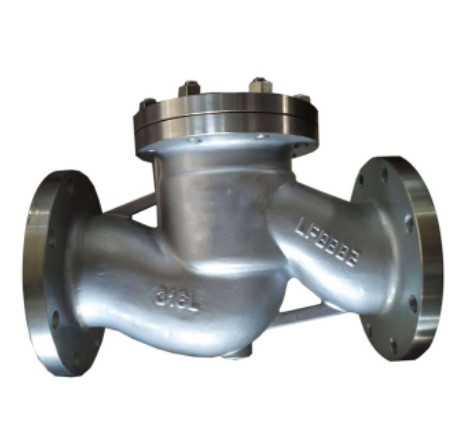
The disc of a lift check valve moves up and down along the vertical centerline of the valve body. Its basic structure includes the valve body, disc, seat, and guide sleeve. Guide sleeves are machined on the upper portion of the disc and the lower portion of the bonnet, allowing the disc to move freely within the sleeve.
The operating process consists of two stages:
- Opening Stage: When the medium flows into the valve body in the direction indicated by the arrow, fluid pressure generates an upward thrust on the disc. Once this thrust exceeds the disc’s weight, the disc lifts off the seat sealing surface, opening the flow passage and allowing the medium to pass smoothly.
- Closing Stage: When the medium stops flowing or begins to reverse, the inlet pressure acting on the disc decreases. The disc then drops under its own weight, assisted by back pressure, reseating against the sealing surface to cut off the flow path and prevent reverse flow. The valve body of a lift check valve resembles that of a globe valve, making certain specifications interchangeable. For high-pressure, small-diameter applications, the disc may adopt a spherical design to enhance sealing performance and durability.
Lift check valves have strict installation requirements: they must be installed in horizontal pipelines only. This is because the closing action heavily relies on gravity. If installed vertically, the disc cannot fall back effectively, resulting in improper closure and loss of check functionality.
Based on the relative direction between the inlet/outlet passages and the seat passage, lift check valves are divided into two structural types:
- Straight-through type: The inlet and outlet passages are perpendicular to the seat passage, resulting in relatively high fluid resistance.
- Vertical type: The inlet and outlet passages align with the seat passage, producing lower fluid resistance and better flow performance.
Lift check valves offer several notable benefits in industrial applications:
- Excellent sealing performance: The disc and seat form a flat sealing surface with a large contact area, providing superior sealing compared to swing check valves.
- Simple and reliable structure: Fewer components mean fewer failure points and high operational stability.
- Fast response: Short disc travel enables quick opening and closing, effectively reducing water hammer duration.
- Easy maintenance: Compact construction allows convenient disassembly, minimizing maintenance workload and cost.
- Long service life: Metal-to-metal or metal-plus-rubber composite seals provide strong wear resistance, enabling years of operation in clean media.
- Suitable for high pressure and temperature: High structural strength allows operation under demanding conditions.
Despite their advantages, lift check valves also have certain restrictions:
- Higher fluid resistance: The internal structure creates noticeable pressure drop, increasing system energy consumption compared to swing check valves.
- Limited installation positions: Horizontal installation only, restricting use in vertically arranged pipelines.
- High cleanliness requirements: Solid impurities may lodge between the seat and disc, preventing proper closure. Upstream filtration is therefore necessary.
- Susceptibility to water hammer: Rapid closure shortens the duration but may generate strong instantaneous impact forces, requiring damping measures in some systems.
- Diameter limitations: Typically suited for small to medium pipe sizes; large diameters require higher opening pressure and may reduce economic efficiency.
Unlike the vertical sliding mechanism of lift check valves, swing check valves use a completely different structural design. If lift check valves rely on vertical lifting to open and close, swing check valves achieve the same function through “rotational swinging.” This design difference provides unique advantages in fluid resistance and installation flexibility, making them a mainstream choice for high-flow pipeline systems.
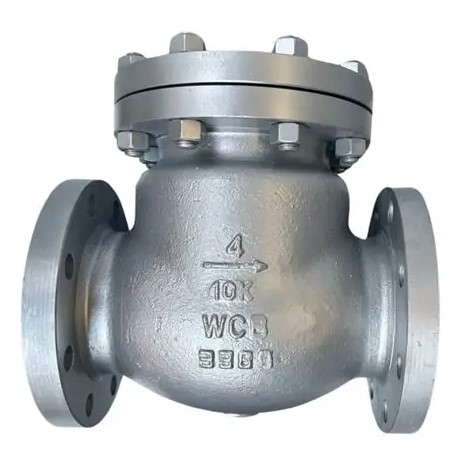
The core component of a swing check valve is a hinged disc (often called a clapper) mounted on a hinge or pivot shaft. One side of the disc connects to the shaft, allowing rotational movement. The disc is typically circular and made from metal or high-performance polymer materials.
- Opening Stage: When fluid flows in the intended direction, higher upstream pressure pushes the disc upward around the hinge, opening the valve. Once open, fluid passes with minimal obstruction and very low pressure drop.
- Closing Stage: When inlet pressure decreases, flow stops, or back pressure develops downstream, the disc swings back under its own weight and reverse pressure, reseating against the valve seat to prevent backflow. The streamlined internal passage significantly reduces flow resistance, making swing check valves ideal for high-flow, low-velocity applications.
Depending on valve size and application requirements, swing check valves are available in three main forms:
- Single-disc type: Suitable for small to medium diameters; simplest structure with one disc, easy maintenance, and lower cost.
- Dual-disc type: Features two symmetrical discs for medium diameters, balancing hydraulic impact and improving closing characteristics.
- Multi-disc type: Composed of multiple smaller discs, primarily for large-diameter pipelines, reducing hydraulic shock while ensuring rapid response.
Swing check valves offer significantly greater installation adaptability than lift check valves:
- Horizontal installation: The most common method, suitable for most industrial piping systems.
- Vertical installation: Small-diameter swing check valves can also be installed vertically. However, flow must be controlled to prevent excessive velocity that could hinder proper closure or cause severe vibration.
This flexibility allows swing check valves to accommodate more complex piping layouts and provides advantages where space is limited.
Swing check valves are widely favored in industry for several reasons:
- Extremely low fluid resistance: Streamlined flow paths result in minimal pressure drop and excellent energy savings.
- High operational efficiency: Reduced pumping energy lowers long-term operating costs, especially in water supply and HVAC systems.
- Convenient maintenance: The bonnet can be removed with only a few bolts, allowing easy inspection of the hinge and disc while minimizing downtime.
- Strong installation adaptability: Can be installed horizontally or vertically (small diameters), offering greater design flexibility.
- Optimized water hammer control: Models with lever-and-weight or spring mechanisms enable soft closing, reducing pipeline damage risk.
- Excellent large-diameter capability: Multi-disc designs support very large valve sizes for major water or oil pipelines.
- Outstanding cost-effectiveness: Simple structure and fewer moving parts result in lower manufacturing and maintenance costs.
Despite their widespread use, swing check valves also have drawbacks:
- Relatively weaker sealing: Line or partial contact sealing is less effective than the flat sealing of lift check valves, which may be unsuitable for zero-leakage requirements.
- Not ideal for pulsating flow: Frequent flow changes cause disc oscillation, leading to vibration, noise, accelerated wear, and potential seat damage.
- Reduced performance at low velocities: The disc may remain partially open, increasing resistance and causing unstable flow.
- Space requirements: The disc needs room to swing, resulting in a larger valve body.
- Slower closing speed: Swing motion is slower than vertical seating, which may not meet rapid shutoff demands.
Comparison Dimension | Lift Check Valve | Swing Check Valve |
Sealing Performance | Excellent, flat sealing, low leakage | Good, line contact, relatively higher leakage |
Fluid Resistance | Higher, noticeable pressure drop | Extremely low, strong energy-saving effect |
Installation Direction | Horizontal only | Horizontal or vertical (small diameters) |
Applicable Sizes | Mainly small to medium | Suitable from small to large diameters |
Flow Velocity Suitability | Handles variable flow well | Best for stable, low-velocity flow |
Pulsating Flow Adaptability | Better | Poor |
Water Hammer | Fast closure; strong but brief impact | Soft closure possible; better control |
Cleanliness Requirement | High; filtration required | Relatively high but slightly better |
Maintenance Convenience | Good | Excellent |
Typical Applications | High-pressure systems, high sealing requirements | Water supply, high-flow transport, HVAC |
Cost | Moderate | Lower, high cost-performance |
After understanding the working principles, structural features, and performance differences, the key question becomes how to choose correctly in real engineering projects. Different industries and operating conditions impose vastly different requirements on check valves.
Petrochemical industry: Excellent sealing prevents leakage and backflow contamination of corrosive, toxic, or flammable media.
High-pressure boiler systems: Structural strength and sealing reliability meet demanding pressure and temperature conditions.
Pharmaceutical and food industries: Fast closure and strong sealing prevent cross-contamination.
Pump outlet protection: Rapid closure prevents reverse impact on pump impellers and seals.
Metering and proportioning systems: Reliable one-way control ensures accurate flow direction and measurement.
Municipal water supply systems: Large flow and stable velocity benefit from low pressure drop, reducing pumping energy.
Wastewater treatment: Suitable for high-volume pipelines with lower clogging risk and simpler maintenance.
HVAC systems: Significant energy savings and low operating noise make them ideal for commercial buildings.
Large-diameter oil and gas pipelines: Multi-disc designs support large sizes while reducing overall pressure loss.
Marine and offshore engineering: Ideal for seawater cooling and ballast systems requiring high flow and low resistance.
Fire protection systems: Ensure one-way high-flow water delivery and prevent contamination of water sources.
Regardless of valve type, the following points should be observed in practical engineering applications:
- Accurately calculate pressure drop: Ensure valve losses do not disrupt system operation. Lift check valves typically have coefficients of 4.0–6.0, while swing check valves range from 0.8–1.2.
- Strictly filter the medium: Install upstream filters to remove particles and prevent disc sticking or sealing surface damage.
- Mitigate water hammer risks: Consider swing check valves with slow-closing devices or install water hammer arrestors downstream of lift valves.
- Verify installation direction: Always confirm the flow arrow matches the pipeline direction. Lift check valves must be strictly horizontal.
- Conduct regular inspections: Check disc flexibility, sealing surface wear, and guide lubrication, and remove deposits promptly.
- Match materials to the medium: Select valve body materials based on corrosion, temperature, and pressure—common options include cast iron, carbon steel, stainless steel, brass, bronze, and engineered plastics.
- Plan for future expansion: Allow flow margin to accommodate system upgrades and avoid costly replacements.
Lift check valves and swing check valves each offer distinct advantages and application ranges. Lift check valves, with their superior sealing, rapid response, and reliable operation, are the preferred choice for high-pressure, high-temperature environments with strict sealing requirements. Swing check valves, on the other hand, dominate high-flow, low-pressure-drop systems thanks to their minimal fluid resistance, flexible installation, and excellent energy efficiency.
In practical engineering selection, technical personnel should comprehensively evaluate medium characteristics, operating pressure, temperature, flow rate, installation space, sealing requirements, energy constraints, and maintenance convenience to determine the most suitable valve type. Proper selection not only ensures safe and stable system operation but also significantly reduces energy consumption and maintenance costs, creating long-term economic benefits.
With advances in materials science and manufacturing technology, both valve types continue to evolve. Innovations such as composite discs, low-torque designs, and intelligent monitoring functions will further enhance performance and reliability, meeting the increasingly complex demands of modern industrial applications.
