
What is Forged Steel Globe Valve
A forged steel globe valve is a key valve device used in industrial pipeline systems to control the flow of media. Its primary function is to shut off or open the passage of fluid. The main structure of this valve is manufactured through a forging process, which provides superior strength, reliability, and pressure resistance compared to cast valves, making it particularly suitable for high-temperature, high-pressure, or severe operating conditions.
Forged steel globe valves are widely used in essential industries such as petroleum, natural gas, chemical processing, and power generation. As industrial automation continues to advance, the design and manufacturing of these valves have been continuously optimized. For example, bellows sealing technology has been introduced to enhance leak prevention, while multi-stage pressure reduction structures help accommodate high differential pressure conditions. In the global industrial valve market, forged steel globe valves have become indispensable control components in many critical process industries due to their outstanding reliability and adaptability.
The performance of a forged steel globe valve largely depends on the material selection and manufacturing processes of its core components. Unlike conventional cast valves, forged steel globe valves utilize integral forging technology, resulting in a denser and more uniform molecular structure that forms the foundation of their high-pressure capacity. The key components are described below.
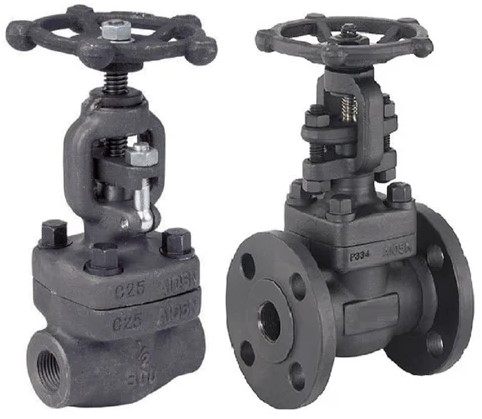
A forged steel globe valve consists of multiple precision parts, each serving an essential function:
- Valve Body and Bonnet: Typically forged from high-quality carbon steel (such as A105), alloy steel (such as F22), or stainless steel (such as F304/F316). After precision machining and heat treatment, these components exhibit high mechanical strength and corrosion resistance, suitable for pressure ratings from Class 150 LB to 2500 LB (approximately 1.0–42.0 MPa).
- Disc and Seat: These are the core sealing components. The sealing surfaces undergo special hardening treatment, usually with Stellite cobalt-based hardfacing, offering heat resistance up to 570°C and more than three times the wear resistance of standard materials. This treatment effectively prevents erosion caused by flowing media and significantly extends the valve’s service life.
- Stem: The stem is quenched, tempered, and surface-nitrided to greatly enhance anti-scuffing performance. It transmits the operating force and drives the disc up and down to open or close the valve.
- Sealing Elements: The middle cavity adopts a self-tightening sealing structure, while the stem packing box uses flexible graphite or PTFE materials combined with a backseat design to effectively prevent external leakage.
The working principle of a forged steel globe valve is simple and reliable. By rotating the handwheel or using an electric actuator, the stem moves vertically, causing the disc to separate from or contact the seat, thereby controlling the flow of media.
- Opening Process: The stem moves upward, lifting the disc away from the seat and allowing the media to flow. Notably, the opening height is generally only one-quarter of the seat passage diameter, meaning the disc requires only a short travel distance. This reduces operating time and mechanical wear.
- Closing Process: Under stem pressure, the disc forms a double seal with the seat (flat or conical sealing), ensuring zero leakage. Because the friction between the disc and sealing surface is lower than that of gate valves, forged steel globe valves demonstrate superior wear resistance under frequent operation.
- Self-Sealing Principle: The pressure self-sealing bonnet is a major feature. The higher the internal pressure, the tighter the seal ring fits between the valve body and bonnet, resulting in improved sealing performance. This characteristic makes the valve especially effective in high-pressure systems.
Depending on how the valve body and bonnet are connected, forged steel globe valves are mainly available in three structural forms, allowing users to select the most appropriate option for their operating conditions.
This design connects the body and bonnet with bolts and uses a spiral wound gasket for sealing. Its primary advantage is ease of maintenance—when servicing is required, the bonnet can be conveniently removed to inspect or replace internal components. This traditional structure is widely used in medium- and low-pressure applications.
The body and bonnet adopt a fully welded sealing structure, eliminating the risk of external leakage. Welded connections remove potential sealing hazards associated with bolted designs and are particularly suitable for applications requiring extremely high sealing integrity, such as pipelines carrying flammable, explosive, or toxic media. Although maintenance is less convenient, its exceptional sealing reliability makes it highly favored in critical applications.
This design connects the body and bonnet via threads and uses an internal pressure-activated seal ring. Its core advantage is that sealing performance improves as internal pressure increases. By utilizing media pressure to enhance the sealing effect, this structure is especially suitable for high-pressure conditions and effectively addresses sealing challenges caused by pressure fluctuations.
- Short Stroke and Reliable Shutoff: The stem travel for opening or closing is relatively short, enabling rapid response to operational commands and quick isolation or connection of media. Its shutoff capability is highly reliable, making it critical in emergency isolation scenarios.
- Excellent Wear Resistance: Because friction between the disc and sealing surface is lower than in gate valves, wear resistance is improved. Combined with hardened sealing surfaces, the valve maintains stable sealing performance even under frequent operation, significantly extending maintenance intervals and service life.
- Outstanding Sealing Performance: The tight fit between the seat and disc effectively prevents media leakage. The self-tightening structure enhances sealing under high pressure, while the dual sealing design (flat/conical) provides multiple layers of protection to ensure pipeline integrity and prevent environmental or equipment damage.
- Wide Temperature Range: Forged steel globe valves offer excellent temperature adaptability. Carbon steel versions operate from -29°C to 570°C, while stainless steel variants can extend from -196°C to 700°C, covering applications from cryogenic liquefied gases to high-temperature steam.
- Strong Corrosion Resistance: Special treatments such as nitriding and alloy hardfacing allow the valve body and sealing surfaces to withstand corrosive media like liquid ammonia, nitric acid, and urea. Forged steel materials inherently provide good corrosion resistance for long-term stable operation in harsh environments.
- Easy Maintenance: Typically featuring only one sealing surface on the body and disc, the simplified structural design facilitates maintenance. The disc and packing can often be replaced online, reducing downtime. With a straightforward structure and low failure rate, lifecycle maintenance costs are minimized.
- Petrochemical Industry: In petroleum refining and chemical production, forged steel globe valves are used in crude oil pipelines, high-temperature steam systems, and corrosive media control (such as hydrogen sulfide), ensuring safe operation of refining units. In synthetic ammonia and urea production, they effectively resist corrosion and erosion from high-pressure liquid ammonia.
- Power Industry: In thermal power plants, these valves control boiler feedwater and steam systems, withstanding temperatures up to 550°C and pressures above 16 MPa. In auxiliary pipelines of nuclear power plants, they ensure safe isolation of radioactive media, directly impacting nuclear safety.
- Metallurgy and District Heating: In the desilication workshop of alumina production, forged steel globe valves handle media prone to coking. In small-diameter pipelines (DN10–50) of urban heating networks, they enable precise flow regulation, helping maintain reliable residential heating.
- Other Industrial Fields: Forged steel globe valves are also suitable for water, steam, oil products, nitric acid, acetic acid, oxidizing media, and many other fluids, demonstrating broad application potential across industries.
Choosing the right forged steel globe valve requires evaluating multiple factors:
- Pressure and Temperature: Select a valve capable of handling the actual operating pressure and temperature to ensure reliability and safety.
- Media Characteristics: Choose appropriate forged steel materials based on fluid properties and working environments. Stainless steel or specially treated valves are recommended for corrosive media.
- Pipeline Parameters: Match the valve size and connection type to ensure tight and compatible integration with the pipeline system.
- Sealing Requirements: For applications demanding high sealing performance and precise flow control, select valves with superior sealing and flow characteristics.
- Operation Method: Choose suitable actuation methods, manual, electric, or pneumatic, to meet automation needs.
- Maintenance Convenience: Opt for models with simple structures and easy online maintenance to minimize downtime.
With the high strength provided by forging processes, excellent sealing performance, reliable shutoff capability, and broad applicability, forged steel globe valves have become indispensable components in modern industrial pipeline systems. From oil and gas to chemical and power industries, and from high-temperature, high-pressure environments to corrosive media, these valves consistently deliver outstanding performance.
As industrial technology continues to advance, forged steel globe valves are evolving through innovations in material science, sealing technology, and automation control, further expanding their application scope. For industrial users, gaining a thorough understanding of their structural characteristics, performance advantages, and selection criteria helps ensure informed decisions in engineering practice, ultimately supporting safe, stable, and efficient pipeline operation.
When selecting and using forged steel globe valves, users are advised to carefully evaluate specific operating conditions, choose appropriate structural designs and material configurations, and follow standardized installation and maintenance procedures to fully leverage the advantages of these high-performance valves and provide reliable support for industrial production.
