
Single-Seated vs. Double-Seated Control Valves
Control valves are essential devices in fluid systems used to regulate flow, pressure, and temperature. By controlling the medium inside pipelines, they ensure stable system operation. In industrial applications, single-seated control valves and double-seated control valves are the two most common types. These two valve types differ significantly in structural design, performance characteristics, and applicable operating conditions. Therefore, proper selection based on specific application requirements is critical. Incorrect selection may lead to system instability, reduced efficiency, or even equipment failure. This article provides a detailed explanation of structural principles, performance characteristics, application differences, and selection considerations to help readers understand the core differences between these two types of control valves.
The structure of control valves is generally similar to that of globe valves. They can typically be divided into single-seated control valves and double-seated control valves. As the names suggest, the main difference lies in the number of valve seating surfaces. A single-seated valve has only one seating surface inside the valve body, while a double-seated valve has two seating surfaces and two plug structures.
Different operating conditions, such as pressure fluctuations, temperature changes, and medium characteristics, can significantly affect valve performance. In addition, the two valve types also differ in maintenance cost and service life. Therefore, understanding their differences is very important in engineering design and system selection.
After understanding the basic concept of control valves, it is necessary to examine single-seated control valves in detail. As one of the most widely used types, their structure, working principle, advantages, and disadvantages form the foundation for selection decisions.
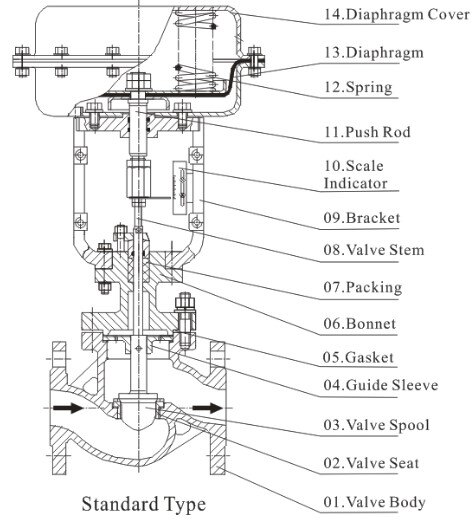
A single-seated control valve is a valve that contains only one seating surface and one valve plug. In this structure, the medium pressure acts on the bottom of the plug, generating an upward force that is transmitted to the valve stem. Single-seated valves usually adopt a top-guided structure, which provides good flow regulation performance.
Their structural forms are diverse, including straight-through globe type, angle type, and bar-stock type designs. Some configurations may also adopt reversible plug designs to accommodate different working conditions.
During operation, the actuator must provide sufficient driving force to counteract the thrust generated by the medium pressure, thereby enabling the valve to open or close. When the valve size is large or the medium pressure is high, this force increases significantly, requiring a larger actuator output.
Therefore, single-seated valves are generally not suitable for high-pressure or large-diameter applications. During selection and design, it is necessary to properly match the actuator capacity with the plug structure according to the system pressure conditions.
Single-seated control valves offer several technical advantages. First, they provide a wide control range and can meet broad flow regulation requirements. Second, they have low leakage and excellent sealing performance, making them suitable for applications requiring high sealing integrity.
Third, due to their single-seated structure, the overall design is relatively simple, resulting in easier maintenance and lower cost. Fourth, they offer good control accuracy and are suitable for medium-pressure and relatively stable operating conditions.
Despite their advantages, single-seated valves also have notable limitations. The unbalanced force acting on the plug due to medium pressure is relatively large, requiring a larger actuator to provide sufficient driving force.
Their pressure recovery capability is relatively low, and their applicable size range is limited. When the valve diameter is large or pressure is high, the unbalanced force increases further, placing higher demands on the actuator. Therefore, single-seated control valves are restricted in large-flow or high-pressure systems.
Compared with single-seated valves, double-seated control valves differ significantly in both structural design and performance characteristics. Understanding their structure, force balance principle, and advantages and disadvantages helps in comparison during selection.
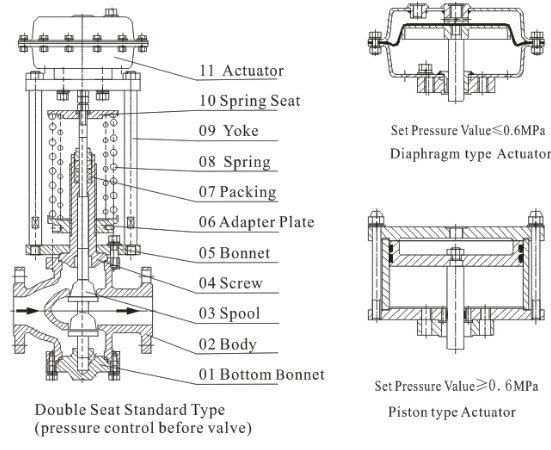
Double-seated control valves, also known as double-ported valves, typically adopt an upper-and-lower guided structure. Internally, they contain two valve plugs and two seating surfaces. In this structure, the medium pressure acts on both the upper and lower plugs, generating upward and downward forces respectively.
Double-seated valves have a higher flow capacity. Under the same nominal diameter, their flow capacity is usually 20% to 50% higher than that of single-seated valves.
The key feature of double-seated valves is force balance. Since the upper and lower plugs experience pressure in opposite directions, the forces can partially cancel each other out, resulting in a smaller unbalanced force on the valve.
This mechanical balance makes double-seated valves especially suitable for high-pressure and large-flow conditions. Because the force acting on the actuator is relatively balanced, they can operate stably under high differential pressure with reduced actuator load.
The primary advantages of double-seated valves lie in their ability to handle large flow rates and high pressure differentials. They are suitable for high-flow, high-pressure-drop conditions and require less actuator force, making them ideal for large-diameter industrial systems.
Under the same valve size, double-seated valves typically offer higher flow capacity than single-seated valves. Therefore, they are widely used in large-scale transportation and distribution systems such as chemical plants, heating systems, and parts of the power industry.
However, double-seated control valves also have drawbacks. Their sealing performance is relatively weaker. Due to the presence of two sealing surfaces, it is difficult to achieve tight shutoff comparable to single-seated valves, resulting in higher leakage rates.
They are not suitable for applications requiring extremely high sealing performance. In addition, the dual flow paths make them more susceptible to erosion or cavitation, which may lead to long-term wear of internal components.
Double-seated valves are also unsuitable for fibrous or high-viscosity media. Their structure is more complex, requiring higher manufacturing and assembly precision, which increases cost.
After understanding both types individually, a systematic comparison helps clarify their application boundaries.
Single-seated valves have one plug and one seating surface, while double-seated valves have two plugs and two seating surfaces. Single-seated valves typically use a top-guided structure, whereas double-seated valves use an upper-and-lower guided structure. The single-seated design is simpler and easier to manufacture and maintain, while the double-seated structure provides more balanced force distribution.
Single-seated valves offer better sealing performance and can achieve very low leakage or near-zero shutoff. Double-seated valves, due to two sealing pairs, have higher leakage rates and cannot achieve tight shutoff. Therefore, single-seated valves are preferred for applications requiring strict sealing.
Single-seated valves are suitable for lower differential pressures. Under high pressure, the unbalanced force increases significantly, which may cause seat wear or reduced sealing performance. Double-seated valves, due to their force-balanced design, can withstand higher differential pressures more effectively.
Single-seated valves have limited flow capacity due to a narrower flow path. Double-seated valves provide significantly higher flow capacity. Under the same size, their flow rate can be 20% to 50% higher, making them suitable for large-flow applications such as power plants and water distribution systems.
Single-seated valves are better suited for applications requiring high sealing performance and relatively stable pressure conditions. Double-seated valves are better suited for high-flow and high-pressure-drop environments but are not suitable for fibrous, high-viscosity, or high-leakage-sensitive systems.
Single-seated valves have a simpler structure, fewer components, and lower manufacturing cost. They are also easier to maintain and repair. Double-seated valves are more complex, more expensive, and require more careful maintenance due to their dual sealing structures.
Applications of Single-Seated Control Valves: Single-seated control valves are widely used in industries such as oil and gas, power generation, and chemical processing where precise control and wide adjustment range are required. They are suitable for clean media systems with strict leakage requirements. They are commonly used in HVAC systems, water treatment, small-to-medium chemical plants, laboratories, and pharmaceutical or food processing industries, where precise flow control and tight sealing are essential.
Applications of Double-Seated Control Valves: Double-seated control valves are widely used in industrial processes requiring high flow capacity and large pressure differentials. They are commonly applied in oil and gas, petrochemical industries, and large-scale industrial facilities. They are especially suitable for power stations, large chemical plants, and large water treatment systems. Their ability to handle high flow and high pressure makes them ideal for large-scale transmission and distribution systems.
A systematic approach is necessary when selecting between single-seated and double-seated control valves. The decision should consider operating conditions, medium characteristics, actuator requirements, and cost factors.
If the system has low differential pressure, moderate flow requirements, and strict sealing requirements, a single-seated valve is preferred. If the system involves high flow and high differential pressure with less strict leakage requirements, a double-seated valve is more suitable.
Medium properties significantly affect valve selection. Single-seated valves perform well with clean and low-viscosity fluids. Double-seated valves are not suitable for fibrous or high-viscosity media.
In abrasive or corrosive environments, double-seated valves may suffer erosion or cavitation damage, requiring careful evaluation before use.
Single-seated valves require larger actuator force due to unbalanced forces. Proper matching between actuator and valve design is essential. Double-seated valves require less actuator force due to their balanced structure, reducing system power requirements.
Selection must also consider both initial investment and long-term operating costs. Single-seated valves are more economical and suitable for simpler systems. Double-seated valves have higher initial costs but may offer better performance in high-flow, high-pressure systems, reducing long-term operational issues.
Single-seated and double-seated control valves are the two most commonly used types in industrial fluid control systems. Single-seated valves offer simple structure, excellent sealing performance, and low leakage, making them suitable for medium-pressure applications requiring high tightness.
Double-seated valves provide higher flow capacity, better pressure balance, and suitability for high differential pressure conditions, making them ideal for large industrial systems. However, they have weaker sealing performance and higher leakage rates.
In practical engineering applications, selection must be based on pressure level, flow demand, medium characteristics, and sealing requirements. Proper selection ensures stable operation, improved efficiency, reduced maintenance costs, and extended equipment lifespan. Understanding the fundamental differences between single-seated and double-seated control valves is a crucial part of industrial valve engineering.
