
Common Faults and Maintenance Guide for Control Valves
Control valves are the core actuating components in industrial process control systems and are often described as the hands and feet of industrial automation systems. By receiving control signals and using power-driven mechanisms, they regulate key process parameters such as flow rate, pressure, temperature, and liquid level in pipelines. In continuous production industries such as petrochemicals, power generation, metallurgy, and pharmaceuticals, the stable operation of control valves is directly related to product quality, production safety, and economic efficiency. Once a control valve fails, it may cause process parameter fluctuations that affect product quality in mild cases, and lead to plant shutdowns or even safety accidents in severe cases.
However, control valves often operate under harsh conditions involving high pressure, high temperature, and corrosive media. Combined with impurities in the process fluid, mechanical wear, and aging of internal components, control valves have become one of the equipment types with relatively high failure rates in automation systems. This article systematically summarizes the most common failure modes of control valves in practical operation, including sticking and blockage, internal leakage, packing leakage, valve seat leakage, oscillation, and failures of positioners and air supply systems, and provides targeted diagnostic approaches and maintenance methods to help instrument maintenance personnel quickly locate problems and restore production.
As the core actuating component of industrial automation systems, the stable operation of control valves directly determines the safety and efficiency of the entire process. Due to complex working conditions and diverse media types, various faults inevitably occur during long-term operation. Among them, sticking and blockage are the most common and troublesome problems encountered in field maintenance, especially during the initial startup stage of new installations or after major overhauls.
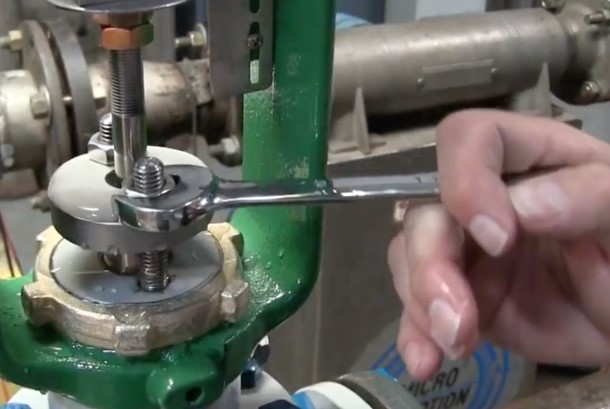
Sticking is one of the most common control valve faults, particularly during the initial operation of newly built installations or during restart after maintenance shutdowns. When an operator issues a control signal, the valve may exhibit typical symptoms of “no response at small signals but excessive movement at large signals”. In other words, the valve stem remains motionless under small control signals but suddenly moves significantly when the signal increases beyond a certain threshold, leading to loss of control accuracy.
The fundamental cause of sticking is blockage of moving components by solid impurities inside the pipeline. These impurities mainly include:
- Welding residues: Welding slag and spatter left during pipeline construction if not cleaned properly
- Corrosion products: Rust and oxide scales detached from the inner wall of the pipeline
- Mechanical debris: Metal fragments, gasket pieces, bolts, or nuts left during installation or maintenance
These solid particles tend to accumulate at the throttling zone (the narrow passage between the valve plug and seat) and guiding parts (the guide sleeve or track that directs stem movement), causing a sharp increase in stem movement resistance. In addition, if the gland packing is tightened excessively during maintenance, the friction between the stem and packing will also increase significantly, producing symptoms similar to sticking.
When sticking occurs on site, the following measures can be taken from simple to more complex depending on the situation.
- Medium flushing: Quickly open the bypass valve or repeatedly operate the control valve to use the flow impact force of the process medium to flush away blocking impurities. This method is suitable for cases where blockage is not severe and the plug has not been completely jammed. During operation, observe valve position changes; once the plug begins responding to signals, flushing is considered effective.
- External loosening assistance: While maintaining control signal pressure, gently clamp the valve stem with a pipe wrench and rotate it slightly in both forward and reverse directions to allow the plug to move slightly away from the sticking position. Care must be taken to avoid damaging the stem surface.
- Increasing driving force: If the above methods are ineffective, the air supply pressure (for pneumatic control valves) may be appropriately increased to enhance actuator output force and repeatedly move the plug up and down. In most cases, this method can resolve the problem.
- Disassembly and cleaning: If the valve still fails to move after the above treatments, the valve must be removed from the pipeline for complete disassembly and inspection. Thoroughly remove welding slag, rust, and other impurities from the throttling zone and guiding parts, and check whether the plug, stem, and guide sleeve are scratched or deformed. Damaged components should be repaired or replaced if necessary.
After solving the sticking problem and ensuring normal valve movement, maintenance personnel must also pay attention to sealing performance. If sticking affects valve actuation, internal leakage directly tests the valve’s shutoff capability.
Internal leakage refers to the situation where process media continue to leak downstream through the sealing interface between the valve plug and seat even when the valve is in the fully closed position. Besides damage to the sealing surface itself, improper stem length is also an important but often overlooked cause of internal leakage.
For air-to-open valves, excessive stem length is a common problem. Such valves rely on spring force to close when the air signal is lost. If the stem is too long, when the actuator pushes the stem to its mechanical limit, the plug may fail to fully contact the seat, leaving a tiny gap that causes incomplete sealing and internal leakage.
For air-to-close valves, insufficient stem length is the opposite problem. These valves open automatically when the instrument air supply is lost. If the stem is too short, the plug cannot fully contact the seat during the closing stroke due to insufficient travel, resulting in leakage.
The treatment method for this type of internal leakage is relatively straightforward: adjust the stem length to eliminate the gap.
For air-to-open valves with excessive stem length, shorten the stem appropriately
For air-to-close valves with insufficient stem length, extend the stem appropriately
After adjustment, a sealing test should be performed to ensure no visible leakage occurs in the fully closed state. It is important that stem length adjustment be performed only when the valve is disassembled, and the adjustment amount must be accurately calculated to avoid creating new problems.
Solving internal leakage addresses the shutoff sealing performance of the valve, but another component remains under continuous dynamic sealing stress during operation — the packing assembly. If the seal between the plug and seat is considered “static” (functioning mainly in the closed position), the seal between the stem and packing is “dynamic”. The stem moves reciprocally inside the packing during every control action, and this continuous friction and wear makes the packing gland one of the most vulnerable leakage points.
The packing gland is a critical dynamic sealing component and also one of the most common leakage locations in field operations. After packing is installed in the gland cavity, axial pressure is applied through the gland bolt. The plastic deformation of the packing generates radial sealing force, theoretically allowing tight contact with the stem. In practice, however, the contact pressure is often uneven — some areas may be overcompressed while others remain loose or even uncontacted.
During valve operation, the stem moves up and down continuously with control actions, generating ongoing friction with the packing. In addition, process media often involve high temperature, high pressure, or highly permeable characteristics, making the packing gland a high-risk leakage zone.
Packing leakage mainly falls into two categories:
Interface leakage occurs at the contact interfaces between packing and stem or between packing and the gland wall. The main causes include time-dependent reduction of packing contact pressure, aging and loss of elasticity, and stem surface wear, which allow process media to leak outward along microscopic gaps.
Permeation leakage may occur in braided packing materials such as graphite or PTFE packing, where the medium migrates through microscopic fiber gaps.
- Packing leakage can be improved from three aspects: structural design, material selection, and installation maintenance.
- Structural optimization: A chamfer should be machined at the top of the packing chamber to facilitate packing insertion and prevent edge cutting damage. A metal anti-extrusion ring should be installed at the bottom of the packing gland. The contact surface between this ring and the packing must be flat rather than inclined, and the clearance must be kept small to prevent high-pressure media from forcing packing material out from the bottom.
- Surface treatment: All metal surfaces in contact with packing, including the gland and packing chamber wall, should be finely machined (typically requiring surface roughness Ra 1.6 or better) to improve surface smoothness, reduce packing wear, and extend service life.
- Material upgrade: Flexible graphite packing is preferred. Compared with traditional braided packing, flexible graphite offers superior gas tightness, self-lubricating performance, and low friction. Its performance remains relatively stable after long-term use, with a wide temperature and pressure resistance range. Even if slight thermal damage occurs, retightening the gland bolts will not significantly increase friction. It also has good chemical stability and does not cause electrochemical corrosion with stem or gland metals.
Through these measures, sealing reliability and service life can be significantly improved while reducing field maintenance workload.
Packing leakage mainly concerns dynamic sealing of the stem section, while the core sealing function of the valve, the shutoff sealing between plug and seat, faces more severe challenges. If packing leakage represents gradual “dripping and seepage” loss, plug-seat leakage is a fundamental functional failure of the valve. This type of leakage is not simply mechanical loosening but rather the result of long-term interaction between corrosion and wear mechanisms.
The sealing interface between plug and seat is the core of control valve shutoff performance. Leakage in this area is usually caused by a combination of manufacturing defects and process medium erosion.
Manufacturing defects such as pits, sand holes, and pores formed during casting or forging can become corrosion initiation points. Under corrosive media, localized corrosion develops and gradually expands into grooves or cavities.
Erosion and corrosion caused by high-speed media flow through the throttling zone can lead to two destructive effects:
Erosion occurs when high-speed fluid carries solid particles that mechanically scour metal surfaces.
Cavitation occurs when pressure at the throttling zone drops below the saturated vapor pressure of the liquid medium, causing bubble formation. When bubbles collapse in high-pressure regions, microjets and shock waves are generated, repeatedly causing fatigue spalling of metal surfaces.
These mechanisms gradually deform the plug and seat surfaces, making them oval or irregular and destroying precise matching between sealing surfaces, eventually leading to leakage.
Strict selection of valve type and material is essential. Corrosion-resistant materials such as stainless steel, hard alloy, or Stellite alloy should be selected according to medium characteristics. During procurement, products with visible defects such as pits or sand holes should be rejected.
For plugs and seats with minor deformation, manual lapping using fine sandpaper or specialized grinding tools can remove surface scratches and corrosion pits, improving surface smoothness and restoring sealing performance.
If damage is severe (such as large-scale peeling of sealing surfaces or deep corrosion pits), the plug-seat assembly should be replaced. For expensive valves, surface hardening treatments such as Stellite overlay welding or plasma spraying may be adopted to enhance wear and corrosion resistance.
Solving plug-seat leakage addresses valve sealing performance, but another hidden failure may occur even when the valve moves normally and seals well — oscillation. High-frequency reciprocating movement of the plug around a certain position may appear to be normal regulation but actually indicates loss of stability. This dangerous signal not only deteriorates control quality but also accelerates mechanical wear and may trigger pipeline resonance, making it a hidden threat to system safety.
Control valve oscillation is characterized by high-frequency reciprocating movement of the plug around a certain position, leading to poor regulation quality, accelerated component wear, and sometimes noise and pipeline vibration.
Major causes include:
- Insufficient stiffness: Low actuator spring stiffness makes the system prone to self-excited vibration under fluctuating medium pressure or fluid forces.
- Frequency resonance: The natural frequency of the control valve is close to that of the pipeline or equipment system, causing mechanical resonance.
- External transmission: Severe vibration from pipelines or mounting structures is transmitted to the valve body.
- Improper sizing: If the valve flow coefficient (Cv value) is too large, the valve may operate for long periods under very small opening conditions (e.g., below 10%). In this case, drastic changes in flow resistance and velocity may cause fluid forces to exceed plug stability thresholds and trigger oscillation.
Different measures should be adopted based on specific causes.
Increase stiffness: Replace the spring with one of higher stiffness or switch to a piston-type actuator, which provides better rigidity compared to diaphragm-type actuators.
Eliminate resonance: Improve pipeline support structures and add pipe brackets to reduce vibration transmission. If the valve operating frequency matches the system frequency, replace the valve with a different structure (such as switching from a single-seat straight-through valve to a double-seat straight-through valve) or select a different valve specification.
Resolve small-opening oscillation:
Re-select a valve with smaller flow capacity (Cv value)
Adopt split-range control to divide one control signal to drive two valves, expanding the adjustable range
Use a master–slave valve configuration where a small valve handles low flow while both large and small valves operate together under high flow conditions
As the brain connecting the controller and the valve, the positioner converts electrical signals into pneumatic pressure signals to precisely drive valve positioning. However, traditional mechanical positioners often become a source of failures due to inherent structural limitations. With technological advancement, smart positioners have emerged, achieving a transition from mechanical force balance control to electronic control. Nevertheless, technological upgrades do not eliminate all problems, and both generations of positioners have their own failure characteristics and applicable limits.
Conventional positioners operate based on mechanical force balance principles (nozzle–flapper technology) and have several weaknesses:
- Many moving components: Levers, springs, flappers, and nozzles are sensitive to temperature changes and mechanical vibration, which can cause zero drift and valve fluctuation.
- Nozzle blockage: The nozzle aperture is usually only 0.2–0.3 mm and is highly susceptible to clogging by dust or oil contaminants in the air supply, leading to positioner malfunction.
- Nonlinear errors: Field harsh environments such as temperature variations and corrosion can change spring elastic coefficients, disrupting force balance relationships and degrading control characteristics.
Smart positioners use microprocessors (CPU), A/D and D/A converters, and other electronic components. Their working principle is completely different from traditional positioners. The setpoint and actual valve position are compared through pure electronic signal processing, eliminating dependence on mechanical force balance and overcoming many defects of traditional positioners.
However, smart positioners also require attention in certain applications:
Emergency shutdown valves such as emergency isolation valves and emergency vent valves are required to remain in a fixed position for long periods. Long-term static operation may cause zero drift in electronic converters, resulting in dangerous symptoms such as non-response to small signals.
Position sensing potentiometers are installed in field environments and are susceptible to temperature, humidity, and vibration, which may cause extreme phenomena such as no response to small signals or full opening under large signals.
Therefore, for critical safety valves, even when smart positioners are used, a strict and frequent testing schedule must be established to ensure reliable operation during emergency situations.
Control valve fault diagnosis is a technical task that requires both theoretical knowledge and practical experience. When handling faults, maintenance personnel should follow the principle of “from outside to inside and from simple to complex”, first checking external conditions such as air and power supply, then examining intermediate components such as positioners and converters, and finally considering disassembly of the valve body.
At the same time, it is necessary to establish a comprehensive preventive maintenance system. Regular maintenance of packing, air filters, and positioners, along with stroke testing and full-stroke switching tests for critical valves, can minimize failure occurrence and ensure long-term stable operation of process units.
By mastering the failure characteristics and treatment methods introduced in this article, instrument maintenance personnel can respond quickly and accurately when control valve problems occur, ensuring safe and reliable industrial production.
