
Electric Ball Valve Faults and Maintenance
Electric ball valves are critical actuators in industrial automation control systems, widely used in industries such as petrochemicals, power generation, metallurgy, and water treatment. They operate by driving a ball to rotate 90° via an electric actuator, enabling the opening and closing of pipelines. Electric ball valves are known for their compact structure, ease of operation, and excellent sealing performance. However, during long-term operation, various faults inevitably occur, affecting production efficiency and system safety. This article systematically summarizes the common fault types, diagnostic methods, and maintenance techniques for electric ball valves from a practical application perspective, assisting technicians in quickly locating issues and restoring normal operation.
Before discussing faults, it is essential to understand how electric ball valves operate. When a DCS (Distributed Control System) sends a 4–20 mA DC positioning signal to the actuator according to control requirements, the actuator’s internal circuit board compares the given signal with the feedback signal and outputs a deviation signal. After amplification, this deviation signal determines whether the motor rotates forward or backward and drives the corresponding solid-state relay, which then powers the motor to rotate in the correct direction.
The motor’s output shaft drives the valve opening through a reduction gearbox and a rocker or connecting rod. The reduction gearbox has two critical mechanical outputs: one at the input, which triggers over-torque protection if the load torque is excessive, and one at the bottom of the control box, which drives limit switches and a position potentiometer to output the mechanical position signal. Limit switches send interrupt commands upon reaching the upper or lower travel limits, while the position potentiometer provides a continuous resistance signal that the circuit board converts into a 4–20 mA position feedback signal for the DCS.
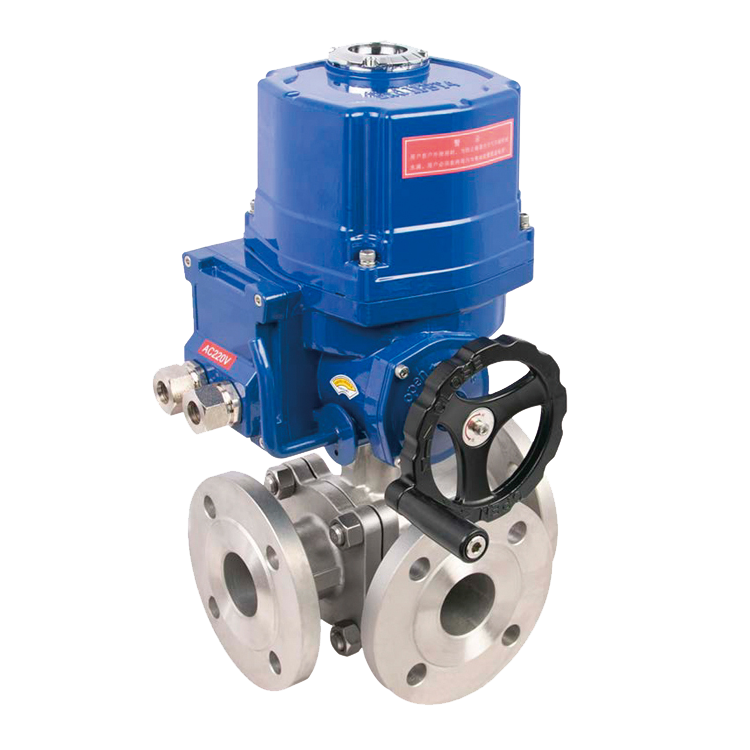
The motor is the core power source of the electric ball valve actuator, and its condition directly determines whether the valve can open or close normally. In practice, motor faults account for more than 40% of total electric ball valve failures, commonly manifesting as overheating, failure to rotate, or abnormal noise. Accurate identification and timely handling of motor faults are key to ensuring reliable operation.
Motor overheating is one of the most common electric ball valve faults. Abnormal noise or excessive heat typically indicates:
Causes:
Poor motor cooling; fan or heat sink malfunction
Excessive mechanical resistance due to valve jamming, increasing motor load
Prolonged continuous operation exceeding rated duty
Internal motor faults, such as bearing damage or winding short circuits
Solutions:
Check the motor cooling system, clean dust or debris from the heat sinks, and inspect the mechanical transmission for any jamming. If the motor temperature exceeds 100–120°C, the thermal switch will cut off power—allow the motor to cool before further inspection. Damaged motors should be replaced or repaired promptly.
When the electric ball valve fails to operate and no motor sound is heard:
Power Check: Measure the supply voltage with a multimeter (e.g., for 220V devices, ensure 198–242V) and check all power and control connections for looseness or oxidation.
Motor Check: If the capacitor is intact, disconnect the motor terminals and apply supply voltage directly. If the motor still does not rotate, the winding may be burned or open. The insulation resistance should exceed 0.5 MΩ; lower values require motor replacement.
Transmission Mechanism Check: If the motor rotates but the valve does not move, the gears, worm drive, or other components may be damaged or jammed. Open the actuator housing for inspection and replace damaged parts.
The control system is the “nerve center” connecting the DCS to the actuator, responsible for signal reception, comparison, amplification, and output. Even if the motor and mechanical parts are intact, control system faults can prevent normal valve response. Common symptoms include signal loss, feedback anomalies, or protection misoperations. Diagnosis typically involves indicator lights and measurement tools.
If the actuator is stuck at zero position but functions normally in manual mode, input signal loss is likely.
Troubleshooting Steps:
Inspect the 4–20 mA input signal wiring for disconnection or poor contact.
If feedback suddenly drops to zero, check motor temperature. Overheating may indicate thermal switch action, requiring power cut-off and cooling.
If the motor is normal but the circuit board is unpowered, measure AC voltage across the thermal switch terminals. Absence of 220V indicates a damaged thermal switch that needs replacement.
Circuit board issues manifest as complete power loss or malfunction. If the ON/OFF indicator lights correctly, the solid-state relay may be damaged and should be replaced. Persistent single indicator illumination suggests board malfunction or a loose connection between the potentiometer shaft and the rocker, requiring board replacement or reconnection.
An over-torque indicator light signals that protection has activated. Check the load torque: if the valve is indeed jammed, clean it. Otherwise, check the micro switch, mechanical connections, and adjust the over-torque action point if necessary.
If the motor and control system are functional but the valve fails to operate or seal, the problem is usually mechanical. Mechanical faults are often apparent and can be preliminarily assessed by manual operation and visual inspection. They are commonly caused by impurities, wear, or lubrication failure.
Jamming is often due to blockages in the closed area. Foreign matter in the medium can prevent the ball or stem from rotating.
Solution: Disassemble the valve, remove debris, and inspect the ball and stem. Replace worn or damaged components. For long-unused valves, rust removal and repeated manual/electric operation may restore function.
Leakage may be external (stem or flange) or internal (ball-to-seat).
External: Stem leaks often result from worn packing—tighten the gland or replace packing. Flange leaks may require retightening bolts to the correct torque and replacing gaskets suited to the medium and temperature.
Internal: Ensure the actuator fully closes the ball. If leakage persists, minor wear can be repaired by grinding; severe damage requires ball or seat replacement.
Excessive actuator vibration can loosen components and cause electrical shorts.
Solution: Improve actuator mounting, add vibration damping, secure loose parts, and inspect for electrical grounding issues.
Water Damage: Water may short the circuit board or enter the motor via the gearbox, causing failure. Replace damaged parts, remove water, and properly seal the actuator.
Solid-State Relay Damage: Rare, but can cause short circuits. Replace the relay and verify the drive circuit.
After fault elimination or part replacement, recalibration ensures control accuracy. This involves electrical parameter calibration and mechanical position setting. Proper adjustment prevents incomplete opening/closing, feedback deviation, or actuator oscillation.
If the actuator cannot fully open/close:
Set a defined input (e.g., 8 mA), connect a multimeter to the feedback terminal, and gently move the handle forward and backward.
Record the maximum and minimum feedback currents to calculate the deadband and balance deviation.
Adjust the deadband potentiometer to meet the required width and the balance potentiometer for symmetric distribution.
The balance potentiometer aligns input and feedback accuracy.
The deadband potentiometer adjusts sensitivity.
Excessive deadband reduces control precision; too small causes oscillation. Modern actuators often feature automatic deadband calibration.
Transmission gaps in gears or linkages can delay feedback. Some actuators use spring-loaded cams to minimize gap effects. Inspect and adjust these springs during maintenance.
Preventive Maintenance Recommendations
Regular Inspection: Maintain operational logs and routinely check seals, balls, seats, motors, and transmission components.
Lubrication: Regularly lubricate moving parts with appropriate greases for high temperature or food-grade applications.
Medium Management: Keep the medium clean, install upstream filters, and apply heating/insulation for solids-prone fluids.
Environmental Protection: Seal actuators, add vibration damping, and enhance cooling in high-temperature environments.
Always cut power and release pipeline pressure before maintenance. Wear protective equipment according to medium hazards. For complex faults or high-pressure/nuclear applications, contact specialized technicians to avoid safety incidents.
Fault diagnosis and maintenance of electric ball valves require systematic knowledge and practical experience. By mastering the fault types, diagnostic methods, and handling techniques discussed, technicians can efficiently resolve field issues, minimize downtime, and ensure safe production. Preventive maintenance and regular inspections further reduce failures, extend valve lifespan, and maximize economic benefits for enterprises.
