
Solutions for High-Temperature Valve Flange Leakage
High-temperature valve flange leakage is a common fault in industrial equipment operation, particularly frequent in air heating systems, petrochemical, and power generation industries. Simply put, it refers to the flange connecting the pipeline and valve, where under high temperature and high pressure, the sealing gasket cannot fully prevent the medium from escaping, resulting in gas or liquid leaking from the connection. Although such leakage may seem minor, it poses a significant hidden hazard.
For example, in an air heating system of a certain test facility, the system uses a centrifugal compressor unit, with outlet air heated through a tubular heating furnace before being supplied to end-use equipment via high-temperature valves. The medium is compressed air, reaching a maximum temperature of 500℃ and a maximum pressure of 2.5 MPa. Once leakage occurs at the flange connection, high-temperature, high-pressure gas will spray out, not only causing potential casualties but also leading to severe property damage. Therefore, thoroughly solving the problem of high-temperature valve flange leakage has important safety significance and economic value.
In actual operation, high-temperature valve flange leakage usually presents the following characteristics:
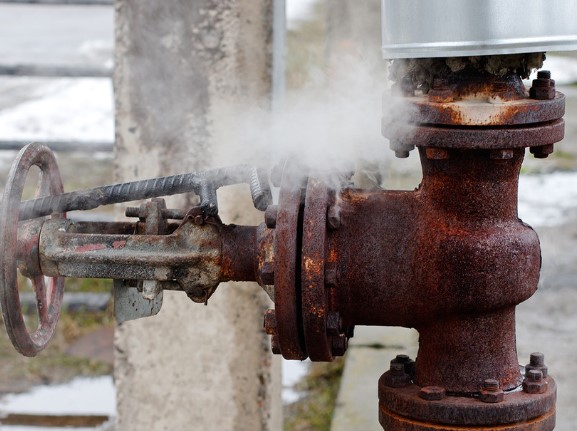
Heating systems usually operate intermittently, with each cycle lasting approximately 8 hours, including heating, constant temperature, and cooling stages. During use, leakage mainly manifests as medium escape caused by gasket damage. Even after removing the insulation layer, replacing the gasket, and tightening the bolts, the leakage situation is temporarily controlled, but after several uses, leakage occurs again, and the problem cannot be fundamentally solved.
Through on-site inspection and modeling analysis, it was found that leakage points are often concentrated at specific positions of the gasket, especially the upper region of the gasket. This is closely related to the deformation characteristics of the flange under high temperatures.
To understand the causes of leakage, it is first necessary to understand how flange sealing works.
A flange connection system consists of three core components: bolts, flanges, and gaskets. These three components work together to achieve effective sealing. Among them, the gasket is the core component for achieving the seal.
The basic principle of sealing is: through the preload of the bolts, sufficient pressure is generated between the gasket and the flange sealing surface. The gasket then deforms accordingly, filling the microscopic unevenness of the flange sealing surface, thereby preventing medium leakage.
This process may seem simple, but in high-temperature, high-pressure environments, all three components undergo complex changes, and any failure in one part can result in seal failure.
After understanding the basic principle of flange sealing, let us examine the factors that cause seal failure in actual operation. Through analysis of leakage cases and modeling calculations, high-temperature valve flange leakage is mainly caused by the following five reasons:
Under large preload stress, gaskets experience creep and stress relaxation. Creep refers to the slow deformation of a material under long-term stress; stress relaxation refers to the gradual decrease of internal stress in the material under fixed deformation conditions.
The likelihood of these phenomena occurring increases significantly with rising temperature. During heating, these changes occur gradually. Currently, commonly used metal-graphite gaskets for high-temperature valves have poor stiffness and relatively weak resistance to bolt overload. Under high-temperature and high-pressure conditions, their rebound capacity and actual sealing performance decrease significantly, which is one of the main factors affecting flange sealing.
Structurally, during heating, the flange ring experiences a temperature difference from inner to outer regions. Heat transfers from the inner wall to the outer wall, with temperature changes at the outer wall lagging behind the inner wall. At the initial heating stage, the flange nozzle heats and expands faster than the flange ring, resulting in significant differences in thermal expansion. Further expansion of the nozzle is constrained by the flange ring, causing the flange to deform outward significantly.
This deformation further compresses the inner side of the gasket, increasing gasket stress. If the deformation is excessive, the gasket undergoes plastic deformation, reducing its rebound capability. With new technologies, modern heating furnaces can achieve a temperature rise rate of 350℃/h. Such rapid heating compresses the gasket excessively in a short time, causing loss of partial rebound capacity while inducing significant flange deformation, reducing overall sealing performance.
Instantaneous rapid cooling can also cause problems. The flange undergoes significant deformation in a short time, generating large transient thermal stress, leading to leakage. Rapid temperature changes increase temperature differences among the pipeline, flange, gasket, and bolts, and their stress-strain cannot coordinate in a short period, resulting in reduced flange sealing performance or even failure.
The purpose of bolt preload is to compress the flange onto the gasket, causing gasket deformation and achieving a seal. Preload needs to be controlled within a reasonable range: too low cannot form an effective seal, too high will over-deform the gasket and reduce rebound capacity.
In practice, if bolt preload across the flange surface is uneven, the preload stress on the gasket will be uneven. Areas with the least stress become the weakest points of the seal, while points with excessive stress may exceed the gasket’s crush strength, causing gasket damage. These become potential leakage points during operation.
During actual bolt tightening, due to site space limitations and operator skill differences, the correct bolt tightening sequence (e.g., cross-pattern or equidistant symmetry) is often not followed. Most bolts are tightened sequentially, resulting in inconsistent bolt preload. This is one of the main causes of repeated flange leakage.
Modeling and analysis of typical valves that frequently leak in the system allow for a clearer understanding of the problem.
Valve operating temperature: 410℃
Flange outer wall temperature: 120℃
Valve installed on horizontal piping, with one end fixed and the other end compensated via an elbow
Ambient temperature: 22℃
Gasket strain distribution: Maximum strain occurs at the upper part of the gasket, fully matching the actual leakage location.
Gasket stress distribution: Stress fluctuates due to bolt arrangement, but the overall trend is clear; maximum stress occurs at the upper and lower parts of the gasket.
Bolt stress distribution: Maximum stress occurs at bolts connecting the top flange of the valve, with noticeable flange opening on both sides.
These analysis results highly correspond with on-site flange leakage, verifying the correctness of the above cause analysis.
Based on the above problems, improvement measures can be implemented in four areas: gasket material, bolt material, tightening process, and operational control.
Metal-graphite gaskets struggle to maintain sealing performance under repeated high-temperature and high-pressure use. It is recommended to replace them with wavy-type composite gaskets.
Wavy-type composite gaskets are suitable for applications requiring high gasket rebound, with the following advantages:
Excellent thermal conductivity, suitable for high-temperature, high-pressure, and corrosive environments
Metal skeleton provides good resilience
Parabolic grooves are machined on the upper and lower surfaces of the metal skeleton in a staggered pattern
Flexible expanded graphite of certain thickness is molded into the grooves
Linear sealing: under bolt preload, the graphite fills the space between flange surface and groove, forming multiple expanded graphite sealing rings
Effectively seals air and other media, ensuring system sealing performance
According to industry data, wavy composite gaskets are widely used, suitable for low and high temperatures (-200℃~+700℃), as well as low and high pressures (vacuum~25 MPa), making them an ideal alternative to traditional metal-wound or metal-jacketed gaskets.
During inspection, stainless steel bolts were found to exhibit tensile bending deformation. It is recommended to replace flange fasteners (including bolts, nuts, flat washers, and spring washers) with 35CrMo high-strength alloy steel.
35CrMo is a commonly used high-strength alloy structural steel with good strength and toughness, suitable for high-temperature and high-pressure environments. By selecting higher-strength bolt materials, greater preload can be applied, ensuring flange sealing performance.
Use specialized hydraulic wrenches: tighten bolts symmetrically with two hydraulic wrenches to ensure uniform preload
Cross-pattern tightening sequence: strictly follow the cross-pattern sequence to avoid uneven preload caused by sequential tightening
Control preload torque: apply recommended torque to ensure all bolts have consistent preload
Control flange parallelism: maintain flange non-parallelism within ±0.2 mm
Handling old bolts: for bolts disassembled more than three times, increase preload by 5%-10% based on recommended torque
Regular inspections: periodically check bolts and replace worn components in time
Excessive heating and cooling rates are important factors causing reduced flange sealing performance. It is recommended to reduce the system heating rate from 350℃/h to 150℃/h and similarly reduce the cooling rate. This minimizes temperature differences among the pipeline, flange, gasket, and bolts, allowing coordinated stress-strain changes to maintain good sealing performance.
After the above comprehensive modifications in the air heating system of a test facility, significant results were achieved:
In dozens of test runs over the past six months, no high-temperature valve leakage occurred
Bolt inspections showed no loosening, and flange parallelism remained within controlled limits
This demonstrates that the adopted measures effectively solved the high-temperature valve flange leakage problem, ensuring safe system operation. This solution has practical value for addressing similar high-temperature flange leakage issues domestically.
High-temperature valve flange leakage is a systematic problem involving gasket materials, bolt performance, tightening procedures, and operational control. Solving this problem requires comprehensive consideration rather than addressing symptoms individually.
Core recommendations:
- Material upgrades: Replace metal-graphite gaskets with wavy-type composite gaskets, and replace stainless steel bolts with 35CrMo high-strength bolts
- Process standardization: Use hydraulic wrenches, cross-pattern tightening, control preload torque, and ensure flange parallelism
- Operational control: Reduce heating and cooling rates to allow sufficient temperature equilibrium time
- Regular maintenance: Establish bolt inspection and replacement procedures; increase preload or replace frequently used bolts in time
Through the comprehensive application of these measures, high-temperature valve flange leakage can be effectively resolved, ensuring safe and stable operation of industrial equipment.
