
High-Pressure Globe Valve: Design, Operation & Applications
High-pressure globe valves are specialized types of valves engineered to control high-pressure fluid media within industrial systems. Their primary function is to enable the opening, closing, and precise regulation of fluid flow in pipelines. Compared to standard low-pressure valves, high-pressure globe valves exhibit significant differences in structural strength, sealing performance, and material selection. They are designed to safely handle pressures exceeding 1,500 psi (approximately 10.3 MPa), with some industrial-grade forged steel models capable of withstanding extreme pressures above 10,000 psi (around 69 MPa).
High-pressure globe valves are classified as force-sealed valves, meaning that closing the valve requires applying a certain force to the disc (or plug) to ensure that the sealing surfaces of the disc and seat are tightly engaged, preventing leakage of the medium. This force-sealing characteristic provides exceptional sealing reliability under high-pressure conditions, making these valves indispensable in critical industrial applications.
The core components of a high-pressure globe valve include the valve body, bonnet, stem, disc, and seat.
- Valve body: The main structural component, bearing the pressure from the pipeline system.
- Bonnet: Connects to the valve body to form a complete pressure boundary and houses the stem and packing assembly.
- Stem: Links the actuator or handwheel to the valve disc, transmitting motion for opening or closing.
- Disc: The movable element that obstructs or allows fluid flow.
- Seat: The fixed surface that mates with the disc to create a tight seal.
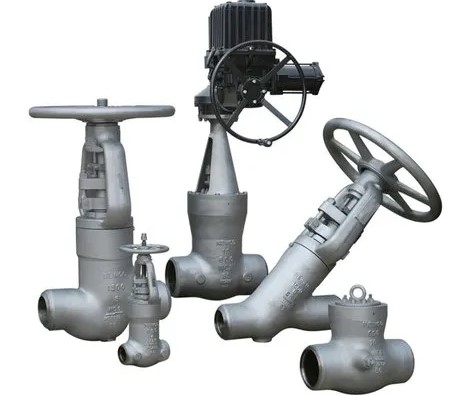
The direction of fluid flow in high-pressure globe valves significantly affects both sealing performance and operational characteristics. Traditionally, media enters from below the valve disc. This conventional design has the advantage that, when the valve is closed, the fluid pressure exerts an upward force on the disc, enhancing the sealing effect. However, it also introduces challenges when opening the valve. Operators must overcome not only the friction between the stem and packing but also the force exerted by the fluid on the disc. As a result, the closing force is typically greater than the opening force, necessitating a stem with sufficient diameter and strength to avoid bending or failure under load.
With the advent of self-energized sealing technology, flow directions in high-pressure globe valves have evolved. In newer designs, the medium enters from above the valve disc. In this configuration, fluid pressure assists in closing the valve, reducing the effort required for shutoff. Conversely, opening the valve now requires overcoming the upstream pressure, increasing the opening force. This approach allows for optimization of the stem diameter and overall valve structure while maintaining sealing reliability.
Regardless of the chosen flow direction, proper fluid entry is critical. Media should enter horizontally and act centrally on the disc to concentrate closing forces along the vertical stem, maintaining alignment and minimizing uneven stress. Side-loading can lead to uneven forces, reduced sealing efficiency, and accelerated wear of valve components.
The fully open position of a high-pressure globe valve is determined by the stroke of the disc. When the disc is lifted to approximately 25–30% of the valve’s nominal diameter, the flow reaches its maximum, defining the “full-open” state. Unlike gate valves or other on-off valves that provide unobstructed flow, globe valves inherently introduce some flow resistance and are therefore not designed for completely free passage.
High-pressure globe valves offer several distinct advantages, making them suitable for demanding industrial applications:
The structural simplicity of globe valves—with fewer components than many other valve types—facilitates easier manufacturing, inspection, and repair. Fewer parts mean fewer potential points of failure, and maintenance personnel can quickly diagnose and resolve issues. In industrial settings, this simplicity translates into reduced downtime and lower maintenance costs.
The short stroke of the valve stem allows full travel from open to closed positions with only a few turns of a handwheel or actuator rotation. This rapid response makes globe valves ideal for applications requiring frequent operation or emergency shutoff. Operators can quickly isolate fluid flow in critical situations, enhancing system safety.
Sealing surfaces of high-pressure globe valves are often overlaid with Stellite cobalt-based hard alloys, which are highly wear-resistant, corrosion-resistant, and able to withstand high temperatures. The contact between the disc and seat forms a tight seal, further reinforced by fluid pressure under high-pressure conditions. For applications where leakage must be minimized, globe valves provide reliable performance.
The relationship between disc lift and flow area is approximately linear, allowing precise flow control. High-pressure globe valves are particularly effective for regulating the pressure downstream of pumps or compressors. This linear modulation outperforms many other valve types, making globe valves the preferred choice for fine-tuned process control.
The combination of durable materials and optimized structural design enables high-pressure globe valves to withstand repeated opening and closing cycles. With proper maintenance, these valves can operate reliably over extended periods, even in harsh environments.
The unique design features of high-pressure globe valves ensure they perform reliably under demanding conditions:
- Pressure-Activated (Self-Energized) Sealing: Modern high-pressure globe valves often use pressure-activated sealing, where increasing media pressure further compresses the sealing element, enhancing leak-tightness. This design complements traditional force-applied sealing and provides an additional safety margin under ultra-high-pressure conditions.
- High-Temperature Creep Resistance: Materials used in high-pressure globe valves are selected to resist creep—gradual deformation under long-term stress at high temperatures. Proper material choice and structural reinforcement maintain dimensional stability and seal integrity during prolonged high-temperature service.
- Forged Stem and Surface Treatment: Valve stems are typically forged as a single piece, subjected to heat treatment for optimal mechanical properties, and surface-treated (e.g., nitriding) to improve hardness, wear resistance, and corrosion resistance. This ensures the stem can withstand frequent operation and abrasive or corrosive fluid flow.
- Bonnet Packing Design: The bonnet packing chamber is carefully engineered to house sealants with corrosion inhibitors. High-pressure designs may include multilayer packing, lantern rings for lubrication or leakage monitoring, and live-loaded packing to maintain constant sealing force while minimizing friction during operation.
Material selection for high-pressure globe valves is divided into pressure-bearing components and sealing components:
Pressure-bearing parts such as the body, bonnet, stem, and disc must withstand high forces. Common materials include:
- A105 carbon steel: Suitable for general industrial applications; moderate strength and low cost.
- WCB/WC6 cast steel: Offers good casting and mechanical properties.
- F316 stainless steel: Ideal for corrosive media and elevated temperature conditions.
For extreme high-pressure applications, such as oilfield valves, high-strength specialty alloys are used.
Sealing components emphasize elasticity and recovery for high-pressure cycling:
- RPTFE (reinforced PTFE) seats: Excellent chemical resistance, low friction, and reliable sealing under high pressure.
- Graphite packing: Superior high-temperature and chemical resistance compared to conventional PTFE, nylon, or rubber, ideal for high-pressure, high-temperature applications.
Material choice must consider the chemical nature of the medium, temperature, pressure, and economic feasibility.
High-pressure globe valves are classified according to ANSI and API standards:
The American National Standards Institute (ANSI) categorizes valves based on standard pressure ratings:
- Class 150: Low-pressure applications
- Class 300: Medium pressure
- Class 600: High-pressure applications
- Class 900: Higher pressure
- Class 1500: Ultra-high pressure
- Class 2500: Extreme high-pressure applications
Temperature affects the allowable working pressure, so both must be considered when selecting a valve.
The American Petroleum Institute (API) provides additional specifications for oil and gas applications, including fire resistance and emergency shutdown capabilities. In upstream and downstream facilities, high-pressure globe valves may need to handle pressures above 10,000 psi, requiring specialized designs and materials.
Typical safety factors for high-pressure globe valves range from 4:1 to 6:1. For example, a valve rated at 1,500 psi may be tested at 6,000–9,000 psi during manufacturing. This margin ensures operational reliability and long service life. Operating pressures should remain well below the maximum rated pressure to prevent component failure or catastrophic events.
- Oil and Gas Industry: High-pressure globe valves are used in wellhead equipment, refining processes, and long-distance pipelines. They must handle extreme pressures, corrosive media, and stringent safety requirements. Failure can result in environmental hazards and safety incidents, necessitating high reliability.
- Power Generation: In power plants, especially thermal plants, high-pressure globe valves are used in steam, feedwater, and cooling circuits. They must withstand high temperature and pressure while enduring frequent thermal cycling. Reliable shutoff is critical for operational safety.
- Petrochemical Industry: Reactor vessels, distillation columns, and process pipelines rely heavily on high-pressure globe valves. Valves must resist corrosive chemicals while providing precise flow control.
- Metallurgy and Urban Utilities: High-pressure steam in urban heating networks, high-pressure water systems, and steelmaking gas systems commonly use globe valves. Durability and ease of maintenance are key considerations.
- Chemical Industry: High-pressure globe valves isolate corrosive, flammable, or explosive media. Proper selection ensures safe and efficient operation of chemical processes.
Despite their advantages, high-pressure globe valves have limitations:
- Higher pressure drop: Internal flow paths create resistance, increasing energy consumption. Full-bore alternatives like floating ball valves may reduce this effect.
- Wear of internal components: Discs and seats may wear faster in abrasive media; upstream filters can protect valves.
- Unsuitability for media with suspended solids: Particles can damage sealing surfaces or prevent proper closure.
When selecting high-pressure globe valves, consider:
- Pressure rating: Choose ANSI or API classes with adequate safety margin.
- Material compatibility: Match body and sealing materials to media chemistry, temperature, and corrosion potential.
- Functional requirements: Identify whether the valve is used for shutoff, throttling, or flow regulation.
- Operational frequency: Frequent operation requires wear-resistant sealing and robust stem design.
- Maintenance considerations: Simple, serviceable designs reduce downtime.
- Certification standards: Ensure compliance with industry standards like API fire-safe or ISO quality certifications.
High-pressure globe valves combine force-applied sealing, precise flow regulation, and robust construction, making them a reliable choice for high-pressure applications. From oil and gas to power, petrochemical, metallurgy, urban utilities, and chemical processing, these valves play a crucial role in ensuring safety, process control, and operational efficiency.
A clear understanding of their operating principles, design features, and selection criteria, along with proper maintenance, maximizes performance, extends service life, and ensures safe, stable operation of high-pressure systems. For precise valve selection and application, consulting professional valve suppliers is recommended to match the valve design to specific operational parameters.
