
Dual Plate Check Valves: Design, Operation & Maintenance
In industrial piping systems, preventing fluid backflow is a fundamental yet critical function. Backflow not only reduces system efficiency but can also damage key equipment such as pumps and compressors, and may even lead to safety incidents. The dual plate check valve is specifically designed to address this issue. Unlike traditional swing or lift check valves, the dual plate check valve uses two spring-loaded plates that can close rapidly before flow reversal occurs, effectively preventing water hammer and protecting downstream equipment. This valve features a compact structure, lightweight design, and low pressure drop. It can be installed in both horizontal and vertical pipelines and is suitable for a wide range of media including liquids, gases, and steam. As a result, dual plate check valves are widely used in industries such as oil and gas, water treatment, chemical processing, power generation, HVAC, and marine engineering.
This article systematically introduces the dual plate check valve from multiple perspectives, including its structural characteristics, working principle, main advantages, technical parameters, application fields, installation and maintenance, and selection considerations, helping readers gain a comprehensive understanding of its performance and usage.
A dual plate check valve is a specialized type of non-return valve. Its primary function is to allow fluid to flow in one direction while preventing reverse flow. The design purpose is to control flow direction and protect piping systems and equipment from damage caused by backflow.
The name “dual plate” comes from its internal structure. Inside the valve body are two semi-circular plates, also called discs. These two plates are connected by a central hinge pin, allowing them to open and close like doors. Each plate is equipped with a spring, which ensures rapid closing.
When fluid flows in the designed direction, pressure pushes the two plates open. Once opened, the fluid passes smoothly through the valve. When flow decreases or begins to reverse, the springs force the plates to close quickly. After closing, the plates form a tight seal, preventing reverse flow. This fast-closing mechanism protects pumps and compressors from damage caused by backflow.
The spring-assisted mechanism also plays an important role in reducing water hammer. Water hammer refers to pressure surges caused by sudden changes in flow direction. The spring-assisted non-impact closing of the dual plate check valve significantly reduces these pressure shocks, improving overall system efficiency.
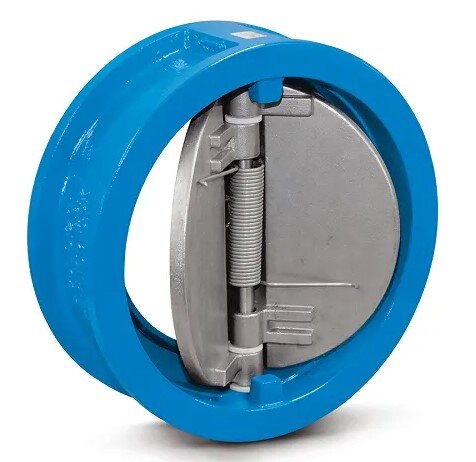
After understanding the basic function and working principle, it is necessary to examine the internal structure in detail. The structural design determines performance, reliability, and operating conditions. The excellent performance of dual plate check valves in low pressure drop, fast response, and non-slam closing is mainly attributed to their unique design.
Dual plate check valves adopt a non-pin body structure, meaning there are no through-body fastening points. Traditional valves often require bolts or pins passing through the valve body to secure internal components, which can become potential leakage paths. The dual plate design eliminates these penetration points, improving overall integrity under high-pressure conditions. This simple yet robust structure is suitable for harsh industrial environments.
The core components are two spring-loaded plates. Unlike swing check valves that rely on gravity for closing, dual plate check valves rely on springs. The springs provide fast response, ensuring closure occurs before flow reversal. This reduces wear on the plates and minimizes operational noise.
The structure is extremely compact. Compared to conventional flanged check valves, the weight of a dual plate check valve can be reduced by 80% to 90%. Its face-to-face length is also shorter, requiring less installation space. This compact design reduces installation costs and saves space. The wafer-type configuration allows installation between two flanges, making it ideal for space-constrained piping systems.
Dual plate check valves are typically manufactured from high-grade materials, including stainless steel, ductile iron, and carbon steel. These materials offer excellent corrosion resistance and durability. For special applications, advanced alloys such as duplex stainless steel, Hastelloy, and titanium alloys can be used. Sealing materials may include EPDM, NBR, Viton, or metal-to-metal seals. Springs are commonly made of 316 stainless steel or Nimonic alloys to ensure reliability under high pressure conditions.
The working principle is based on structural design. The two plates are connected by a central hinge, and each plate is spring-loaded.
When fluid enters the valve in the designed direction, pressure acts on the plates. Once the pressure is sufficient, the plates open, allowing flow through the valve. The opening angle increases as flow rate increases.
When flow decreases, the pressure acting on the plates also decreases. At this point, spring force begins to dominate and pushes the plates toward the closed position. When reverse flow begins, reverse pressure combined with spring force rapidly closes the plates.
After closing, the two semi-circular plates form a complete disc that tightly seals against the valve seat, preventing backflow.
This rapid closing mechanism effectively reduces water hammer. Water hammer is caused by sudden stoppage or reversal of flow, generating pressure waves that can damage pipelines, valves, and pumps. The spring-assisted closure prevents such pressure surges. This feature is known as non-slam closing.
- Non-Slam Performance: Spring-loaded plates close quickly before flow reversal occurs. This significantly reduces water hammer and pressure shock. Reduced water hammer leads to lower noise and vibration, extending system lifespan, especially in large-diameter and high-flow systems.
- Low Pressure Drop: The dual plate design provides a larger flow area. When open, fluid passes through a streamlined path with reduced resistance. Compared with traditional check valves, pressure loss is lower, resulting in reduced energy consumption and improved efficiency.
- Installation Flexibility: Dual plate check valves can be installed in both horizontal and vertical upward flow pipelines. Wafer-type valves are clamped between flanges, lug-type valves allow end-of-line service, and double-flanged types are suitable for large diameter and high-pressure systems.
- Cost Advantage: Compared to nozzle-type or axial-flow check valves, dual plate check valves are more economical while maintaining good performance. They provide an excellent balance between cost and functionality.
- Low Maintenance Requirements: The design reduces wear and leakage risks. Maintenance mainly involves checking disc wear, spring condition, and sealing performance. Lug-type designs allow quick disassembly, often requiring only 15 to 20 minutes for maintenance.
- Oil and Gas Industry: Used in hydrocarbon transport pipelines to prevent backflow and protect pumps and compressors. Their fast-closing function reduces water hammer in high-pressure, high-flow systems.
- Water Treatment and Supply Systems: Prevents reverse flow and contamination when pumps stop. Helps maintain water quality and system stability.
- HVAC and Refrigeration Systems: Suitable for compact systems requiring low pressure drop and space-saving designs. Improves energy efficiency.
- Chemical Industry: Prevents cross-contamination of corrosive media. Can be made from corrosion-resistant alloys to improve system efficiency.
- Power Generation Industry: Protects turbines from reverse flow damage. Suitable for large-scale high-pressure systems.
- Marine Engineering and Desalination: Resistant materials such as duplex stainless steel and titanium are used to handle seawater corrosion.
- Fire Protection Systems: Provides fast response and high reliability, essential for emergency conditions.
- Low and High Temperature Systems: Special alloys such as Monel or Inconel ensure reliable operation under extreme temperatures.
- Size Range: Typically 2” to 48” (NPS 2 to NPS 48)
- Pressure Ratings: Class 150 LB to 2500 LB
- Connection Types: Wafer, Lug, and Double Flanged
- Standards Compliance: API 594, API 6D, ASME, ISO standards
- Media Compatibility: Liquids, gases, and steam
Compared with Swing Check Valves: Dual plate valves close faster using springs, reducing water hammer. They are lighter, smaller, and require less maintenance.
Compared with Nozzle Check Valves: Nozzle check valves are suitable for compressor discharge applications but are more expensive. Dual plate valves offer better cost efficiency for medium-pressure systems.
Compared with Single Plate Check Valves: Dual plate design provides balanced force distribution, better sealing, smoother flow, and lower pressure drop.
Installation Notes: Suitable for horizontal and vertical upward flow pipelines. Proper alignment of flanges is essential. The flow direction must strictly follow the valve marking. Internal cleaning is required before installation.
Maintenance Requirements: Regular inspection of disc wear, spring condition, and sealing performance is recommended. Damaged components should be replaced promptly. Lug-type valves allow quick maintenance and short downtime.
Common Issues: Noise may occur under high pressure or pulsating flow. At low flow rates, plates may not fully open, reducing efficiency. Dual plate check valves are not suitable for flow regulation.
Key factors include:
- Fluid type (gas, water, oil, or corrosive media)
- Pressure and temperature ratings
- Size and flow requirements
- Installation orientation
- Material compatibility
- Maintenance convenience
Proper selection ensures optimal performance and system reliability.
The dual plate check valve is an essential component in modern piping systems. Its working principle is based on two spring-loaded plates connected by a central hinge pin. Under forward flow, the plates open to allow passage. When flow reverses, the springs rapidly close the plates to prevent backflow. This fast response effectively reduces water hammer and protects downstream equipment.
Dual plate check valves offer key advantages including compact structure, lightweight design, low pressure drop, and ease of installation and maintenance. Their low energy loss improves system efficiency, while spring-assisted operation reduces pressure shocks and equipment damage risks.
They are widely used in chemical processing, power generation, oil and gas, municipal water supply, wastewater treatment, fire protection, and other industrial systems. Their customizable design allows selection of size, material, and connection type based on application needs. They are especially suitable for high-pressure and high-flow systems requiring rapid shutoff.
In valve selection, cost is an important factor but should not be the only consideration. Low-cost valves may result in higher maintenance costs and shorter service life. High-quality dual plate check valves offer greater reliability, reduced downtime, and lower long-term operating costs. A balanced evaluation of cost, performance, and durability is essential to achieve maximum overall value.
