
Guide to V-Port Ball Valve Selection
In industrial production processes, fluid control is of vital importance. As an efficient and reliable control component, the V-port ball valve is widely used in petroleum, chemical, metallurgical, hydropower, and many other industries. It not only provides the shut-off function of conventional ball valves, but also enables precise regulation of medium flow, making it an indispensable part of industrial automation control systems. However, to fully utilize the performance advantages of V-port ball valves, correct selection is the key. This article will introduce the selection points of V-port ball valves in detail, helping you choose the most suitable V-port ball valve from numerous products.
The closing element of a V-port ball valve is a hemispherical ball with a V-shaped opening. The V-shaped opening has sharp cutting edges. During the rotation of the ball, a wiping action is generated between the sealing surfaces. This design gives the V-port ball valve strong cutting capability for the medium. At the same time, the V-shaped opening and the valve seat flow passage form a fan-shaped area. Rotation of the ball changes the cross-sectional area of the flow passage, thereby enabling precise regulation of medium flow.
V-port ball valves belong to fixed ball valves with single-seat sealing. Their regulating performance is outstanding among ball valves. They feature an equal-percentage flow characteristic, with a turndown ratio of up to 100:1, which allows them to far exceed other types of ball valves in terms of control accuracy.
The valve body adopts an integral side-entry structure. Whether wafer type or flanged type, it has strong structural rigidity and is not prone to deformation or external leakage. Upper and lower self-lubricating bearings are installed inside the valve body, providing a large contact area with the valve stem, high load-bearing capacity, and a low friction coefficient, thereby reducing valve operating torque.
The valve seat of imported V-port ball valves can be selected as metal hard seat or PTFE soft seat according to the medium and operating conditions. Metal hard seats are strengthened through hard alloy overlay welding, hard chrome plating on the ball surface, spray welding, or ion nitriding, enhancing the service life and temperature resistance of the sealing surface. Soft-seated PTFE or reinforced PTFE valve seats offer good sealing performance and corrosion resistance, making them suitable for a wide range of applications.
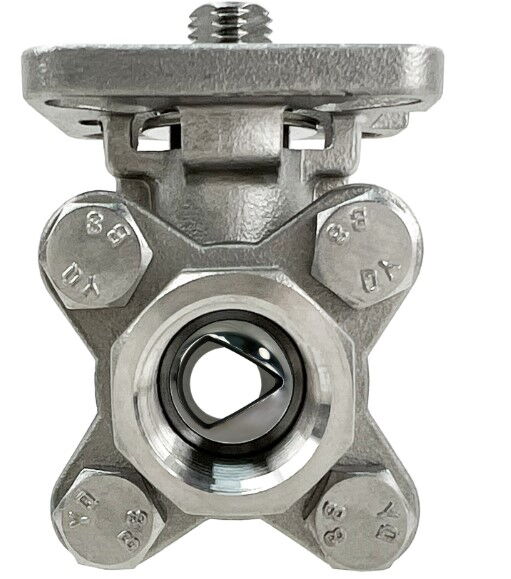
Correct selection is the foundation for ensuring optimal performance of V-port ball valves in practical applications. Improper selection may result in the valve failing to meet operating requirements, affecting normal system operation, or even causing safety accidents. Therefore, when selecting a V-port ball valve, multiple factors must be comprehensively considered to ensure that the selected valve perfectly matches actual application requirements. The following sections will discuss the key selection points in detail to help you choose the most suitable V-port ball valve.
Before selection, the pipeline diameter must first be determined, as it will decide the size and connection type of the V-port ball valve. Different pipeline diameters require matching valve sizes to ensure proper operation and flow capacity. At the same time, common pipeline parameters such as flow rate, allowable flow resistance, and valve seat bore size must also be determined. The accuracy of these parameters directly affects the flow control performance of the V-port ball valve. Improper selection may lead to inaccurate flow control and affect overall system efficiency.
V-port ball valves are suitable for a wide variety of media, including liquids, gases, and media containing fibers, fine solid particles, or slurry. Due to the shearing force between the V-shaped opening and the valve seat, as well as the smooth and rounded internal flow passage, media are not easily retained inside the valve cavity. Therefore, V-port ball valves are particularly suitable for controlling media containing fibers and solid particles.
During selection, appropriate V-port ball valves should be chosen based on medium type, temperature, pressure, specific gravity coefficient, critical pressure, and other parameters. For low-temperature media, cryogenic ball valves with extended bonnets should be selected. For corrosive media, V-port ball valves made of materials with strong corrosion resistance should be prioritized.
Pipeline operating temperature and pressure are important factors that must not be ignored during selection. Different V-port ball valve materials and structures are suitable for different temperature and pressure ranges. For example, metal hard-seated V-port ball valves are usually suitable for high-temperature and high-pressure conditions, while soft-seated PTFE V-port ball valves are more suitable for low-temperature and low-pressure environments.
Excessively high or low operating temperatures may cause degradation of valve material performance, affecting sealing effectiveness and service life. Operating pressures exceeding the valve’s rated capacity may result in valve damage or even safety accidents. Therefore, selection must be based on actual pipeline operating temperature and pressure.
V-port ball valves are usually used in combination with pneumatic or electric actuators to achieve automated control.
Pneumatic actuators adopt a piston-cylinder and crank-arm conversion structure, featuring high output torque, compact size, and fully sealed waterproof design with high protection ratings. The cylinder body is mirror-finished, oil-free lubricated, with low friction, corrosion resistance, and excellent durability. All gearbox bearings adopt boundary self-lubricating bearings for oil-free lubrication, ensuring that the transmission shaft does not wear.
Electric actuators feature accurate control, compact size, light weight, low flow resistance, large flow coefficient, simple structure, and good sealing performance. When selecting actuators, the type and specifications should be determined based on actual operating conditions and control requirements. Pneumatic actuators are more suitable for applications requiring fast opening and closing, while electric actuators are advantageous for precise flow control.
The size selection of V-port ball valves is crucial, as it directly affects system regulation performance and flow control effectiveness. Oversized valves reduce system control performance, while undersized valves cause excessive pressure loss and fail to meet flow requirements.
To select an appropriate valve size, calculations and evaluations should be based on the following parameters: medium type, inlet pressure (absolute), temperature, flow velocity (maximum, normal, minimum), outlet pressure (absolute), pipeline size, medium specific gravity coefficient, and critical pressure.
First, select an appropriate Cv calculation formula to determine the required Cv value. Then determine whether cavitation exists based on FL and Xt values. Finally, refer to Cv tables to select the appropriate valve size and V-port angle. It should be noted that the minimum and maximum Cv values of the V-port ball valve should fall between 20% and 80% valve opening to ensure good flow control performance across the entire operating range.
V-port ball valves are available with various connection types, including flanged, threaded, and welded connections. Different connection types are suitable for different pipeline systems and operating conditions.
Flanged connections are suitable for higher pressure and large temperature variations and are easy to install and disassemble. Threaded connections are suitable for small pipelines and low-pressure systems and are simple to install. Welded connections provide high sealing performance and strength and are suitable for high-temperature and high-pressure conditions.
Valve material selection is also critical. Common materials include carbon steel, stainless steel, and alloy steel. Carbon steel is suitable for general media under normal temperature and pressure. Stainless steel offers good corrosion resistance and is suitable for corrosive media. Alloy steel is suitable for special high-temperature and high-pressure conditions. Material selection should be based on medium characteristics and operating requirements to ensure valve service life and reliability.
The orientation of the V-port opening also affects control performance. For high-precision control at small openings, the sharp tip of the V-port should face upstream. For high-precision control at large openings, the curved surface of the V-port should face upstream. In addition, the V-port should be positioned on the high-pressure side of the medium to better utilize the shearing effect and improve control and sealing performance. The orientation should be determined based on specific control requirements and operating conditions.
During the selection process, attention should also be paid to certain details and additional considerations. Although these factors may appear minor, they can have a significant impact on long-term valve performance and overall system stability.
Before finalizing selection, do not rush to choose a product. First, understand which V-port ball valve products are popular in the market and how they perform. Contact multiple manufacturers to obtain catalogs and product information, compare options, and select products with better cost performance. Differences may exist in quality, performance, and price among manufacturers. Pay attention to performance indicators such as sealing performance, control accuracy, corrosion resistance, and temperature resistance.
The V-port ball valve is an important component of the pipeline system. Selection should consider not only valve performance and parameters, but also overall system integration. Fully understand process flow, control requirements, and upstream and downstream equipment performance to ensure coordinated system operation and optimal control performance.
Operating conditions may change during actual operation. Therefore, sufficient control margin should be reserved during selection to accommodate possible variations in flow, pressure, and temperature. Selecting a valve with slightly higher Cv or a larger turndown ratio improves system stability, reliability, and valve service life while reducing replacement frequency.
Maintenance is crucial for long-term stable operation. Select valves that are easy to maintain, with reasonable structure, easy disassembly, and replaceable seals at low cost. Understand maintenance cycles and requirements, establish reasonable maintenance plans, and conduct regular inspection and servicing to prevent failures and ensure reliable operation.
To better illustrate the selection points of V-port ball valves, the following is a practical case study.
A chemical plant needed to install a V-port ball valve on a pipeline transporting corrosive media containing fibers and fine solid particles for flow regulation and shut-off. The pipeline diameter was DN100, operating pressure 1.6 MPa, operating temperature 80°C, maximum flow rate 50 m³/h, normal flow rate 30 m³/h, and minimum flow rate 10 m³/h.
Based on these parameters, pipeline operating data such as flow capacity, allowable pressure loss, and seat bore size were determined. Stainless steel V-port ball valves with strong corrosion resistance were selected. Due to the fibrous and particulate medium, the shearing action of the V-port effectively prevents accumulation, making the valve suitable for this application.
Based on temperature and pressure, PTFE soft seats were selected to ensure good sealing and corrosion resistance. Cv calculations were performed, cavitation was ruled out based on FL and Xt values, and a DN100 valve with a 60° V-port was selected.
Flanged connections were chosen for installation and maintenance convenience. An electric actuator was selected to meet automation and control requirements. For high-precision control at small openings, the V-port sharp edge was oriented upstream on the high-pressure side.
Through this detailed selection process, the plant successfully installed a suitable V-port ball valve, achieving precise flow control, reliable shut-off, improved automation, and enhanced operating efficiency.
As an efficient control component combining shut-off and regulating functions, V-port ball valves play an important role in industrial applications. Correct selection is the key to fully realizing their performance advantages. By comprehensively considering pipeline parameters, medium characteristics, operating temperature and pressure, actuator type, valve size and flow performance, connection method, material, and V-port orientation, and by following proper selection procedures and precautions, reliable, safe, and efficient fluid control solutions can be achieved, ensuring stable system operation and efficient industrial production.
