
How to Select a Pneumatic Control Valve?
In industrial automation control systems, pneumatic control valves play an indispensable role. They are capable of accurately regulating key process parameters such as flow rate, pressure, and temperature within pipelines, ensuring stable and efficient production processes. However, faced with a wide variety of pneumatic control valves with different structures and functions, how to make a reasonable selection based on actual requirements has become a major concern for many engineers and industry practitioners.
Pneumatic control valves can be classified in various ways, including by structural form, actuator type, and mode of action. Each classification has its own characteristics and applicable scenarios.
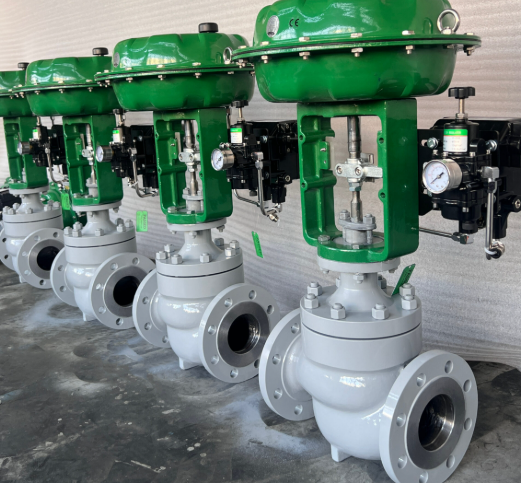
- Pneumatic Straight-Through Single-Seat Control Valve: This type of valve has a simple and clear structure, with only one valve plug and one valve seat inside the body. It offers excellent sealing performance and extremely low leakage, achieving very good shut-off capability. However, because the valve plug is subjected to relatively large unbalanced forces, especially under high differential pressure conditions, the allowable pressure differential is relatively small. Therefore, it is more suitable for applications that require minimal leakage, small pipe diameters (usually DN < 25 mm), and relatively low working pressure differentials with clean media. For example, in fine chemical production processes where strict control of micro-leakage is required for low-flow, low-pressure-differential liquid pipelines, pneumatic straight-through single-seat control valves can fully leverage their advantages to precisely control fluid flow and ensure safe and accurate production.
- Pneumatic Straight-Through Double-Seat Control Valve: This valve contains two valve plugs and two valve seats. The fluid forces acting on the two plugs are in opposite directions and largely offset each other, significantly reducing unbalanced force and allowing for a much higher pressure differential. However, its manufacturing process is more complex, and due to factors such as thermal expansion, the leakage during closure is somewhat greater than that of single-seat valves. Its key advantage lies in its ability to handle large pressure differentials in applications where leakage requirements are not particularly stringent. It is one of the most commonly used control valve types. In large industrial steam pipeline systems, where steam pressure and pressure differentials are high, pneumatic straight-through double-seat control valves can effectively regulate steam flow, meeting dynamic steam demand during production and ensuring normal equipment operation.
- Pneumatic Sleeve Control Valve: This valve is an improved and upgraded version based on the double-seat valve, featuring a unique sleeve-and-plug structure. The sleeve is designed with specific functional ports, and by adopting a balanced plug structure, vibration is effectively avoided while allowing a large pressure differential. In addition, the sleeve ports can be designed for noise reduction to meet stringent noise control requirements. Moreover, changing the sleeve or port design allows easy modification of flow characteristics, and maintenance is very convenient, requiring only replacement of the sleeve or plug. Compared with single-seat and double-seat valves, sleeve control valves are heavier and slightly more expensive. However, they are widely used in applications with large pressure differentials that require low noise and high stability, such as compressed air systems in large factories, where they regulate air pressure and flow while reducing noise and ensuring stable operation of pneumatic equipment.
- Pneumatic Angle Control Valve: This valve features a 90-degree angle between the inlet and outlet, with a simple flow path and low resistance. It is particularly suitable for high-viscosity media or media containing suspended solids or particles. This structure makes clogging less likely during fluid flow. Although the flow coefficient is relatively small, the valve performs exceptionally well in right-angle piping systems, high-pressure-differential conditions, and media that are prone to crystallization or contain particles. For example, in wastewater treatment plants, pneumatic angle control valves can effectively regulate the flow of wastewater containing large amounts of solid particles and impurities, preventing accumulation and blockage at the valve and ensuring smooth system operation.
- Pneumatic Three-Way Control Valve: This valve body has three ports and is available in two configurations: mixing type (two inlets, one outlet) and diverting type (one inlet, two outlets). Its primary function is to split one fluid stream into two or to combine two streams into one. It is widely used in heat exchanger temperature control, ratio control, and bypass control. For instance, in chemical heat exchange systems, pneumatic three-way control valves can precisely control the mixing ratio of fluids at different temperatures to achieve the desired heat exchange effect and ensure stable product quality.
- Pneumatic Butterfly Valve: When used as a control valve, it regulates flow by rotating a disc-shaped butterfly plate around a shaft within the valve body. It has a compact structure, light weight, large flow capacity, and relatively low cost, making it particularly cost-effective for large-diameter valves. However, due to structural limitations, leakage is relatively higher, although high-performance eccentric butterfly valves can achieve good sealing performance. Pneumatic butterfly valves are ideal for large-flow, large-diameter (DN > 200 mm), low-pressure-differential gas or liquid control applications such as ventilation systems, dust collection systems, and water supply systems. In large commercial building HVAC systems, they can quickly and effectively regulate airflow to precisely control indoor temperature and air quality.
- Pneumatic V-Type Ball Valve: The ball features a V-shaped notch. As the ball rotates, the V-notch forms a fan-shaped flow area with the valve seat to regulate flow. It offers strong shearing force, a wide control range (large rangeability), and excellent sealing performance. It is especially suitable for controlling suspensions containing fibers, slurry, or particles. Although its cost is higher than that of ordinary ball valves, pneumatic V-type ball valves are capable of precisely controlling complex media flow in industries such as pulp production, wastewater treatment, and particle-laden process control, ensuring continuous and stable production.
- Pneumatic Diaphragm Control Valve: This valve uses corrosion-resistant linings (such as PTFE) and an elastic diaphragm to completely isolate the flow passage from the actuator. As a result, it features low flow resistance, zero leakage, and excellent resistance to highly corrosive media. However, the diaphragm is a wear part that requires periodic replacement, and its pressure and temperature resistance is relatively limited. Pneumatic diaphragm control valves are indispensable for conveying and controlling strong acids, strong alkalis, highly corrosive, high-purity, or toxic media. For example, in ultra-pure water systems for semiconductor manufacturing, these valves ensure contamination-free water delivery, meeting the extremely high water quality requirements of chip production.
- Diaphragm Actuator: This is the most commonly used actuator type. It uses air pressure acting on a diaphragm to generate thrust and drive valve movement. It has a simple structure, smooth operation, and relatively large output force, but its stroke is relatively short. It is ideal for applications that do not require long stroke lengths but demand stable and reliable operation. For example, in feed pipelines of small chemical reactors, diaphragm actuators can accurately control valve opening based on pneumatic signals to ensure uniform raw material supply.
- Piston Actuator: This actuator uses air pressure acting on a piston to drive valve movement. It provides large output force and long stroke, making it suitable for high-pressure-differential applications that require significant thrust, such as large-diameter valves. In large industrial boiler feedwater systems, piston-actuated pneumatic control valves can overcome high water pressure and ensure stable feedwater supply to maintain normal boiler operation.
- Rack-and-Pinion Actuator: Typically used with butterfly valves and ball valves, this actuator converts the linear motion of a piston into 90-degree rotary motion to drive valve rotation. It delivers high torque, meeting the requirements of large-diameter butterfly or ball valves during opening and closing. In large oil pipeline systems, rack-and-pinion actuators paired with pneumatic butterfly valves can easily handle high-pressure, high-flow conditions, ensuring safe and efficient oil transportation.
- Air-to-Open: The valve opens when signal pressure is applied and closes when the signal is lost. This is also known as fail-close (FC). Selection is primarily based on safety considerations. If it is safer for the valve to close when air or signal pressure is lost, an air-to-open valve should be chosen. For example, in fuel gas control valves for heating furnaces, automatic closure upon signal or air failure effectively prevents gas leakage and potential accidents.
- Air-to-Close: Opposite to air-to-open, the valve closes when signal pressure is applied and opens when the signal is lost. This is known as fail-open (FO). It is selected when it is safer for the valve to remain open upon signal failure. For example, in boiler feedwater control valves, fail-open operation ensures continuous water supply during signal loss, preventing dry firing and serious safety incidents.
When selecting a pneumatic control valve, multiple key factors must be considered to ensure accurate, efficient, and safe operation.
The operating temperature and pressure range are fundamental considerations. For temperatures between –20°C and +250°C, standard valve structures are sufficient. For ranges of –50°C to +450°C, valves with heat-dissipating bonnets are required. Special ultra-high or ultra-low temperature conditions demand careful consideration of material and sealing adaptability.
Pressure ratings must meet maximum operating pressures, and pressure differential effects, especially cavitation, must be addressed. For example, in high-temperature steam systems, both temperature resistance and pressure rating must be carefully matched.
Good sealing performance is critical for stable operation. Common packing materials include PTFE and asbestos packing. PTFE offers superior sealing but at a higher cost. For highly toxic, volatile, or permeable media, PTFE packing is strongly recommended to ensure safety and environmental protection.
This choice should be based on safety analysis of process impact when signal or air pressure is lost. For example, feed valves to reactors may require fail-close operation, while venting systems may require fail-open operation.
Control valve actuators include electric, pneumatic, and self-operated types. Electric actuators are convenient but expensive and less suitable for hazardous environments. Self-operated actuators are economical but less accurate. Pneumatic actuators offer simplicity, fast response, high reliability, and excellent explosion-proof performance, making them the most widely used.
Accessories include positioners, converters, boosters, lock-up valves, pressure regulators, filters, solenoid valves, handwheels, and more. Not all applications require all accessories. Selection should be based on actual needs to balance performance, cost, and reliability. Whenever possible, accessories should be supplied and assembled by the manufacturer to ensure compatibility and reliability.
Valves should operate smoothly and offer good control even at small openings. Proper flow characteristics and rangeability must be selected, with minimal flow resistance and sufficient flow coefficient to improve system efficiency. Fast response is essential for dynamic processes such as filling lines in the food and beverage industry.
Even clean media may carry impurities that cause clogging. Rotary valves generally offer better anti-clogging performance than linear valves. Material selection must also consider corrosion resistance, balancing performance and cost. Lined materials must be compatible with operating conditions, and improper selections should be avoided.
Define Process Requirements: Analyze the process thoroughly to identify controlled parameters, media properties, operating conditions, piping details, and installation constraints. This information forms the foundation for proper selection.
Preliminary Selection: Based on process needs and valve characteristics, determine valve type, structure, actuator type, and mode of action. Ensure pressure and temperature ratings meet requirements.
Detailed Parameter Calculation and Optimization: Calculate valve size using flow coefficient (Cv) or equivalent area principles. Evaluate rangeability, flow characteristics, leakage, pressure rating, temperature resistance, and corrosion resistance to ensure suitability.
Accessory Selection and System Integration: Select appropriate accessories to enhance performance. Integrate the valve, actuator, and accessories into a complete system, followed by thorough testing and commissioning.
Reliability and Economic Evaluation: Assess reliability based on materials, manufacturing quality, and brand reputation. Evaluate total lifecycle cost, including purchase, installation, operation, and maintenance, to select the most cost-effective solution.
As a core component of industrial automation systems, pneumatic control valves require careful consideration of valve type, key parameters, accessories, and process requirements during selection. Proper selection and optimization ensure optimal performance, improved efficiency, and enhanced safety. With ongoing technological advancement, pneumatic control valves will continue to evolve toward intelligence, higher precision, greater reliability, energy efficiency, environmental friendliness, and multifunctional integration, providing stronger technical support for sustainable industrial development.
