
Knife Gate Valves: Operation, Features and Industry Uses
A knife gate valve is a type of industrial pipeline valve, also known as a knife gate slurry valve. Its core design feature is the use of a thin, sharp-edged blade as the opening and closing element, which can directly cut off the medium flow when the valve is closed. Compared with conventional gate valves, knife gate valves show significant advantages when handling media containing solid particles, fibers, sludge, and other impurities, effectively preventing blockage caused by foreign materials.
The main components of a knife gate valve include three parts: the operating handwheel, the external valve body wall, and the internal control mechanism. By rotating the handwheel, the operator drives the internal mechanism to move physically, thereby opening or closing the valve and controlling the pipeline flow state.
After understanding the basic structure, it is important to examine how knife gate valves function. Although the operation process is straightforward, the internal mechanical design is highly sophisticated.
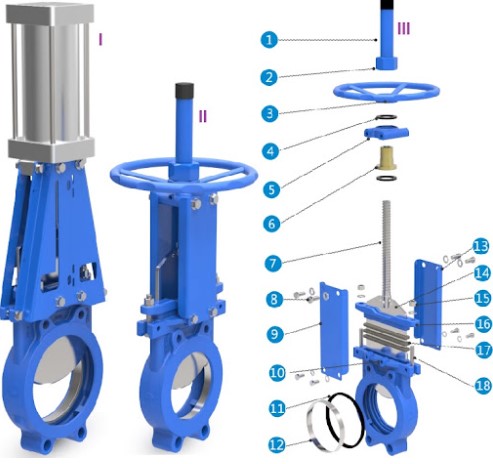
The operation of a knife gate valve is relatively intuitive. When the operator rotates the handwheel, the rotational motion drives the lever and gear system inside the valve. This linkage mechanism allows the internal blocking component to change position rapidly. Depending on the direction of rotation, the valve performs either opening or closing actions. The entire operation takes very little time, improving work efficiency.
The closing element of a knife gate valve is the gate plate, whose movement direction is perpendicular to the fluid flow direction. This vertical motion design allows the knife gate valve to function only in fully open or fully closed states and makes it unsuitable for flow regulation or throttling control.
The gate plate has two sealing surfaces, typically designed in a wedge-shaped configuration. The wedge angle is usually determined according to valve specifications and is generally around 50 degrees.
Gate plates can be designed in two forms:
- Rigid gate plate: Manufactured as an integral structure with simple construction and high mechanical strength.
- Flexible gate plate: Allows slight deformation, which improves process performance, compensates for machining deviations of sealing surfaces, and enhances sealing effectiveness.
Knife gate valves mainly adopt two sealing modes:
- Self-sealing: The pressure of the medium pushes the sealing surface of the gate plate against the valve seat, ensuring tight sealing without external force.
- Forced sealing: When the valve is closed, external force (such as handwheel torque or actuator thrust) is applied to press the gate plate against the valve seat to maintain sealing performance. Most modern knife gate valves adopt this sealing method.
For applications requiring higher sealing performance, O-ring seat designs can be used to achieve bidirectional sealing. The gate plate moves vertically within side guide grooves and is pressed tightly against the seat by a bottom lug to ensure reliable sealing.
Based on the working principle described above, knife gate valves exhibit several unique structural advantages that allow them to adapt to complex industrial operating conditions.
The knife gate valve adopts a cavity-free design, which is one of its most important characteristics. Traditional valves usually contain internal cavities where media can accumulate, while knife gate valves eliminate such spaces. The gate plate moves vertically within side guide grooves, bringing several benefits:
- Prevents medium accumulation inside the valve
- Suitable for conveying scaling or viscous fluids
- Reduces maintenance and cleaning workload
Knife gate valves commonly use a wafer-type integrated structure, offering compact size and light weight. The fully open flow channel design helps prevent sedimentation inside the valve.
In terms of materials, traditional cast steel bodies have gradually been replaced by ductile iron, which provides better corrosion resistance and extends service life.
Knife gate valves adopt a full-bore design, meaning the internal flow passage diameter is approximately equal to the pipeline diameter. This design offers several advantages:
- Low flow resistance and strong medium passing capacity
- Minimal pressure loss without reducing pipeline transport pressure
- Unrestricted flow direction and reduced turbulence
- Suitable for high-flow transport applications
Knife gate valves feature replaceable sealing components, which solve the maintenance difficulties associated with conventional slurry valves and knife gate valves. When sealing parts are worn or damaged, there is no need to disassemble the entire valve; only the sealing component needs to be replaced, greatly reducing maintenance cost and downtime.
According to the visibility of the valve stem, knife gate valves are divided into two types:
- Rising stem type: The valve stem is visible during opening and closing operations, allowing easy observation of valve position.
- Non-rising stem type: The valve stem is concealed, resulting in a more compact structure and making it suitable for installations with limited space.
Structural design determines the fundamental performance of the valve, while sealing form and material selection directly affect service range and lifespan.
Knife gate valves provide multiple sealing options to adapt to different operating conditions.
- Soft seal: Made of rubber or other elastic materials, suitable for gas, liquid, and relatively clean media. Soft seals offer excellent sealing performance but have limited high-temperature resistance and are not suitable for high-temperature environments.
- Hard seal: Uses metal-to-metal sealing, providing excellent wear resistance and high-temperature resistance, making it suitable for transporting slurry, dust, and abrasive media. However, sealing performance is relatively lower compared to soft seals.
- Single-side sealing: Sealing is provided only on one side of the gate plate, offering simple structure and lower cost.
- Double-side sealing: Both sides of the gate plate are sealed, providing better sealing performance for applications requiring high sealing integrity.
Material selection directly influences the service scope and lifespan of knife gate valves.
- Cast iron: Low cost and suitable for general operating conditions, though corrosion resistance is moderate.
- Cast steel: Higher strength and good pressure resistance, suitable for medium and high-pressure applications.
- Carbon steel: Excellent mechanical performance, moderate price, and wide application range.
- Stainless steel: Excellent corrosion resistance, widely used in food processing, chemical, and hygienic industries.
- Fluorine-lined materials: Fluoropolymer lining is applied to the metal substrate, providing extremely strong corrosion resistance and is suitable for highly corrosive media.
Knife gate valves support multiple driving methods according to practical application requirements:
- Manual drive: Operated directly by handwheel, featuring simple structure and low cost, suitable for small-diameter valves and infrequent operation.
- Electric drive: Equipped with electric actuators to enable remote control and automation, suitable for large-diameter valves or applications requiring precise opening control.
- Pneumatic drive: Uses compressed air as the power source, providing fast response speed and suitable for rapid opening and closing operations.
- Hydraulic drive: Uses hydraulic oil as the power source and provides large torque output, suitable for high-pressure and large-diameter valves.
- Worm gear drive: Uses a gear reduction mechanism to increase torque while reducing operating effort, suitable for large-diameter manual valves.
- Electro-hydraulic linkage: Combines electric and hydraulic advantages to achieve high control accuracy and large output force.
- Pneumatic-hydraulic linkage: Combines pneumatic and hydraulic advantages, offering both fast response and strong output force.
The availability of multiple driving methods enables knife gate valves to support remote position indication and centralized control, meeting modern industrial pipeline automation requirements.
- Mining and metallurgy: In mining and metallurgical industries, knife gate valves are widely used for transporting slurry, mineral sand, and similar media. The knife-shaped gate plate provides good shearing capability to cut off fluids containing solid particles and prevent blockage. Typical applications include the control of gold powder, coal slurry, and other clogging-prone or corrosive media.
- Chemical industry: Chemical production often involves corrosive media and impure fluids. The corrosion-resistant materials and reliable sealing performance of knife gate valves make them an ideal choice for slurry and powder material transport systems.
- Paper industry: Large amounts of pulp and fiber media are generated during papermaking processes. These media are prone to wrapping and blocking conventional valves. The blade design of knife gate valves effectively cuts fiber materials and is widely used in pulp transport systems.
- Wastewater treatment and environmental protection: Knife gate valves are used in wastewater treatment plants, water supply and drainage systems, and sedimentation tanks to control the flow of contaminated fluids. The cavity-free design prevents sludge accumulation, and soft or hard sealing can be selected according to medium characteristics.
- Food industry: Stainless steel knife gate valves can be used in food processing fluid control systems to meet hygienic standards and are suitable for slurry media containing solid particles.
- Petrochemical industry: Various complex media are present in the petrochemical sector. The availability of multiple material and sealing options allows knife gate valves to meet different corrosion, temperature, and pressure requirements.
Simple structure: Fewer components, lower failure rate, and higher reliability.
- Compact size and light weight: Wafer-type design saves installation space and support cost.
- Low flow resistance: Full-bore design minimizes pressure loss and provides significant energy-saving effects.
- Strong anti-blocking capability: Knife-type gate plate can cut fibers and solid particles, reducing jamming risk.
- Easy maintenance: Replaceable sealing structure allows repair without disassembling the valve.
- Cost-effective: Competitive pricing compared with other valve types of the same specification.
- Labor-saving operation: Lever and gear mechanisms make manual operation easier.
- Wide application range: Various materials and sealing options are available.
- Seal surfaces are prone to wear: In media containing solid particles, sealing surfaces may be eroded or scratched, making maintenance more difficult.
- Relatively large external dimensions: Although compact in structure, knife gate valves still occupy more space than ball valves in some cases.
- Opening requires vertical space: Rising stem valves require sufficient overhead space during operation.
- Longer opening and closing time: The stroke is longer compared to ball valves, resulting in slower actuation.
- Cannot regulate flow: The valve can only be fully opened or fully closed and is not suitable for throttling control.
When selecting a knife gate valve, the following factors should be considered comprehensively:
- Medium characteristics: Include medium type, temperature, pressure, corrosion level, and solid content. Corrosive media should use stainless steel or fluorine-lined materials, while high-temperature media should adopt hard sealing structures.
- Pipeline parameters: Include pipeline diameter, working pressure, and installation position to ensure proper valve sizing and pressure rating.
- Operating frequency: Electric or pneumatic drives are recommended for frequently operated valves to reduce labor intensity, while manual operation may be used for infrequent use to reduce cost.
- Sealing requirements: Soft seal or double-side seal should be selected for high sealing performance requirements, while hard seal is more suitable for abrasive media.
- Installation environment: Consider space limitations, explosion-proof requirements, and protection ratings.
- Control requirements: For remote control or automation integration, appropriate actuators should be installed and compatible control interfaces should be considered.
As a valve type with simple structure and reliable performance, knife gate valves offer unique advantages in handling impurity-laden fluids. Their blade gate design, cavity-free structure, and multiple material and drive options allow them to meet the requirements of mining, metallurgy, chemical processing, papermaking, wastewater treatment, and other industrial applications. Understanding the structure, working principle, features, and application scope of knife gate valves helps ensure reasonable selection and correct operation in engineering practice, maximizing performance advantages and ensuring safe and efficient pipeline system operation.
