
A ball check valve is a specialized pipeline component designed to control the unidirectional flow of fluids. Its primary function is to allow fluid to pass smoothly in one direction while automatically preventing backflow. This type of valve operates entirely without manual intervention or external power, relying solely on the pressure of the fluid itself to open and close automatically.
The term "ball check valve" can easily be confused with a standard ball valve, but their functions are fundamentally different. A conventional ball valve is a bidirectional valve that requires manual rotation of a handle or operation through an actuator to control fluid flow. It is primarily used as an on/off device. In contrast, a ball check valve is a one-way automatic valve whose core purpose is to prevent backflow, making it inherently self-operating.
The operational mechanism of a ball check valve is both intuitive and reliable. Internally, the valve contains a spherical ball capable of moving back and forth within the valve body. When fluid flows in the correct direction, the fluid pressure pushes the ball away from the valve seat, creating a pathway for the fluid to pass through. The minimum pressure required to initiate this movement is known as the cracking or opening pressure.
If the fluid flow slows or a backflow tendency occurs, the ball returns to the valve seat under the influence of gravity or a spring, forming a tight seal that prevents reverse flow. This entire process is automatic and requires no external control.
Some ball check valves incorporate a spring mechanism, which helps the ball quickly return to the valve seat. This feature is particularly useful in low-pressure systems or applications requiring rapid response. When flow ceases or backflow occurs, the spring ensures the ball reseats quickly, enhancing the valve’s closure speed and preventing reverse flow.
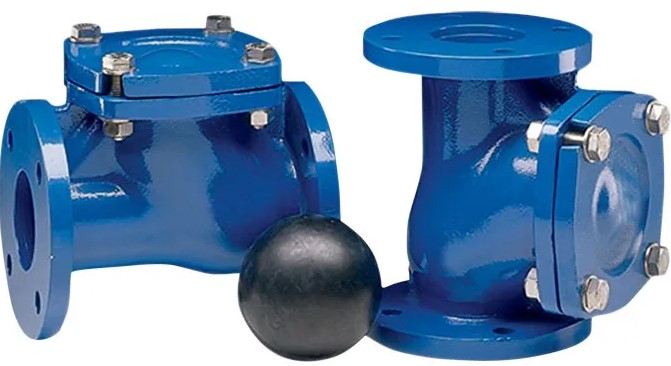
Although a ball check valve has a simple structure, each part plays an important role. The main components are described in detail below:
The ball is the core moving component of the valve and directly controls fluid passage. The material of the ball must be selected according to the type of fluid and system conditions. Common materials include metals (e.g., stainless steel), rubber or elastomers, and plastics. The size and weight of the ball affect valve performance: lighter balls are suited for low-pressure systems, while heavier balls are ideal for high-pressure environments. The ball’s surface must remain smooth to ensure a tight seal with the valve seat.
The valve seat is the area where the ball seals to prevent backflow. When fluid attempts to reverse direction, the ball rests on the seat to form a tight seal, preventing leakage. Valve seats must balance durability and fluid compatibility, and common materials include metals, plastics, or rubber. The seat’s shape is specially designed to guide the ball back accurately, ensuring reliable sealing with every operation.
The valve body houses and protects internal components while determining the valve’s connection type. The body material must withstand system pressure, temperature, and fluid type. Common options include stainless steel, brass, and plastic. The design of the body also dictates the pipeline connection method, such as threaded, flanged, or welded connections.
End connections allow the valve to integrate into a pipeline system. Typical types include:
The choice of connection impacts the ease of installation and maintenance.
Some ball check valves include a spring mechanism. The spring assists the ball in returning to the seat when flow stops or backflow occurs, which is important in low-pressure or vertical installations. The spring’s stiffness must be selected carefully: too stiff makes the valve difficult to open, while too soft prevents effective sealing.
A removable valve cover allows easy inspection and maintenance of the ball and seat. Not all ball check valves include this feature, but it can significantly simplify maintenance in systems where periodic checks are required.
After understanding the main parts of a ball check valve, let’s take a look at the key benefits this valve offers in real-world applications:
The defining feature of a ball check valve is its automatic operation. It requires no external power or manual operation, responding solely to changes in fluid pressure. This eliminates the need for operator intervention, reduces labor costs, and minimizes the risk of human error.
With minimal moving parts—typically only the ball and, in some cases, a spring—ball check valves are mechanically simple. This simplicity reduces the likelihood of mechanical failure and lowers maintenance frequency. Additionally, the rotational movement of the ball provides a self-cleaning effect, reducing debris accumulation and further minimizing maintenance requirements.
The ball reseats immediately when backflow occurs, providing rapid response that protects system performance and safety. The precise fit between the ball and the seat ensures a tight seal, effectively preventing reverse flow and protecting system components from contamination or damage.
Ball check valves can handle a wide range of fluids, including gases, liquids, and slurries. By selecting appropriate materials, they can operate in applications ranging from drinking water systems to corrosive chemical pipelines, and in temperature conditions from low to high. This versatility makes them suitable for numerous industries.
Ball check valves are small, lightweight, and easy to install. They can be installed in horizontal or vertical pipelines, making them ideal for space-constrained or complex piping systems. Their compact design allows retrofitting into existing systems without major modifications.
Compared to other valve types, ball check valves are generally economical. While price varies with material, size, design, and brand, they remain a cost-efficient solution for controlling fluid flow.
Thanks to these advantages, ball check valves find widespread use in many industries and fields:
Wastewater Treatment: Ball check valves prevent treated or contaminated water from flowing back into clean water systems, safeguarding water quality.
Chemical Processing: They maintain fluid direction and prevent backflow that could cause hazardous reactions or cross-contamination.
Oil and Gas Pipelines: They stabilize pressure and flow direction, protecting equipment from damage caused by backflow.
Food and Beverage Production: Ball check valves ensure smooth flow of liquids, prevent contamination, and are easy to clean to meet hygiene standards.
HVAC Systems: Control water or refrigerant flow and prevent backpressure from disturbing system operation.
Automotive and Aviation Fuel Systems: Maintain fuel direction and prevent reverse flow that could compromise engine safety.
Compressed Air Systems: Prevent backflow of air, maintaining pressure and operational efficiency.
Domestic Water Supply: Installed in household plumbing to prevent sewage backflow into potable water lines.
Sewage Pump Discharge: Prevents wastewater from returning, keeping areas dry.
Home Irrigation: Maintains steady water flow and prevents contamination in garden or lawn irrigation systems.
Selecting the appropriate ball check valve is crucial for ensuring system efficiency, performance, and reliability. Key factors include:
Material selection directly affects valve lifespan and corrosion resistance. Typical options include:
Stainless Steel: Suitable for high-pressure, high-temperature, and corrosive environments
Cast Iron: Suitable for moderate pressure and temperature applications
Plastic (PVC/PP): Ideal for non-abrasive fluids in low-pressure systems
Rubber-Lined: Best for abrasive fluids or slurries
Consider system pressure, temperature, and flow requirements:
Pressure Range: Ensure valve’s rated pressure exceeds the system’s maximum working pressure
Temperature Range: Material must withstand the system’s highest and lowest temperatures
Flow Capacity: Valve diameter should match pipeline size; oversizing or undersizing affects efficiency
Select the valve according to the type of fluid:
Clean Liquids: Standard materials suffice
Corrosive Fluids: Require corrosion-resistant materials
High Viscosity or Solid-Laden Fluids: Require special design to prevent clogging
Consider pipeline layout and direction:
Horizontal Pipelines: Suitable for most ball check valves
Vertical Pipelines: Requires vertical-specific models or spring-assisted valves
Space Limitations: Choose compact models if installation space is restricted
Spring-assisted ball check valves are recommended when:
Low-Pressure Systems: Gravity alone cannot return the ball to the seat
Vertical Installations: Spring aids in closing
Rapid Response Needed: Prevent water hammer or flow reversal
While ball check valves are low-maintenance, regular checks are necessary:
The ball check valve is a seemingly simple yet highly effective pipeline component. By using an internal ball, it automatically controls unidirectional flow without external power or manual intervention. Its simple structure, low maintenance needs, rapid response, wide applicability, flexible installation, and cost-effectiveness make it a critical element in industrial, commercial, and residential systems.
Selecting the right ball check valve requires consideration of material compatibility, operating conditions, fluid characteristics, installation orientation, and spring requirements. Proper installation and regular maintenance ensure reliable long-term performance, protecting the system from backflow-related issues.
Whether preventing sewage backflow, safeguarding pumps, or maintaining pressure stability, the ball check valve is a practical, economical, and reliable solution. Thoughtful selection and maintenance can significantly enhance the safety, reliability, and efficiency of any fluid system.

Copyright © 2026 China Topper Valve Packing Seal Kits Co., Ltd. All Rights Reserved.