
Concentric Butterfly Valve vs. Eccentric Butterfly Valve
In industrial piping systems, flow control is a critical factor for ensuring production safety and operational efficiency. As one of the most widely used flow control devices, the butterfly valve is favored for its compact structure, easy operation, and cost-effectiveness. It is extensively applied in water treatment, petrochemical, power generation, and many other industries.
However, with the wide variety of butterfly valves available in the market, engineers and procurement professionals often face a common dilemma: what is the difference between concentric and eccentric butterfly valves, and which one is more suitable for a specific system? This article provides a systematic selection guide from four key perspectives: structural principles, performance characteristics, application scenarios, and selection criteria.
A butterfly valve is a quarter-turn valve that controls fluid flow by rotating a circular disc installed in the center of the pipeline. When the disc is parallel to the flow direction, the valve is fully open, resulting in minimal flow resistance. When the disc rotates perpendicular to the flow, the valve is fully closed, blocking fluid passage. By adjusting the disc angle, precise flow regulation can also be achieved.
Compared with ball valves and gate valves, the biggest advantage of butterfly valves lies in their simple structure, compact size, and lightweight design. The valve body is typically only a fraction of the pipe diameter in thickness, occupying minimal installation space. In addition, the valve only requires a 90-degree rotation for opening and closing, making it ideal for frequent operation or quick shut-off applications.
Based on the relative position between the stem and the disc, butterfly valves are mainly classified into two types: concentric (center-line type) and eccentric types. This structural difference directly determines their performance limits and suitable applications.
Concentric butterfly valves are among the most widely used valve types in industrial piping systems. Their design philosophy focuses on simplicity and practicality, achieving a balance between cost and performance through a centrally aligned structure. They are often the most cost-effective solution for low-pressure, low-temperature, and clean medium applications.
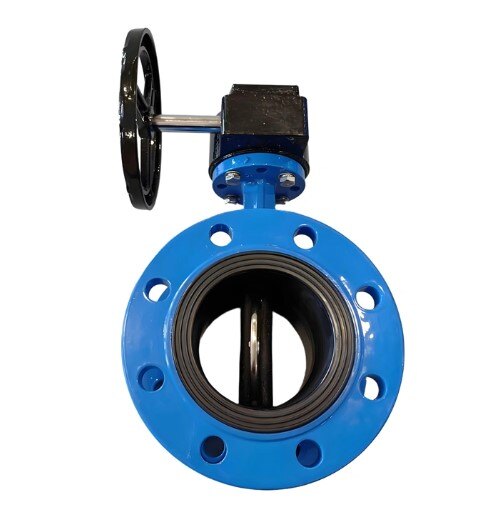
A concentric butterfly valve, also known as a zero-offset butterfly valve, features a design where the valve stem axis, disc center, and pipeline centerline all coincide on the same axis. The disc is positioned in the center of the pipe, and sealing is achieved through an elastic seat made of rubber or similar materials.
This design is characterized by its simplicity. The stem passes directly through the center of the disc, while the sealing ring is evenly distributed around the disc edge, forming a compression seal with the elastic valve seat. Since all components are aligned centrally, manufacturing precision requirements are relatively low, and the production process is mature, resulting in lower manufacturing costs.
The advantages of concentric butterfly valves can be summarized in three main aspects:
- Significant cost advantage: Due to their simple structure and low machining complexity, their manufacturing and procurement costs are typically only one-third to one-half of eccentric butterfly valves. This makes them particularly attractive for budget-sensitive projects and large-scale municipal applications.
- Easy installation and maintenance: They are lightweight and impose low structural load on pipelines, requiring no special alignment tools during installation. Maintenance mainly involves checking seat wear and sealing performance, and seat replacement is relatively simple and does not require highly specialized technicians.
- Good flow characteristics: The disc is located at the center of the pipeline, allowing fluid to pass evenly on both sides when open, resulting in stable flow patterns and relatively low pressure loss. For clean media such as water and air, this performance is generally sufficient for most applications.
The structural characteristics of concentric butterfly valves also define their performance boundaries. Since the disc remains in continuous contact with the seat during operation, friction inevitably occurs, leading to gradual wear of the rubber seat and a decline in sealing performance over time.
Therefore, concentric butterfly valves are generally suitable for the following conditions:
- Pressure rating: typically not exceeding PN16 or Class 150 (≈1.6 MPa)
- Temperature range: usually below 120°C due to rubber seat limitations
- Media type: clean water, air, oil, etc., without solid particles or corrosive components
- Operating frequency: suitable for low to medium frequency operation, not for high-cycle control
Based on these characteristics, concentric butterfly valves are widely used in:
- Municipal water supply systems: urban water distribution networks, secondary water supply systems, and water treatment plants, where pressure is typically 0.3–1.0 MPa
- HVAC systems: chilled water and cooling water circuits in central air conditioning systems and building ventilation systems
- Agricultural irrigation systems: large-scale irrigation and drip systems where cost efficiency is critical
- Fire protection systems: fire water tanks, pump stations, and pipeline networks that remain mostly open and are only occasionally operated
Eccentric butterfly valves are an upgraded design of concentric valves. By modifying the relative position between the stem and disc, they eliminate the inherent friction found in concentric designs. Depending on the degree of offset, eccentric butterfly valves are classified into single, double, and triple eccentric types, with double and triple eccentric designs being the most widely used.
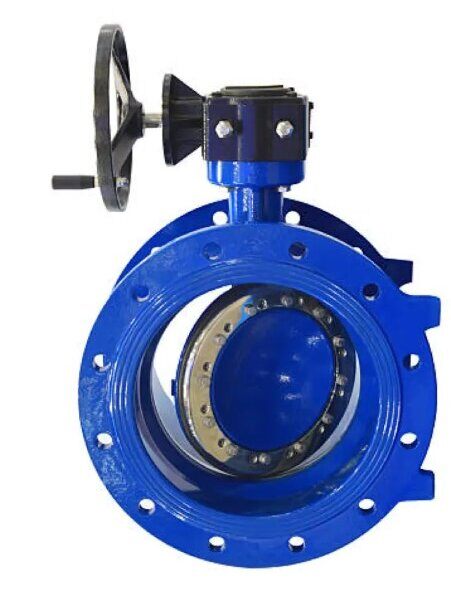
Double eccentric butterfly valves feature two offsets:
- The first offset moves the valve stem axis slightly behind the disc center. This allows the disc to close at a more optimal angle against the seat, forming a stable sealing contact.
- The second offset shifts the stem axis laterally away from the pipe centerline. This is the key innovation: during opening, the disc quickly disengages from the seat, significantly reducing friction during the initial rotation phase.
The benefits are substantial:
- Seat wear is reduced by more than 80%
- Service life is significantly extended
- Operating torque is lower, allowing smaller actuators
Double eccentric valves typically use PTFE, reinforced PTFE, or elastomer composite sealing materials. They can handle pressures up to PN25–PN40 and temperatures up to 150–200°C, making them suitable for most industrial applications.
Triple eccentric butterfly valves introduce a third offset: a conical sealing surface design. The sealing surfaces of the disc and seat form a precise conical geometry, with the cone axis offset from the stem axis.
This design enables a unique sealing mechanism:
During closing, the disc gradually wedges into the seat, achieving a tight metal-to-metal seal
During opening, the sealing surfaces separate without sliding friction
Triple eccentric butterfly valves are typically made from stainless steel or hard alloys, often combined with graphite or metal composite seals. They offer:
- High pressure capability: Can exceed PN100 and meet Class 600 or Class 900 standards.
- Wide temperature range: Suitable for extreme conditions from -196°C (cryogenic LNG) to 600°C (high-temperature steam).
- True zero leakage performance: Meets the highest sealing class under ISO 5208, suitable for toxic, flammable, and high-value media.
- Extremely long service life: With minimal friction during operation, cycle life can reach tens of thousands of operations, making them ideal for frequent regulation.
Eccentric butterfly valves are widely used in demanding industrial environments:
- Oil and gas industry: pipelines, stations, and storage systems requiring high safety and sealing reliability
- Chemical processing systems: reactors, distillation columns, and corrosive media pipelines
- Power generation systems: steam pipelines, cooling systems, and nuclear auxiliary systems
- Metallurgical and heavy industry: blast furnace cooling, furnace fuel systems, and compressed air systems
- Precision flow control: processes requiring accurate and stable flow regulation
To better understand the distinction, the key differences can be summarized as follows:
- Structural design: Concentric valves use a central symmetrical structure, while eccentric valves use single, double, or triple offsets to eliminate contact during operation.
- Sealing principle: Concentric valves rely on elastic seat compression. Eccentric valves use progressive sealing, with triple eccentric designs enabling metal-to-metal sealing.
- Pressure capability: Concentric: ≤1.6 MPa; Double eccentric: 2.5–4.0 MPa; Triple eccentric: ≥10 MPa
- Temperature range: Concentric: up to ~120°C; Double eccentric: up to ~200°C; Triple eccentric: from cryogenic -196°C to 600°C
- Service life: Concentric valves: 5–10 years; Eccentric valves: 15–20+ years with lower maintenance frequency
- Economic cost: Concentric valves have low initial cost. Eccentric valves are more expensive (2–5× higher), but offer lower lifecycle costs in demanding applications.
Selecting between concentric and eccentric butterfly valves should not rely solely on price or brand. A systematic evaluation is required:
- Medium Characteristics: Clean fluids (water, air, nitrogen) can use either type. However, media containing solids, fibers, or crystallization tendency should use eccentric valves to reduce seat damage and leakage risk.
- Pressure and Temperature Conditions: If pressure exceeds 1.6 MPa or temperature exceeds 120°C, concentric valves are generally unsuitable. For borderline conditions, double eccentric valves are recommended for safety margin.
- Operating Frequency and Control Requirements: Low-frequency operation (e.g., maintenance shut-off) suits concentric valves. High-cycle or continuous modulation applications require eccentric designs due to superior wear resistance.
- Installation Space: Both types are compact, but concentric valves are typically thinner and require less face-to-face distance.
- Life-Cycle Cost: Total cost should include purchase, installation, energy consumption, maintenance, and downtime losses. In critical systems, eccentric valves often provide lower overall lifecycle cost despite higher initial investment.
- Industry Standards: Certain industries mandate specific requirements. For example, petrochemical systems with flammable media often require metal-seated valves, while food and pharmaceutical industries may require certified materials.
Concentric and eccentric butterfly valves serve different engineering needs and operate within different performance boundaries.
Concentric butterfly valves are simple, economical, and easy to maintain, making them ideal for low-pressure, low-temperature, and clean fluid applications.
Eccentric butterfly valves, through structural innovation, eliminate friction-related wear and offer higher pressure and temperature resistance, longer service life, and superior sealing performance, making them suitable for demanding industrial conditions and critical processes.
In practical engineering, valve selection should be based on a comprehensive evaluation of operating conditions, including medium characteristics, pressure, temperature, frequency, control accuracy, budget, and regulatory requirements. Early-stage selection during system design is strongly recommended to avoid costly modifications later.
A clear understanding of the fundamental differences between concentric and eccentric butterfly valves is essential for making safe, efficient, and cost-effective engineering decisions.
