
How to Install Check Valve in Your Piping System
Check valves, also known as one-way valves, are key control elements in fluid piping systems. Their core function is very simple: they allow fluid to flow in only one direction and automatically prevent reverse flow. This seemingly simple function, however, plays an irreplaceable role in practical engineering. In industrial production and daily life, fluid backflow can cause serious consequences. For example, in water treatment systems, sewage backflow can contaminate clean water sources; in chemical pipelines, reverse flow of chemicals may damage expensive pump equipment; in steam networks, steam backflow can affect heating efficiency and even create safety hazards. The existence of check valves provides reliable protection in these scenarios.
There are many types of check valves. Common types include swing check valves, lift check valves, ball check valves, and diaphragm check valves. Among them, swing check valves are one of the most commonly used types in engineering applications due to their simple structure, low flow resistance, and suitability for large-diameter pipelines. This article will focus on the installation points of swing check valves, which are also valuable references for the installation of other types of check valves.
Proper preparation cannot be omitted when installing check valves correctly. This stage mainly involves three tasks: selecting the right valve, cleaning the pipeline, and verifying dimensions.
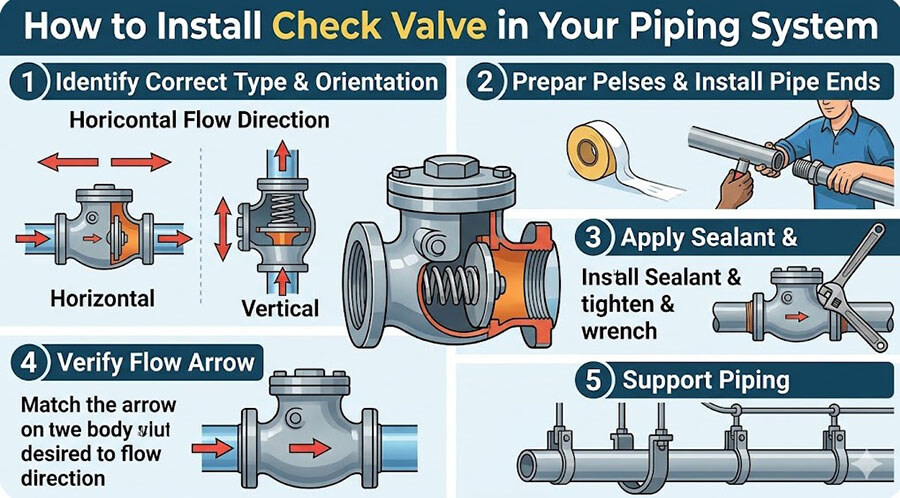
Before installing a check valve, the primary task is to choose a valve suitable for the specific application. Incorrect selection may result in poor valve performance or premature failure. Factors to consider include:
- Fluid characteristics: It is necessary to clarify whether the pipeline transports liquid or gas, whether the fluid is corrosive, and whether it contains solid particles. These factors directly influence the choice of valve material and internal structure design.
- Operating parameters: Including flow rate, working pressure, and temperature range. Flow rate determines the valve size selection, while pressure and temperature affect the material strength and sealing performance. Selection should include an appropriate safety margin to avoid long-term operation at extreme conditions.
- Valve type matching: Swing check valves are suitable for large-diameter pipelines and relatively low flow velocity; lift check valves are more suitable for high-pressure applications; ball check valves respond quickly and are suitable for applications requiring rapid closure; diaphragm check valves are suitable for corrosive media.
Pipeline preparation is the foundation for successful installation. Many installation issues originate from insufficient cleaning or poor pipeline condition.
- Cleaning the internal pipeline: Before installation, thoroughly clean the pipeline to remove welding slag, rust, sediment, and other solid impurities. If these contaminants enter the valve, they can scratch the sealing surfaces, jam moving parts, and cause leaks or valve malfunction. Cleaning methods include mechanical brushing, compressed air blowing, or using appropriate chemical cleaners.
- Checking pipeline condition: Carefully inspect the pipeline for dents, scratches, deformation, or rough inner walls. The pipeline should be straight, and the interior surface smooth. Any defects may affect valve sealing performance or cause local turbulence, accelerating valve wear. Defective sections should be repaired or replaced promptly.
- Dimension verification: Accurately measure the pipe inner diameter to ensure that the check valve’s nominal diameter matches the pipeline. Mismatched diameters can make installation difficult or impede fluid flow. Also check whether the pipeline connection method (flanged or threaded) matches the valve, and whether the flatness of connection surfaces and bolt hole positions meet requirements.
The installation direction determines whether the check valve can operate normally. Regardless of the pipeline layout, the flow direction marking principle must be followed.
Almost all check valves have arrows cast or marked on the body indicating the correct flow direction. During installation, ensure that the actual flow direction in the pipeline matches the arrow direction. This is the most basic and important installation principle.
If installed in reverse, the valve will not only fail to stop backflow but may also be damaged due to abnormal forces. In some cases, a reverse-installed valve may not open at all, causing pipeline blockage.
Horizontal installation is the preferred method for swing check valves and is also the most common configuration in engineering. This installation fully utilizes gravity to assist closure, ensuring the most reliable operation.
- Hinge position requirements: When installing a swing check valve in a horizontal pipeline, the hinge pin or pivot must be at the top. This configuration allows the disc (swing plate) to swing upward smoothly during forward flow and to naturally close downward under its own weight when flow stops or reverses.
- Incorrect hinge placement: If the hinge is installed incorrectly (e.g., on the side or bottom), the disc movement will be adversely affected. A side hinge may cause the disc to tilt, resulting in incomplete closure; a bottom hinge prevents gravity-assisted closure, completely losing the check function.
- Advantages of horizontal installation: This method ensures reliable sealing, effectively preventing backflow. Additionally, the disc’s movement path aligns with gravity, minimizing mechanical wear and extending valve life. Horizontal installation is ideal for long-term stable operation in industrial systems, such as chemical plants, water treatment plants, and steam systems in power plants.
Vertical installation may be necessary in certain scenarios, such as pumping systems that deliver fluid upward. However, vertical installation has strict limitations that must be followed.
- Vertical upward installation (flow upward): This is the only recommended vertical installation. When fluid flows upward, fluid pressure pushes the disc to swing open; when flow stops or reverses, the disc closes downward under gravity, preventing backflow.
- Space requirements: Vertical upward installation requires sufficient surrounding space. When the disc swings upward, there must be enough clearance for full opening; otherwise, flow resistance increases, energy consumption rises, and vibration or noise may occur. Installers must carefully calculate the space required for the fully open valve.
- Vertical downward installation (flow downward) — strictly prohibited: Installing a swing check valve in a downward-flowing vertical pipe is a serious error and must be avoided. When the flow is downward, gravity may keep the disc open or partially open, preventing normal closure. In reverse flow scenarios, the disc may slam shut under fluid impact, causing severe water hammer. The pressure shock wave from water hammer can damage the valve, pipeline connections, and even distant equipment, posing safety risks and economic loss.
The specific location of the check valve in the pipeline and surrounding space directly affects its operational performance and service life.
The check valve should be installed away from elements that disturb flow, such as elbows, tees, reducers, or other valves. These components can alter fluid flow, generating turbulence or vortices. Installing the check valve near such elements may prevent the disc from moving correctly, causing incomplete closure or abnormal vibration. Engineering practice recommends maintaining at least 5–10 times the pipe diameter of straight pipe between the check valve and these components. This allows the fluid to stabilize before entering the valve, ensuring normal operation.
Whether using horizontal or vertical upward installation, sufficient operational space around the valve must be provided.
Clearance requirements: Typically, 1–2 times the pipe diameter should be left in front, behind, and to the sides of the valve. This ensures that the disc can swing freely, provides space for installation and removal, and prevents localized turbulence caused by nearby structures.
Maintenance space considerations: Check valves require regular inspection and maintenance. Reserved space must allow personnel to access all parts of the valve for lubrication, tightening, or seal replacement. Inadequate space increases maintenance difficulty and costs.
Once preparation is complete, actual installation can proceed. Operational points vary depending on the connection method.
- Alignment and tightening: Align the valve flange with the pipe flange, ensuring parallel and concentric faces. Insert bolts and tighten in a cross-diagonal sequence gradually rather than sequentially to ensure even pressure on the flange and avoid leakage.
- Torque control: Use a torque wrench to tighten bolts according to manufacturer-recommended torque. Over-tightening can damage the flange or deform bolts; under-tightening cannot ensure a proper seal. Different materials and sizes of bolts have different torque requirements; refer to technical data or consult the supplier.
- Gasket selection: Gasket material must be compatible with the fluid and operating conditions. Common materials include rubber, asbestos rubber, PTFE, and metal-wound gaskets. Inspect the gasket for damage, aging, cracks, or deformation before installation.
- Sealant application: Apply appropriate sealant such as PTFE tape or liquid thread sealant evenly along the pipe threads, in the direction of tightening, to avoid sealant entering the pipeline and contaminating the fluid or obstructing the valve.
- Threading technique: Screw the valve straight into the pipe, avoiding misalignment. Hand-tighten initially until resistance is felt, ensuring threads are aligned before final tightening with tools.
- Tightening force: Use an adjustable wrench or pipe wrench for final tightening, but moderate force is required. Excessive force can damage threads, reducing connection strength or causing cracks. Check valve orientation after tightening because threaded valves may rotate during this process.
After installation, a leak test must be conducted. Gradually pressurize the pipeline with water or gas depending on the system medium and observe the valve body and connections for leakage. If leakage occurs, determine the cause: if at the connection, further tightening or gasket replacement may be needed; if at the valve body, there may be a manufacturing defect or transportation damage, requiring supplier consultation.
System commissioning and performance verification:
- Forward flow test: Slowly open upstream valves and let fluid flow through the check valve. Observe the valve operation: the disc should open smoothly without sticking or abnormal noise. Verify that the flow resistance at full opening is normal and pressure loss is within expected range.
- Reverse closure test: Close the upstream valve to stop forward flow. Observe the check valve closure: the disc should fall promptly, preventing reverse flow. Check for leakage downstream. If closure is slow or incomplete, inspect installation direction or internal defects.
- Pressure testing: For critical systems, it is recommended to conduct pressure testing at 1.5 times working pressure to verify valve performance. Maintain pressure for a period and inspect for leakage, deformation, or abnormal behavior. After testing, reduce to normal operating pressure.
The following are common problems that may be encountered during the installation or operation of check valves. Timely identification and resolution of these issues can prevent greater damage or loss.
Possible causes: incorrect installation direction, especially hinge position; debris between disc and seat; damaged sealing surface; insufficient fluid pressure.
Solutions: Correct installation, disassemble and clean, repair or replace seals, ensure system pressure meets valve requirements.
Causes: vertical downward installation, high pipeline velocity, or inappropriate valve selection (too fast closure).
Solutions: Strictly avoid vertical downward installation, add slow-closing devices or accumulators, consider check valves with controlled closure.
Causes: insufficient surrounding space restricting disc movement; pipeline obstruction; valve undersized.
Solutions: Expand surrounding space, clean pipeline and valve, recalculate flow requirements, replace with larger valve if necessary.
The quality of check valve installation directly affects the safety and reliability of the entire piping system. From selection, pipeline preparation, flow direction determination, and positioning to installation operations, commissioning, verification, and routine maintenance, every step requires careful attention.
Core principles can be summarized as: strictly follow flow direction markings, prioritize horizontal installation with top-mounted hinge, limit vertical installation to upward flow, reserve sufficient operational space, and perform regular maintenance. Following these principles ensures that check valves can perform optimally, effectively protect equipment, and maintain long-term stable operation of fluid systems.
For specific installation projects, it is recommended to always refer to the technical manuals and installation guides provided by the valve manufacturer and consult professional technicians if necessary. Each application scenario is unique, and combining professional knowledge with on-site conditions is the only way to make the optimal installation decision.
