
What Is a Wafer Check Valve: A Complete Guide
In industrial piping systems, precise control of fluid direction is critically important. The wafer check valve is a mechanical device specifically designed to prevent backflow of the medium. It is installed between two flanges and has a flat, compact shape resembling a “wafer,” which is where its name originates. As a type of non-return valve, its core function is to allow fluid to flow in one direction while automatically preventing reverse flow. Unlike manually operated valves, wafer check valves rely entirely on the pressure of the medium itself to open and close, requiring no external power or human intervention.
The internal structure of a wafer check valve is relatively simple, with the disc (or flap) being the core component. When fluid flows in the designed direction, the pressure of the medium pushes the disc open, allowing smooth passage through the valve body. At this stage, flow resistance is minimal, ensuring high hydraulic efficiency.
When the flow stops or reverses, backpressure forces the disc to close automatically. Some models are equipped with a spring mechanism, which provides additional closing force to ensure faster and tighter sealing. This rapid response is particularly important in preventing water hammer—a pressure surge caused by sudden flow stoppage or reversal, which can seriously damage pipelines and equipment.
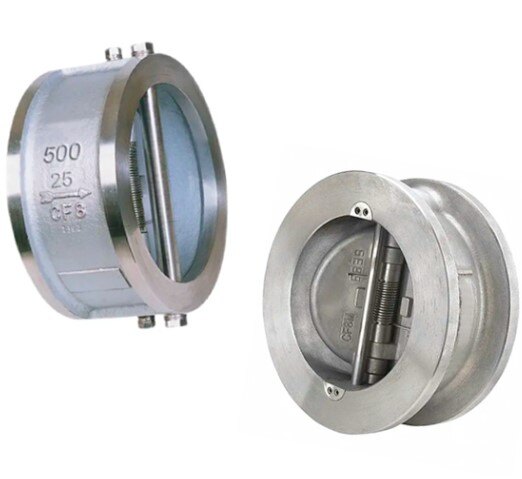
Depending on the disc design and movement mechanism, wafer check valves can be divided into several main types:
The single-disc type has the simplest structure, using one disc to control flow. During forward flow, the disc is lifted open by the fluid; when flow stops, it closes by gravity or light spring force.
Its advantages include low pressure loss and minimal flow resistance. Due to its simple structure, it is also cost-effective. This type is suitable for low-flow and low-pressure differential applications, such as municipal water supply systems and general industrial water treatment systems.
The dual-disc type uses two semicircular discs connected by a central hinge. Under forward flow, the discs open outward; under reverse flow, springs quickly force them to close.
Compared to the single-disc design, it offers faster opening and closing response and significantly reduces water hammer effects. The coordinated action of the two discs improves stability and sealing performance. It is widely used in systems with rapid flow variation, such as oil and gas pipelines and chemical processing industries.
This type incorporates a spring mechanism that continuously applies force to the disc. It ensures reliable sealing even under low-pressure conditions and prevents leakage when flow is minimal.
The spring preload can be adjusted according to operating requirements. In chemical systems where flow sensitivity is critical, this design provides more precise and stable control.
The non-slam design uses a cushioning mechanism to reduce closing impact. The disc closes in stages rather than suddenly, preventing violent collision.
This significantly reduces the likelihood of water hammer, as well as noise and vibration in the system. It is widely used in HVAC systems and large pumping systems, where it helps protect pipelines and extend equipment lifespan.
Compared with traditional check valves, wafer check valves exhibit distinct advantages in structural design, installation and maintenance, and operating efficiency. These features make them a preferred choice in industrial applications where space is limited, cost control is critical, and energy efficiency is highly valued. The following sections explain these advantages in five key aspects.
One of the most notable features of wafer check valves is their slim, compact design. The valve body is extremely thin and fits between two flanges without requiring extra space. This makes it ideal for space-constrained systems such as ship piping systems and densely packed industrial facilities.
Compared with traditional flanged check valves, wafer types are significantly smaller and lighter, offering greater flexibility in pipeline layout.
Due to their simple structure and reduced material usage, wafer check valves are much lighter than other types of check valves. This reduces transportation costs and simplifies installation, especially in elevated or large-scale piping systems.
Installation is straightforward: the valve is placed between two flanges and secured by tightening bolts to the specified torque. No complex pipeline modification is required, making it suitable for both new installations and retrofit projects.
The internal flow path design ensures minimal resistance as fluid passes through the valve. Lower pressure loss means reduced energy consumption by pumps, resulting in significant long-term energy savings.
In systems with high flow rates and long operating hours—such as municipal water networks and cooling water circulation systems—this energy-saving benefit is particularly significant.
The rapid closing capability is a key performance feature. When reverse flow is detected, the disc closes almost instantly, effectively blocking backflow.
This is especially important for protecting upstream equipment. For example, at pump discharge lines, a wafer check valve prevents reverse flow when the pump suddenly stops, avoiding damage to impellers caused by reverse rotation.
Considering material, manufacturing, transportation, and installation costs, wafer check valves offer excellent overall value. For projects with budget constraints, they provide reliable functionality while minimizing total investment.
- Water Treatment Systems: Wafer check valves are widely used in water treatment systems. Pumps are the core equipment, and check valves are essential for their protection. Installed at pump outlets, they prevent backflow when the pump stops. Without them, reverse flow can cause impeller rotation in the opposite direction, leading to motor damage or seal failure. They are also used in filtration, reverse osmosis, and ultrafiltration systems to ensure correct flow direction and prevent cross-contamination.
- HVAC Systems: In heating, ventilation, and air conditioning systems, wafer check valves are used in chilled water and cooling water circuits. They ensure correct flow direction and maintain system efficiency. In systems with multiple chillers operating in parallel, they prevent backflow from idle units into running ones. They are also used between cooling towers and pumps to prevent reverse flow and protect equipment. For large commercial buildings, hospitals, and data centers, they are essential components for system reliability.
- Oil and Gas Industry: Oil and gas pipelines operate under high pressure and handle hazardous media, requiring highly reliable valves. Dual-disc and spring-loaded wafer check valves are widely used in this sector. They prevent backflow caused by pump failures or pipeline ruptures, reducing accident escalation. Their compact design is especially suitable for offshore platforms and refineries where space is limited. For corrosive media, materials such as stainless steel and duplex steel are commonly used.
- Chemical Industry: In chemical processes, flow direction control and media purity are critical for safety and product quality. Wafer check valves prevent mixing between process streams and avoid contamination or uncontrolled reactions. For corrosive environments, corrosion-resistant materials are used. Special designs also ensure stable performance under high temperature and pressure conditions.
- Power Industry: In thermal, nuclear, and renewable power plants, cooling systems are essential for safe operation. Wafer check valves are widely used in cooling water, steam, and condensate systems. In nuclear plants, certified high-reliability valves are used to ensure safe heat removal system operation. They also play a key role in wind and solar power cooling systems.
Proper selection of wafer check valves directly affects system efficiency and safety. Key factors include:
Different media require different materials. Water and oil may use carbon steel, while corrosive media require stainless or alloy steels. Temperature, viscosity, and solids content must also be considered.
The valve’s rated pressure must exceed maximum system pressure. Temperature affects material strength and sealing performance.
Valve size must match pipeline flow conditions to avoid excessive pressure loss or instability.
Flow direction must match the arrow on the valve body. Incorrect installation may cause malfunction or damage.
Valve standards (ANSI, DIN, JIS, etc.) must match pipeline flanges to ensure proper sealing and fit.
Regular inspection is essential even for reliable wafer check valves:
- Check disc wear and deformation
- Inspect sealing surfaces for damage
- Test spring performance (spring-loaded types)
- Remove debris and scaling regularly
- Replace seals when leakage occurs
- Perform periodic operational testing
Proper maintenance ensures long service life and stable performance.
The wafer check valve is an indispensable one-way control component in industrial piping systems, offering compact structure, lightweight design, low pressure loss, and fast response. From municipal water supply and HVAC systems to oil & gas, chemical, power, and marine industries, it plays a vital protective role.
With correct understanding of working principles, proper selection, standardized installation, and regular maintenance, wafer check valves can deliver long-term, reliable performance. As materials and manufacturing technologies continue to advance, their application scope will continue to expand, providing safer and more efficient solutions for industrial fluid control systems.
