
Non-Slam Check Valves: Valves for Water Hammer Prevention
In industrial production, the stable operation of piping systems is directly related to the efficiency and safety of the entire process. However, many engineers have encountered the following problem: every time a pump stops, the piping emits a loud banging noise, accompanied by equipment vibration, loose joints, and even pipe rupture. This phenomenon is called "water hammer" and is one of the most common and destructive problems in industrial piping systems. The non-slam check valve is a specialized device designed to solve this problem.
A non-slam check valve, also known as a non-impact check valve or silent check valve, is a valve device specially designed to prevent water hammer in piping systems. Compared with ordinary check valves, its core advantage lies in its ability to achieve fast and smooth closure, avoiding the pressure shock caused by sudden valve closure.
Traditional check valves (such as swing check valves) rely on gravity and reverse fluid flow to close the valve. This passive closure method has a significant time delay. The valve closes only after the fluid has started to flow backward, at which point the impact force acts directly on the piping system. The non-slam check valve uses a spring-assisted disc design, which allows the valve to close before the reverse flow forms, fundamentally eliminating the conditions for impact.
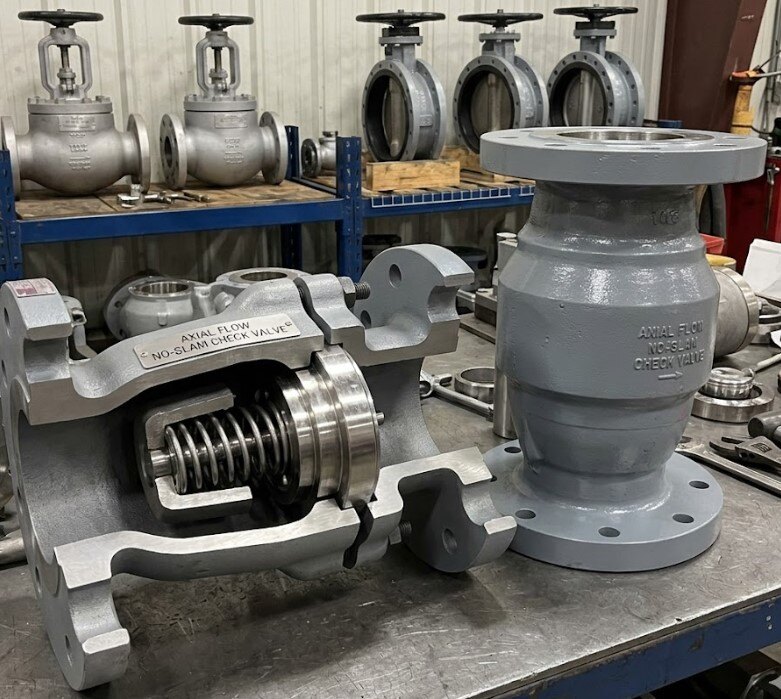
Understanding the working principle of a non-slam check valve requires examining its internal structure. A typical non-slam check valve mainly consists of the following components:
- Valve body: The shell of the valve, which houses all internal parts and guides the direction of fluid flow.
- Disc (valve flap): The key component controlling fluid flow, moving according to fluid pressure to open and close the valve.
- Spring: The core component that balances the closing speed of the disc, ensuring the valve does not close too slowly to cause backflow impact, nor too quickly to cause vibration.
- Valve seat: Provides a sealing surface to prevent fluid backflow.
- Hinge pin: Connects the disc to the valve body and guides the movement trajectory of the disc.
When the pump operates normally, the pressure of the forward-flowing fluid pushes the disc open, compressing the spring. When the pump stops, the fluid velocity begins to decrease, and the spring immediately pushes the disc toward closure. Because the spring force is continuous and controllable, the disc can close fully before the fluid has completely stopped or reversed. This "pre-closure" mechanism prevents the fluid from forming reverse impact, completely avoiding water hammer.
Based on the unique spring-assisted design, non-slam check valves demonstrate performance characteristics that traditional valves cannot match. These advantages not only solve the water hammer noise problem but also improve the operation efficiency of the entire piping system in terms of response speed, energy consumption, and maintenance costs. The main advantages are as follows:
The disc stroke of a non-slam check valve is short, and the distance from fully open to fully closed is very small, making the response extremely fast. This design allows the valve to react to flow changes in a very short time, completing closure the moment reverse flow occurs. This rapid response capability is especially important for pump systems with frequent start-stop operations, effectively preventing water hammer from each shutdown.
Water hammer is a pressure shock wave caused by sudden stopping or reversing of fluid, with destructive power that should not be underestimated. In severe cases, the pressure peak generated by water hammer can reach several times the normal operating pressure, enough to cause pipe rupture, joint damage, and pump body damage. The non-slam check valve achieves smooth closure before reverse flow occurs, controlling pressure fluctuations within a safe range and fundamentally eliminating conditions for water hammer.
The internal flow path of the non-slam check valve is streamlined, reducing fluid resistance and allowing the medium to pass more smoothly. Compared with traditional check valves, this design significantly reduces system pressure loss and pump energy consumption, thereby lowering overall operating costs. For large industrial systems, this energy-saving effect can bring considerable economic benefits over long-term operation.
Non-slam check valves are usually made of high-strength and corrosion-resistant materials, such as stainless steel, carbon steel, ductile iron, or bronze. These materials have good wear and corrosion resistance, adapting to various complex industrial environments. More importantly, by avoiding water hammer impact, pumps, joints, and supports in the piping system are also protected from shock damage, significantly extending the overall system lifespan.
Traditional check valves frequently endure water hammer impact, causing internal parts to wear and require regular inspection and replacement. The impact-resistant design of non-slam check valves effectively reduces wear on internal components, maintaining stable performance over long-term operation. Routine maintenance is limited to checking insulation joints, replacing rubber seals, and anti-rust coatings, greatly reducing shutdown frequency and operational interruption risks.
Non-slam check valves generally have a compact design, occupying less space than traditional check valves. This feature is especially suitable for installations in limited spaces, providing greater flexibility in system layout and simplifying installation processes.
Depending on structural design and application scenarios, non-slam check valves are mainly divided into the following types:
- Disc-type non-slam check valve: The most compact structure with a thin profile, suitable for installation between two flanges, especially for space-limited systems. Commonly used in small pipelines or highly integrated equipment.
- Axial-flow non-slam check valve: Adopts a straight-through flow design with a more streamlined flow path, suitable for high-pressure or high-velocity pipelines. This design further reduces pressure loss and improves system efficiency, often used where energy consumption is critical.
- Double-disc non-slam check valve: Features two spring-assisted discs, suitable for large-diameter pipelines or horizontal installation. The double-disc design provides more uniform sealing and is suitable for high-flow systems.
The choice of material for non-slam check valves directly affects their applicable range and service life. Common materials and their applications are as follows:
- Stainless steel: Excellent corrosion resistance and high strength, commonly used in chemical plants and seawater systems. Although costly, it provides the longest service life in harsh conditions.
- Carbon steel: Lower cost and good durability, an economical choice for oil, gas, and general water systems. Carbon steel valves provide reliable performance in less corrosive environments.
- Ductile iron: Combines high strength and good economy, commonly used in municipal water supply systems. Mechanically superior to ordinary cast iron and more affordable than steel.
- Bronze: Highly resistant to seawater and saltwater corrosion, widely used in marine and offshore projects. Bronze valves are preferred for offshore platforms and ship systems.
- Water supply systems: Installed on pump discharge lines in water treatment facilities, plants, and reservoirs to prevent water hammer, reduce pipeline damage, and lower system maintenance costs. In high-rise building water supply systems, they effectively control pressure surges caused by elevation differences, ensuring safe water delivery.
- Sewage treatment systems: Installed between main drainage pipelines in sewage lift stations to prevent backflow and protect the piping system. Replacing traditional swing check valves with non-slam check valves has eliminated system noise overnight and resolved issues like pipe support cracks, significantly improving operational stability.
- Chemical processing systems: Frequently involve corrosive media and complex piping systems. Non-slam check valves prevent chemical backflow and reduce the impact of closure on the system, protecting expensive chemical equipment and precision instruments.
- Power systems: In turbine condenser water systems of power plants, non-slam check valves protect pumps and pipelines from water hammer. Given the high reliability requirements of power systems, unplanned shutdowns can cause huge losses. Non-slam check valves’ high reliability makes them standard in the power industry.
- HVAC systems: In commercial and industrial heating and cooling systems, non-slam check valves reduce noise and vibration, improve system comfort, and reduce equipment wear, extending system life.
- Oil and gas industry: Pipelines require high safety standards, and any leakage may have serious consequences. Non-slam check valves prevent backflow and pressure shocks in process pipelines, ensuring safe transport.
When selecting a non-slam check valve, consider the following key factors:
- Fluid characteristics: Type, temperature, and corrosiveness of the medium. Different fluids require valves made of materials that can withstand them.
- System parameters: Operating pressure, temperature, and flow range. Valve specifications must match system parameters; oversizing or undersizing affects performance.
- Installation conditions: Pipe size, installation space, and orientation (horizontal or vertical). Different types of non-slam check valves have different installation requirements.
- Operational mode: Start-stop frequency and operating duration. The advantages of non-slam check valves are more pronounced in systems with frequent cycling.
- Cost budget: Consider procurement, operation, and maintenance costs. Although the initial investment may be higher than traditional check valves, long-term benefits in energy savings, extended service life, and reduced maintenance often result in better total ownership cost.
Non-slam check valves provide rapid response, effective water hammer suppression, reduced pressure loss, and improved system efficiency, offering essential protection for stable industrial operation. They have become indispensable components in modern industrial systems, helping achieve more efficient, reliable, and cost-effective operation. For engineers facing water hammer or designing new systems, choosing a non-slam check valve ensures quieter operation, more reliable system performance, and lower long-term operational costs. In an era of increasingly intelligent and efficient industrial equipment, non-slam check valves continue to safeguard countless piping systems with their simple yet effective design principles.
