
Flexible Wedge Gate Valve vs. Solid Wedge Gate Valve
In industrial piping systems, valves play a crucial role in controlling fluid flow, pressure, and direction. Different types of valves are suitable for different operating conditions. Among various industrial valves, wedge gate valves are widely used in sectors such as petroleum, natural gas, power generation, chemical, and water supply and drainage due to their reliable structure and excellent sealing performance. Wedge gate valves are primarily divided into two types: solid wedge and flexible wedge. Many users often face confusion during selection: for systems with high pressure, high temperature, or frequent flow adjustments, which type of valve is more appropriate? What are the specific differences between these two valves in terms of gate design, sealing performance, operation and maintenance, and suitable working conditions? To help engineers and procurement personnel make informed decisions, this article provides a comprehensive comparative analysis of flexible wedge gate valves and solid wedge gate valves from multiple dimensions, including structural features, operating principles, performance, and application scenarios.
Flexible wedge gate valves are industrial valves specifically designed to handle high-pressure conditions and temperature fluctuations. The most notable design feature of these valves is the hinge structure in the middle of the gate, allowing the gate to move freely up and down. This movable design enables flexible wedge gate valves to perform exceptionally well under high-pressure conditions, especially in scenarios where sudden pressure surges occur without causing damage.
The gate of a flexible wedge valve is made from a single block of metal, with deep grooves or notches machined along its outer edge. These shallow grooves around the perimeter allow the otherwise rigid metal to behave slightly like a spring. While the gate itself is not soft, the narrow central connection allows the two contacting surfaces to bend independently on a microscopic scale. When minor misalignments occur between the valve seat and the pipeline due to stress or manufacturing tolerances, this design still maintains a tight seal. Additionally, the force required for the operator to rotate the valve stem is lower than that needed for a solid wedge.
Flexible wedge gate valves are suitable for systems requiring frequent flow adjustments. Their adjustable structure allows operators to easily regulate flow according to actual conditions, making operation more convenient. Compared to solid wedge valves, flexible wedge valves also demand lower maintenance, which is why they are often prioritized in many industrial applications.
Solid wedge gate valves feature an integrated gate design, with the gate formed as a single, robust piece. Once installed, these valves cannot be adjusted, making them suitable for applications where pressure fluctuations are minimal and frequent flow adjustments are unnecessary. These valves can operate continuously in high-pressure and high-temperature environments without deformation, making them ideal for extreme service conditions, such as high-pressure steam systems or deep-sea oil drilling operations.
The simple structure of solid wedge valves, with fewer moving parts, reduces maintenance needs and minimizes wear over long-term operation. Moreover, the absence of movable components generally allows solid wedge valves to achieve better sealing performance compared to flexible wedge valves. The flat gate surface ensures that the seal remains intact even under pressure variations, making them highly durable and wear-resistant, and ensuring reliable performance.
Operation of solid wedge gate valves is relatively straightforward, with the gate raised or lowered by turning the valve stem. However, due to the large size and rigidity of the solid gate, greater force may be required, which must be considered in manual operation scenarios. Maintenance is generally simple due to the minimal moving parts, resulting in high reliability. Nonetheless, if the gate or seat becomes damaged, repair difficulty and costs can be higher than for modular-designed valves.
Understanding the advantages and disadvantages of each valve, users are most concerned with their specific differences. These differences are reflected in gate design, procurement cost, sealing performance, maintenance frequency, and the ability to handle thermal binding issues. The following sections provide a detailed comparison.
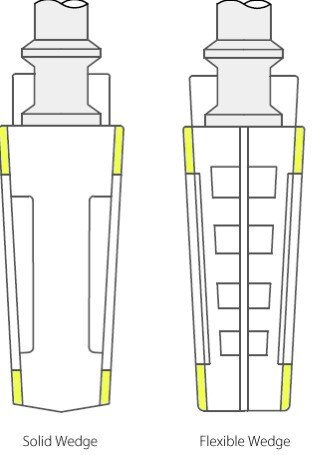
Flexible wedge and solid wedge gate valves differ significantly in gate design. Flexible wedge valves feature a deformable gate that conforms to the valve seat to achieve reliable sealing. Deep grooves or notches along the gate perimeter allow slight compression and bending, preventing the valve from seizing when the system cools or pipeline stress occurs. This design is the optimal upgrade over solid gates for handling systems with periodic high-temperature cooling cycles.
Solid wedge valves use a fixed gate bolted in place to achieve sealing. The gate is a single, rigid piece with no movable parts. While this rigid structure performs best in stable environments, sealing issues may arise under thermal expansion or installation misalignment.
Flexible wedge valves are more expensive than solid wedge valves. This is mainly due to the precise machining required for the perimeter grooves, making the manufacturing process more complex. In contrast, solid wedge valves are simpler to cast, resulting in lower manufacturing costs. Although the initial purchase cost of flexible wedge valves is higher, their superior sealing performance, reduced leakage risk, and lower long-term maintenance needs may provide better overall value over time.
Sealing performance is a core valve indicator. Solid wedge valves can achieve tight sealing when fully closed, as the solid metal gate closely contacts the valve seat to prevent fluid leakage. However, the sealing effectiveness depends on the manufacturing quality of the gate and seat; surface irregularities can cause minor leakage.
Flexible wedge valves, in contrast, adapt better to minor misalignments or pipelines containing particles. The flexible design allows the gate to slightly adjust its angle, compensating for minor seat misalignment or pipeline stress, ensuring reliable sealing. However, under highly corrosive or abrasive media, the mechanical strength of flexible wedge valves may be slightly lower than that of solid wedge valves.
Both valves are durable and high-performing, but maintenance needs differ. Solid wedge valves are simple in structure with few moving parts, ensuring high reliability and low maintenance. Flexible wedge valves also have low maintenance requirements but are slightly more complex than solid wedge valves. In cases of gate or seat damage, repairing a solid wedge valve may be more difficult and costly.
Thermal binding is a common issue in steam or high-temperature systems. When attempting to open a valve after shutdown, the valve may be completely stuck due to the body cooling and contracting faster than the internal gate, pinching the gate tightly.
Flexible wedge valves are specifically designed to address this problem. The flexible wedge allows slight gate deformation, preventing thermal binding. When closing the valve, the gate edges contract slightly, and upon reopening, the gate returns to its original shape, separating smoothly from the seat without extra tools or excessive force.
Solid wedge valves, however, have a higher risk of thermal binding. In hot-close, cold-open scenarios, they may seize if the seat alignment is not perfect, as the design cannot compensate for warping.
After understanding the key differences, the next practical question is: under what circumstances should one choose a flexible wedge valve, and when should a solid wedge valve be used? Different operating conditions impose entirely different requirements on valves, and choosing the wrong type can lead to equipment failure or increased maintenance costs.
Flexible wedge valves are suitable for:
Steam mains, refinery processes, and power plant pipelines with large temperature fluctuations. The adjustable gate enhances adaptability and ease of operation, performing well under variable pressure and temperature conditions.
Pipelines with slight misalignment or sagging. Flexible wedge valves can compensate for minor offsets or pipeline stress, ensuring reliable sealing.
High-pressure and high-sealing-demand applications. Flexible wedge valves handle frequent flow adjustments in high-pressure systems while maintaining excellent sealing performance.
Water supply, HVAC, and general industrial systems, particularly where temperature variations occur.
Solid wedge valves are suitable for:
Stable pressure, fixed-flow systems with low maintenance requirements. Solid wedge valves perform best in stable environments, providing long-term reliability.
High-pressure and high-temperature conditions, such as in petroleum, natural gas, power generation, and petrochemical industries. Solid wedge valves are wear-resistant, stable, and suitable for harsh industrial environments.
Media containing impurities or slurry. Solid wedge valves have no grooves that can trap debris, whereas flexible wedge grooves may accumulate particles or mud, causing corrosion.
Stable conditions in the nuclear industry. Both valves can be used, but solid wedge valves are preferable for long-term reliability under stable conditions.
Flexible wedge valves should be avoided in systems with abrasive or slurry-laden media, as debris can accumulate in the grooves, compromising flexibility or causing corrosion or cracking. Additionally, in extremely turbulent environments, flexible wedge performance is slightly lower than that of solid wedge valves.
Solid wedge valves are not suitable for applications with large temperature or pressure fluctuations, as thermal expansion or seat misalignment may cause sealing issues.
Solid wedge valves provide a straight-through flow path when fully open, resulting in low resistance and minimal pressure loss, which is beneficial for energy efficiency in piping systems. Other gate valve types, even when fully open, may have limited flow paths and complex internal designs, increasing turbulence, pressure loss, and reducing system efficiency.
Flexible wedge valves, with cut gates allowing elastic adjustment, handle pressure and temperature fluctuations more effectively under dynamic flow conditions. Operationally, flexible wedge valves are easier to operate, requiring less force to turn the valve stem and offering greater adaptability.
Solid wedge valves require more effort to operate, particularly in manual scenarios. However, their vibration resistance is excellent, making them suitable for turbulent environments.
When selecting a wedge gate valve, the following factors should be evaluated:
- Fluid condition assessment: Determine whether the system operates in stable or variable conditions. For large temperature and pressure fluctuations, flexible wedge valves are preferable; for stable conditions, solid wedge valves are ideal.
- Sealing requirements: Solid wedge valves rely on rigidity for tight closure, while flexible wedge valves adapt to misalignment. Choose based on pipeline alignment precision and sealing demands.
- Durability assessment: Solid wedge valves suit high-pressure, high-wear applications; flexible wedge valves are better for corrosive media.
- Operational effort: Flexible wedge valves require less operating force; for systems needing frequent operation, they are preferred.
- Industrial application matching: Ensure the selected valve meets actual service requirements.
In summary, flexible wedge valves use a flexible design to address thermal binding, improve ease of operation, and ensure reliable sealing, making them ideal for systems with frequent condition changes. Solid wedge valves, in contrast, demonstrate outstanding durability and sealing performance in stable high-pressure, high-temperature environments, making them suitable for long-term operation under consistent conditions. Each valve type has its advantages, and selection should be based on a comprehensive evaluation of specific operating requirements.
