
Floating Ball Valves vs. Trunnion Ball Valves
In industrial piping systems, ball valves are among the most widely used devices for controlling fluid flow. They offer reliable sealing, low-pressure drop, and rapid operation, making them indispensable across water treatment, chemical processing, oil and gas, power generation, and other industries. Depending on how the ball is supported within the valve body, ball valves can be classified into two primary types: floating ball valves and trunnion-mounted (fixed) ball valves. Selecting the correct type is critical for ensuring safe operation, minimizing operational costs, and extending equipment lifespan.
This guide provides a comprehensive comparison of floating and fixed ball valves, covering their structural differences, performance characteristics, operational torque, automation suitability, application scenarios, maintenance, total cost of ownership, and standards compliance.
The most fundamental difference between floating and fixed ball valves lies in how the ball is supported.
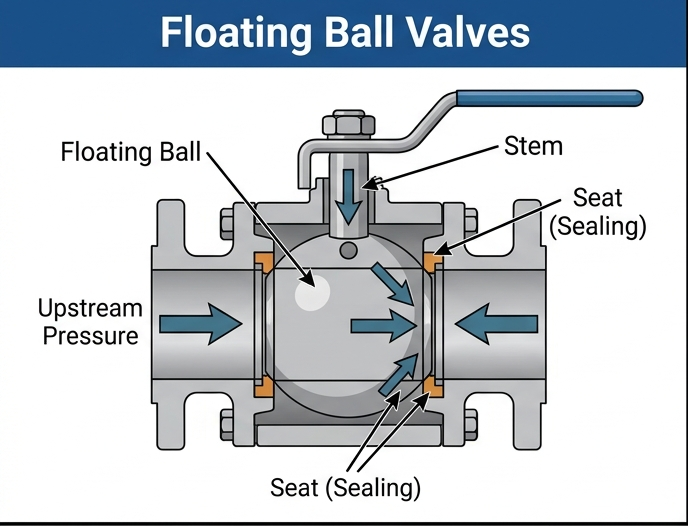
In floating ball valves, the ball is not mechanically anchored; it can move freely within the valve body. The ball is held between two valve seats but is not fixed in place. When the valve closes, the medium’s pressure pushes the ball toward the downstream seat, creating a tight seal. This self-energizing sealing effect means that the higher the system pressure, the stronger the seal.
Floating ball valves have a simple construction, with fewer components, smaller size, and lighter weight. These characteristics make them easier to install and maintain in many low- to medium-pressure systems.
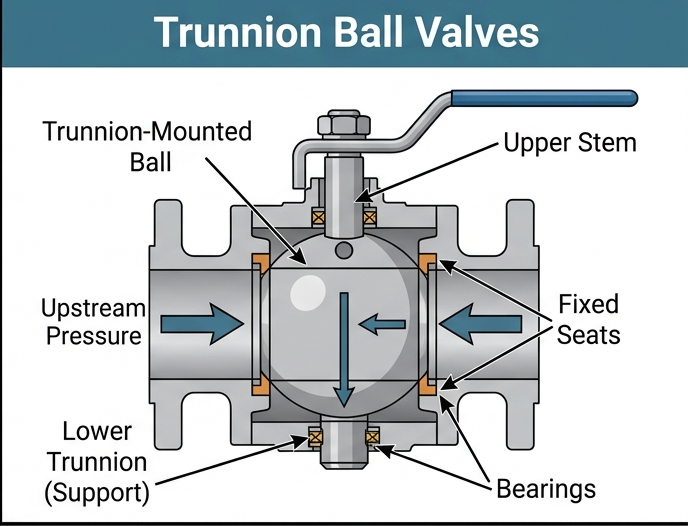
In contrast, trunnion-mounted or fixed ball valves secure the ball using top and bottom support shafts (trunnions or bearings). This mechanical anchoring prevents the ball from moving, even under high-pressure conditions. Sealing is achieved by spring-loaded seats pressing against the ball rather than relying on medium pressure.
The mechanical support structure distributes the load to the bearings, allowing stable operation under high-pressure conditions. This makes fixed ball valves suitable for larger pipelines and high-pressure applications, where a floating ball valve would be impractical due to excessive operating torque or risk of seat deformation.
Floating and fixed ball valves differ significantly in performance parameters, which determine their suitability for specific applications.
Floating ball valves are typically used for pressures from 150 to 1,480 PSI (roughly up to API Class 600). Operation becomes increasingly challenging above 800 PSI, as the torque required to operate the valve rises sharply. For instance, a 4-inch floating ball valve at 1,000 PSI may require 300–400% more torque than at atmospheric pressure.
Fixed ball valves can withstand pressures up to 6,000 PSI (Class 2500) or even higher while maintaining stable performance across the full pressure range.
Floating ball valves are generally used for small-diameter pipelines below 6 inches. Beyond this size, the combination of ball weight and fluid forces makes floating designs uneconomical and impractical.
Fixed ball valves cover 6 to 48 inches and larger. For diameters such as 12 and 24 inches, only fixed ball valves are typically available due to mechanical and sealing requirements.
Floating ball valves typically operate between -20°F to 800°F.
Fixed ball valves are suitable for a broader range, from -100°F to 1,200°F, allowing them to handle high-temperature steam, corrosive chemical processes, or cryogenic media.
Floating ball valves generally have a design life of 10,000 cycles or more, with leakage classes ranging from Class IV to V.
Fixed ball valves can reach 25,000 cycles or more and achieve Class VI leakage ratings, reflecting their superior sealing under high-pressure, high-temperature, or high-frequency operations.
Operating torque is a crucial consideration, as it directly affects actuator selection and energy consumption.
Floating ball valves experience a sharp increase in torque with rising pressure. At 600 PSI, torque can increase by approximately 300% over low-pressure conditions. High-pressure systems require larger-capacity actuators, increasing both equipment costs and energy consumption.
Fixed ball valves distribute loads efficiently, maintaining relatively stable torque across pressure ranges. For example, a 4-inch fixed ball valve may require 33% less torque than a floating valve at the same pressure, and a 6-inch fixed valve could reduce torque demand by 60%. This stability makes fixed ball valves highly suitable for automated systems, allowing electric actuators to be sized 30–50% smaller and reducing pneumatic supply pressure and air consumption.
In automated applications, the benefits are even more pronounced. For instance, a 4-inch floating ball valve at 600 PSI might need a 500 in-lb actuator, while the corresponding fixed valve requires only 200 in-lb, significantly affecting equipment selection and operating costs in large systems.
The characteristics of each valve type make them suitable for distinctly different applications and industries.
- Water treatment systems: including potable water, wastewater, and mid-pressure water transport.
- HVAC systems: chilled and hot water circulation in building systems.
- General industrial pipelines: low- to mid-pressure pipelines not exceeding Class 600.
- Small-diameter oil and gas pipelines: natural gas or petroleum lines below 6 inches.
- Chemical, food, and pharmaceutical industries: applications requiring high sealing but moderate pressure.
- Oil and gas transmission pipelines: long-distance, high-pressure oil and gas transport.
- Refineries and petrochemical plants: high-pressure, high-temperature, and corrosive environments.
- Offshore oil platforms: limited space but extreme pressures.
- Power plants and steel mills: high-pressure, high-temperature steam systems.
- Large chemical installations: frequent operation or automated control is required.
Maintenance considerations differ significantly between the two valve types.
Floating ball valves have lower single-maintenance costs but require more frequent intervention, typically every 5,000 to 8,000 cycles. Seat replacement necessitates full valve disassembly, leading to 4–6 hours of downtime.
Fixed ball valves support longer maintenance intervals (15,000 to 25,000 cycles) and allow online seat replacement with minimal downtime of 1–2 hours. While single maintenance may cost more, the overall maintenance cost is lower across the lifecycle.
From a total cost of ownership perspective, floating ball valves have a lower initial investment, often 30–50% cheaper than equivalent fixed valves. However, in high-pressure or automated applications, fixed ball valves reduce energy consumption, minimize maintenance, and extend service life, achieving overall cost advantages within 3–4 years.
Selecting between floating and fixed ball valves requires careful consideration of several critical factors:
- Below 1,000 PSI: floating ball valves are generally preferred.
- Above 1,500 PSI: fixed ball valves are necessary.
- Between 1,000–1,500 PSI: selection depends on other factors such as size, frequency, and automation.
- Above 6 inches: fixed ball valves are recommended.
- Small sizes (1–3 inches) under 2,500 PSI favor floating ball valves for cost efficiency, but high-pressure automated systems benefit from fixed valves.
- Medium sizes (4–6 inches): floating valves are suitable below 1,480 PSI but may require larger actuators; fixed valves are preferable above 800 PSI or for frequent operation.
- Large sizes (8 inches and above): primarily fixed ball valves.
- Infrequent operation: floating valves are sufficient.
- Frequent opening/closing or throttling: fixed valves offer lower torque and better actuator compatibility.
Media with solids or high viscosity may cause floating valves to jam; fixed valves are more stable in these conditions.
For corrosive media, both valve types require corrosion-resistant materials.
Fixed valves provide consistent torque, making them preferable for electric or pneumatic control systems.
Floating ball valves have a compact structure suitable for limited spaces, though performance may be restricted under high pressure.
Both floating and fixed ball valves must comply with strict industrial standards:
- API 6D: Shell test pressure must be 1.5× rated pressure; seat test pressure must be 1.1×.
- API 607: Fire-resistant testing requires leakage below 5 mL/min per inch of diameter at 1,400°F for 30 minutes.
- API 622: Fugitive emission standards mandate methane leakage below 100 ppm after 1,500 thermal cycles.
- Cycle Testing: Floating valves must pass at least 5,500 cycles, while fixed valves require 10,000 cycles to ensure long-term reliability.
Both floating and fixed ball valves are essential in industrial piping systems, but each has optimal conditions for application.
- Floating Ball Valves: Simple design, lower cost, smaller size, lighter weight. Suitable for pipelines ≤6 inches and pressures ≤1,480 PSI. Self-sealing improves with pressure, but torque increases significantly at high pressures, limiting use in automated or high-pressure systems.
- Fixed Ball Valves: Mechanically supported ball allows high-pressure operation (up to 6,000 PSI+), large diameters (6–48 inches), and frequent automated operation. Stable torque, long lifecycle, and reduced maintenance make fixed valves ideal for high-pressure, high-frequency, or automated systems.
Selection Guidelines:
Prioritize system pressure and pipeline size to determine the feasible valve type.
Consider operational frequency, automation requirements, and medium characteristics.
Evaluate initial cost versus total lifecycle cost to optimize overall value.
For critical systems, consult professional valve suppliers to ensure proper sizing, material selection, and compliance with operational standards.
Understanding the core differences between floating and fixed ball valves is key to optimizing system performance, reducing operational costs, and avoiding downtime. By selecting the appropriate valve type for the specific application, industrial pipelines can achieve long-term, safe, efficient, and cost-effective operation.
