
Ring Type Joint Gaskets: Solution for High-Pressure Sealing
Ring Type Joint (RTJ) gaskets are specialized metal sealing gaskets designed for high-pressure and high-temperature environments. Originally developed for drilling and well completion equipment in the oil industry, they are now widely applied in valves, piping components, and high-integrity pressure vessel connections. The working principle of an RTJ gasket is similar to a metal lock. When two flange faces are bolted together, the gasket is pressed into a pre-machined groove on the flange. This design relies on direct metal-to-metal contact to form the seal, rather than depending on soft filler materials. When the bolts are tightened to generate enormous pressure, the gasket metal flows and deforms, a process called "embossing", allowing the gasket to completely fill the microscopic gaps in the flange groove, forming a strong and airtight seal.
Unlike ordinary gaskets that use soft fillers such as rubber or graphite, RTJ gaskets are made entirely of solid metal. This structure allows them to maintain sealing performance in high-pressure, high-vibration, and extreme temperature environments without failure due to material aging, burning, or extrusion.
Depending on structural design and application scenarios, RTJ gaskets are mainly divided into three basic types: R-type, RX-type, and BX-type. Each type has specific geometric shapes and sealing mechanisms, suitable for different pressure ratings and flange standards.
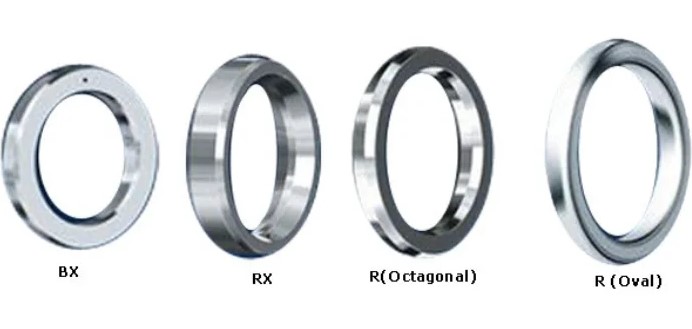
R-type is the most widely used RTJ gasket, manufactured according to API 6A standards, suitable for ANSI/ASME flanges from Class 150 to 2500. R-type gaskets have two geometric shapes:
- Oval R-Type Gasket: The bottom is curved, suitable for round-bottom groove flanges. This design achieves good sealing at relatively low loads but requires high machining precision of the flange groove, needing specially machined flanges for proper use.
- Octagonal R-Type Gasket: Features eight flat surfaces providing concentrated contact lines. This design is relatively simple to manufacture and can be used with standard RTJ flanges. It is currently the most common type in industry. Octagonal gaskets can be reconditioned if necessary, but usually it is recommended to replace with a new gasket after each flange disassembly to ensure sealing reliability.
It should be noted that although oval and octagonal R-type gaskets can be used interchangeably on modern octagonal groove flanges, the finished fit distances of the two are different.
RX-type gaskets are an improved design based on the standard R-type, with the main feature of a pressure-activated effect. When the system is pressurized, the RX-type gasket generates a self-pressurizing effect, using internal pipeline pressure to further enhance sealing performance.
The groove design of RX-type gaskets is the same as the standard R-type, so the joints can be interchanged. However, the improved geometric shape can generate a pressure-activated effect under pressure, significantly improving sealing efficiency while reducing the initial bolt torque requirement.
RX-type gaskets are particularly suitable for high-pressure transmission pipelines in the oil and gas industry, automatically increasing sealing force when system operating pressure rises, reducing the risk of leakage caused by pressure fluctuations.
BX-type gaskets are specifically designed for API 6BX flanges with self-energizing RTJ features, suitable for extreme high-pressure systems with rated pressure up to 20,000 psi (~1380 bar).
A key design feature of BX-type gaskets is the pressure-balancing hole. All BX-type gaskets are designed with this through-hole to equalize pressure generated in the groove, preventing pressure from being trapped in the sealing area. When correctly installed, BX-type gaskets allow direct contact between flange faces, meaning the gasket’s function is confined within the inner and outer diameters, while the flange face itself bears part of the load.
This design makes BX-type gaskets particularly suitable for subsea applications and high-pressure valves, performing excellently in deepwater drilling and extreme pressure environments.
For special needs in marine and subsea operations, SRX-type and SBX-type gaskets have been developed:
- SRX-Type: Subsea improved version of RX-type, with added drainage holes, suitable for subsea high-pressure pipelines.
- SBX-Type: Subsea-specific version of BX-type, designed for deepwater environments to ensure sealing integrity under high-pressure, low-temperature conditions.
Additionally, there are special RTJ gaskets such as blind and double-blind gaskets, which can be used for testing or isolating pipelines. By rotating, they can switch between open and closed states, saving maintenance time.
The choice of RTJ gasket material directly affects sealing performance and service life. The basic principle is: gasket material should be slightly softer than flange material to ensure uniform sealing under pressure while protecting the expensive flange surface from damage.
- Soft Iron: One of the most common RTJ gasket materials, low-cost and highly ductile. Suitable for tight metal-to-metal sealing when flange hardness is limited, effective up to 500°C. Especially suitable for gas pipelines, as it can adapt to irregular flange surfaces and compensate for minor defects.
- Low Carbon Steel: Good mechanical properties and moderate hardness, suitable for general industrial applications, cost-effective.
- Stainless Steel: Grades such as 304 and 316 offer excellent corrosion resistance and high-temperature performance, suitable for chemical processing, marine, and corrosive media environments.
- Duplex and Super Duplex Steel: High-alloy materials combining high strength and excellent corrosion resistance, suitable for high-pressure environments with corrosive media like H₂S and CO₂, common in oilfields and petrochemical plants.
- Rubber-Coated RTJ Gaskets: In specific applications, RTJ gaskets may be coated with rubber for additional sealing and corrosion protection.
When selecting RTJ gaskets, compliance with industry standards is essential, as most flange-gasket failures are caused by mismatched specifications:
- ASME B16.5: Defines flange dimension standards including diameter, thickness, bolt hole location, and size.
- ASME B16.20: Specifically defines metallic gasket design, materials, and dimensions, including RTJ gasket specifications.
- API 6A: Specifies wellhead and Christmas tree equipment requirements, including R-type and RX-type gasket manufacturing standards.
- API 6BX: Design standard for BX-type flanges and gaskets, suitable for ultra-high-pressure applications.
When purchasing RTJ gaskets, both flange and gasket standards must be considered to ensure complete compatibility. Using non-standard or incorrect gasket types can result in leakage or serious safety accidents.
RTJ gaskets play an irreplaceable role in multiple key industrial sectors:
Oil & Gas Industry: The original and most important application of RTJ gaskets includes:
Wellhead and Christmas tree equipment
Blowout preventer (BOP) systems
High-pressure transmission and gathering pipelines
Subsea manifolds and deepwater drilling equipment
High-pressure valves and manifold systems
In these applications, RTJ gaskets must withstand thousands to tens of thousands of psi, corrosive media, and extreme temperatures.
Petrochemical Industry: High-temperature reactors, pressure vessels, and pipelines handling corrosive media widely use RTJ gaskets. These systems often operate under high temperature and pressure with flammable, explosive, or toxic media, requiring extremely reliable sealing.
Power Industry: High-pressure steam systems, boilers, superheaters, and turbine connections in thermal power plants use RTJ gaskets to prevent steam leakage. These gaskets must withstand continuous high-temperature, high-pressure steam.
Marine and Subsea Operations: Deepwater drilling platforms, subsea valves, and pipeline connections use specially designed RTJ gaskets. These gaskets must resist both high pressure and seawater corrosion as well as low-temperature deep-sea environments.
High-Pressure Steam Systems: Industrial high-pressure steam pipelines, steam turbines, and related equipment use RTJ gaskets to prevent steam leakage, ensuring system efficiency and safety.
Proper installation is crucial for RTJ gasket performance. Key steps include:
Inspection Before Installation: Check that flange grooves are clean and undamaged. Any scratches, pits, or corrosion may affect sealing. Inspect gasket condition to ensure no transport damage or deformation.
Correct Placement: Gently place the gasket into the flange groove, ensuring it is centered and fully seated. The gasket must be fully seated in the groove, not tilted or protruding. Never hammer the gasket in with tools to avoid damage.
Bolt Tightening: Use proper bolt lubricant to reduce friction and ensure accurate torque. Tighten bolts in a star (diagonal) pattern in stages:
Stage 1: 30% of target torque
Stage 2: 60% of target torque
Stage 3: 100% of target torque
This staged tightening ensures even flange contact and prevents uneven gasket deformation.
Avoid Over-Tightening: Excessive torque will not improve sealing and may damage the gasket or flange groove. Strictly follow the manufacturer’s recommended torque values.
- Single-Use Principle: RTJ gaskets are designed for one-time use. After flange disassembly, even if the gasket appears intact, a new gasket should be used. Once compressed, the metal structure has changed, and reuse cannot guarantee sealing performance. The only exception is certain professionally repaired octagonal R-type gaskets, which may be reused under strict assessment.
- Specification Matching: Ensure gasket type, size, and material fully match the flange. Common errors include using oval gaskets in octagonal grooves where the flange is incompatible, mismatched material hardness damaging the flange, or using gaskets of the wrong pressure rating.
- Storage and Transport: Store RTJ gaskets in a dry environment, avoiding collisions and scratches. Use proper packaging during transport to prevent deformation.
Can RTJ gaskets be reused? Generally not recommended. RTJ gaskets seal via metal deformation; once compressed, the metal structure has changed, and reuse cannot ensure seal integrity. Reuse may lead to leaks or system failure.
Are oval and octagonal gaskets interchangeable? On modern octagonal groove flanges, yes, but finished fit distances differ. Only use oval gaskets if the flange groove is explicitly compatible, otherwise sealing may fail.
How to choose gasket material? Choose based on media corrosiveness, temperature, and pressure. Soft iron is suitable for moderate conditions and gas pipelines; stainless steel for corrosive environments; duplex and super duplex steel for harsh conditions such as H₂S.
Why comply with ASME B16.20? This standard defines metallic gasket design, material, and dimensions, ensuring correct flange-gasket fit. Non-compliant gaskets may lead to seal failure or safety accidents.
Difference between RTJ and ordinary gaskets? RTJ gaskets are solid metal rings, sealing via metal-to-metal contact, suitable for high-pressure, high-temperature use. Ordinary gaskets use soft filler materials, relying on material compression, suitable for medium or low pressure.
Though small in size, RTJ gaskets play a key role in industrial safety and efficiency. From oil and gas extraction to power generation, chemical processing to subsea operations, RTJ gaskets provide reliable sealing under extreme conditions.
Selecting the right RTJ gasket requires considering pressure rating, material compatibility, geometry, and industry standards. Whether using standard R-type gaskets, pressure self-enhancing RX-type, or ultra-high-pressure BX-type, certified suppliers should be chosen to ensure compliance with ASME B16.20, ASME B16.5, and other key standards.
In high-pressure, high-temperature industrial environments, sealing integrity often determines operational success. Correct selection, installation, and maintenance of RTJ gaskets are the foundation for safe and efficient system operation.
