
Non-asbestos fibre gaskets, commonly referred to as Compressed Non-Asbestos Fibre (C.N.A.F.) gaskets, have become one of the most widely adopted sealing solutions in industrial applications. Designed to replace traditional asbestos-based gaskets, these materials are now considered the standard in industries that demand both high performance and safety compliance. Historically, asbestos was the material of choice for gaskets due to its exceptional heat resistance, durability, and ability to withstand the rigorous conditions of industrial operations. However, as research into the health effects of asbestos progressed, the severe risks associated with exposure became undeniable. Inhalation of asbestos fibres can lead to chronic respiratory illnesses and even cancer. Consequently, the global shift toward non-asbestos materials was driven by an urgent need to protect human health while maintaining industrial performance.
Today, non-asbestos fibre gaskets have matured into a sophisticated and diverse class of sealing materials, capable of meeting the requirements of virtually any industrial environment. From standard water supply pipelines to high-pressure steam systems, from chemical reactors to aerospace engines, these gaskets provide reliable and long-lasting sealing solutions. Over decades of development, manufacturers have optimized their composition, mechanical properties, and chemical resistance, making non-asbestos gaskets both a safe and technically sound alternative to their asbestos predecessors.
The rapid adoption of non-asbestos gaskets is largely due to their superior overall performance across multiple key dimensions. The advantages of these gaskets can be understood in terms of five major areas: safety, chemical stability, temperature adaptability, mechanical performance, and customization potential.
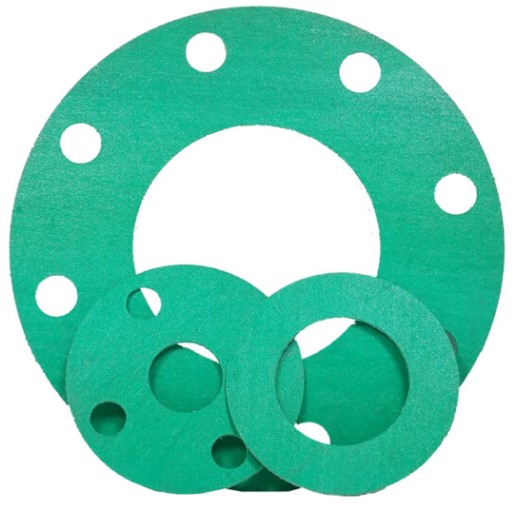
The most significant advantage of non-asbestos gaskets is their inherent safety. Traditional asbestos gaskets pose substantial health risks, especially during installation, removal, or maintenance, when tiny asbestos fibres can become airborne. These fibres, if inhaled, may accumulate in the lungs over time, leading to serious long-term health consequences. Non-asbestos gaskets eliminate this risk entirely, as their materials are composed of environmentally safe and non-toxic substances that do not release hazardous fibres.
This safety feature ensures that non-asbestos gaskets comply with the stringent occupational health and safety regulations enforced worldwide. For businesses, using non-asbestos materials not only fulfills legal obligations but also safeguards employee well-being, minimizes potential liability, and demonstrates a commitment to corporate responsibility. In addition, safer working conditions improve overall operational efficiency by reducing downtime caused by health-related incidents.
Industrial sealing often requires materials to withstand aggressive chemicals. Non-asbestos gaskets exhibit outstanding resistance to acids, alkalis, solvents, oils, and other challenging media. Whether used in petroleum refining, chemical processing, or pharmaceutical production, these gaskets maintain structural integrity and continue to provide effective sealing over extended periods of exposure.
Chemical stability is crucial in applications involving pipelines, valves, storage tanks, and other critical equipment. In highly corrosive environments, non-asbestos gaskets prevent premature failure, reduce maintenance costs, and enhance overall system reliability. By resisting chemical attack, these gaskets help prevent leaks that could result in costly downtime, environmental hazards, or safety incidents.
Non-asbestos gaskets offer excellent versatility across a broad range of temperatures. Manufacturers can adjust material formulations to produce gaskets suitable for both low- and high-temperature applications.
For high-temperature conditions, such as those encountered in boilers, steam turbines, or high-pressure piping systems, non-asbestos gaskets made with mineral fibres and specialized elastomers maintain dimensional stability and sealing effectiveness. Conversely, in low-temperature applications, certain formulations retain flexibility and do not become brittle, ensuring consistent sealing performance. This adaptability enables non-asbestos gaskets to perform reliably in extreme environments where other materials might fail, ensuring operational continuity and safety.
The mechanical performance of a gasket is critical to its ability to maintain a seal under varying conditions. Key properties include compressibility, resilience, and the ability to conform to flange surfaces. Non-asbestos gaskets provide an optimal balance: they compress adequately to fill microscopic surface irregularities, creating an initial tight seal, and rebound sufficiently to maintain sealing performance under thermal cycles, pressure fluctuations, or mechanical vibrations.
Compared to asbestos gaskets, non-asbestos products degrade more slowly over time. Their performance remains stable even after prolonged service, reducing the frequency of replacements and minimizing maintenance costs. This combination of durability and reliability makes non-asbestos gaskets particularly suitable for high-stress industrial applications where long-term performance is essential.
Modern non-asbestos gasket manufacturing allows for extensive customization. Depending on the application, gaskets can be produced in various sizes, shapes, and material compositions. Standard flange connections can use off-the-shelf gaskets, while non-standard or complex equipment interfaces can be fitted with custom-shaped gaskets to ensure precise sealing.
This flexibility makes non-asbestos gaskets suitable for a wide range of industries—from heavy industrial equipment to precision instrumentation. Their ability to meet specialized requirements without compromising performance underscores their value as a universal sealing solution.
Understanding the differences between non-asbestos and asbestos gaskets is essential for selecting the right sealing material. Despite the health risks of asbestos, a direct comparison clarifies the technical and practical advantages of non-asbestos alternatives.
Asbestos gaskets primarily rely on natural asbestos fibres combined with elastomers like rubber. This composition offers high-temperature resistance and mechanical strength but carries serious health hazards.
Non-asbestos gaskets replace asbestos with synthetic fibres such as aramid (aramid fibres provide tensile strength), cellulose (enhances flexibility and conformability), mineral fibres (improve heat resistance), and various elastomers (increase chemical resistance). Optimized combinations of these materials deliver performance that meets or exceeds asbestos gaskets while eliminating health risks entirely.
Historically, non-asbestos materials were believed to underperform in extreme temperature conditions, especially with dry steam. Advances in material science have narrowed this gap, and high-quality non-asbestos gaskets now handle most high-temperature industrial applications effectively. Only in rare extreme cases do asbestos gaskets retain a slight performance edge.
In chemical resistance and dynamic applications, non-asbestos gaskets often surpass asbestos. They remain stable in contact with oils, fuels, and solvents, and their durability under cyclic pressure and temperature variations is superior. Asbestos materials are prone to degradation under cyclical stress, whereas non-asbestos gaskets exhibit greater resilience, making them more reliable under real-world industrial conditions.
The regulatory distinction is crucial. Asbestos is classified as a carcinogen and is banned or heavily restricted in most countries. Non-asbestos materials are free from these legal constraints, facilitating international trade and global industrial compliance. Manufacturers targeting international markets must adopt non-asbestos gaskets to meet regulatory standards and ensure unrestricted market access.
While the upfront cost of non-asbestos gaskets may be higher than some low-end asbestos options, their extended service life, reduced maintenance, and elimination of health-related liabilities make them more cost-effective over time. Longer replacement intervals reduce downtime, prevent production interruptions, and minimize the risk of leaks. Furthermore, the avoidance of asbestos-related occupational health claims represents a significant financial advantage.
Non-asbestos gaskets are available in multiple formats to suit different industrial applications:
When choosing non-asbestos gaskets, several factors must be considered:
Non-asbestos gaskets are used extensively across industries:
Non-asbestos fibre gaskets represent the future of industrial sealing: combining reliable performance with enhanced safety and regulatory compliance. From a technical perspective, these gaskets have matured to the point where they can fully replace asbestos products without compromise. From an industrial application standpoint, they have proven their reliability, durability, and economic efficiency across major sectors.
For manufacturers and end-users alike, selecting non-asbestos gaskets is not only a compliance requirement but also a strategic choice that enhances operational safety and reduces long-term risk. As material science continues to advance, the performance boundaries of non-asbestos gaskets will expand further, offering even more robust and efficient sealing solutions for modern industry.

Copyright © 2026 China Topper Valve Packing Seal Kits Co., Ltd. All Rights Reserved.