
Guide to Electric V-Type Ball Valves in Process Industries
In modern industrial production, the control of fluids is a critical factor in ensuring stable system operation, maintaining process efficiency, and prolonging equipment lifespan. Industries ranging from power generation and petrochemicals to pulp and paper, food, and pharmaceuticals frequently encounter challenges in handling high-viscosity media, suspensions containing solid particles, or fluids prone to scaling. Traditional control valves, such as standard ball valves or butterfly valves, often struggle to meet both precise modulation and reliable sealing simultaneously under these demanding conditions.
The Electric V-Type Ball Valve represents a highly effective solution, combining the robust shut-off capabilities of ball valves with the modulation precision of butterfly valves. Its unique V-notch ball design and advanced actuator integration allow it to maintain excellent control characteristics, prevent clogging, and provide long-term reliability even in complex operating conditions. This article provides a detailed examination of the valve's structure, working principle, functional features, flow characteristics, suitable applications, actuator options, and technical advantages, offering a comprehensive guide for engineers, process designers, and maintenance professionals.
The Electric V-Type Ball Valve is a rotary control valve, with the following main components:
- V-shaped ball: The core flow-control element, precisely machined with a V-shaped notch to achieve controlled flow characteristics.
- Valve seat: Provides a tight seal with the ball, available in metal hard-seal or soft PTFE designs depending on process requirements.
- Valve stem: Connects the ball to the actuator and transmits torque for rotation.
- Actuator: Can be electric, pneumatic, or hydraulic, driving the valve operation based on control signals.
The valve operates by rotating the ball 90 degrees to open, close, or modulate the flow. The V-notch in the ball allows partial opening with precise control, enabling modulation over a wide range of flows.
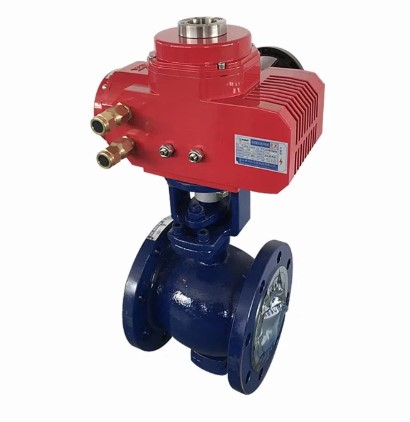
The valve body features a one-piece, side-entry construction, which provides several benefits:
- Enhanced rigidity and structural integrity: The absence of external joints ensures that pipeline stress, flange misalignment, or bolt preloads do not affect the valve body.
- Leakage prevention under high pressure: A solid, integrated pressure-retaining shell reduces the risk of leakage during pressure spikes or system surges.
Inside the body, self-lubricating upper and lower bearings support the valve stem, providing a large contact area, high load capacity, and low friction. This design significantly reduces the torque required for valve operation, ensuring smoother and more energy-efficient performance.
The valve seat is critical for ensuring tight shut-off and reliable modulation:
- Soft seals: PTFE or reinforced PTFE, with a stainless steel core, offer excellent corrosion resistance and bubble-tight sealing for low to moderate temperature applications.
- Metal hard seals: Tungsten-cobalt hard alloy seats, sometimes enhanced with overlay welding or surface hardening treatments on the ball (chrome plating, ion nitriding, or plasma spraying), allow operation under high temperature and high pressure, as well as with abrasive or particulate-laden media.
The seat is further reinforced with alloyed wave springs, enhancing its structural stability and maintaining consistent sealing performance during repeated operations.
The unique combination of the V-ball geometry and integral body design provides several functional advantages that make this valve highly suitable for industrial process control:
Unlike standard ball valves that only provide on/off control, the V-Type Ball Valve functions as both a modulating control valve and a shut-off valve:
In control mode, adjusting the relative position of the V-notch and valve seat allows precise regulation of flow rates.
In closed mode, the ball and seat form a tight seal, ensuring reliable shut-off.
This dual functionality simplifies pipeline design, reduces the number of valves needed, and minimizes space and cost in industrial installations.
The V-shaped notch serves not only for flow modulation but also provides a shearing effect when the valve closes. This is particularly valuable for:
Fibrous media: Pulp, wastewater containing fibers, or other fiber-laden slurries. The notch cuts fibers to prevent entanglement and valve jamming.
Particulate media: Slurries containing solid particles are less likely to form deposits due to the shearing action, improving long-term reliability.
Scaling-prone fluids: Small deposits are mechanically scraped off the sealing surfaces, reducing the risk of obstruction.
This shearing functionality ensures consistent performance in challenging environments such as pulp and paper mills, wastewater treatment facilities, and chemical slurry systems.
The valve's zero-clearance rotary design allows relative motion between the ball and seat during operation. This motion scrapes off accumulated debris and deposits from the sealing surfaces, providing a self-cleaning effect. As a result:
Maintenance intervals are reduced.
Valve lifespan is extended.
System reliability is improved, particularly in processes with high fouling potential.
The small-diameter V-ball machining technique allows for low flow coefficient (CV) values, supporting precise control of small flow rates. Combined with the optimized angle of the V-ball, this design ensures consistent modulation across the full travel range, even in systems with highly variable process conditions.
Flow characteristics describe the relationship between relative flow rate and valve opening under constant pressure conditions. The Electric V-Type Ball Valve exhibits approximately equal-percentage flow characteristics, considered superior for most process control applications.
Equal-Percentage Characteristics
The change in flow rate per unit valve travel is proportional to the current flow.
At low valve openings, flow changes are small, enabling fine control of low flow rates.
At high openings, flow changes are larger, accommodating high-capacity requirements.
This feature ensures:
Consistent control accuracy across the valve's entire operating range.
Smooth modulation in systems with fluctuating loads, avoiding oscillations common with linear or parabolic characteristics.
Wide Turndown Ratio: The valve achieves a turndown ratio up to 300:1, allowing a single valve to handle extremely low to high flow rates, reducing the number of valve sizes required in a plant and lowering overall system costs.
Stable Modulation: Compared to linear or parabolic valves, the equal-percentage design ensures that control sensitivity is consistent throughout the stroke, resulting in stable and predictable process behavior. This is particularly beneficial in systems with large flow variations or rapid load changes.
The Electric V-Type Ball Valve is especially suitable for:
- High-viscosity fluids: Slurries, heavy oils, colloids; the V-notch prevents clogging and keeps operating torque manageable.
- Solid-laden fluids: Mining slurries, ash-water mixtures, chemical catalyst slurries; rotary motion combined with smooth flow paths reduces wear and prevents sediment accumulation.
- Fibrous media: Paper pulp, fiber-laden wastewater; V-notch shearing avoids fiber entanglement.
- Scaling-prone media: Solutions prone to crystallization or fouling; self-cleaning surfaces prevent scale accumulation.
- Powdery media: Pneumatic powder transport; ensures accurate dosing and reliable shut-off.
Installation types:
Flanged connection: High reliability for high-pressure systems.
Wafer/compact connection: Lightweight, space-saving, cost-effective.
Valve variants:
Control type: Optimized for precise modulation and flow characteristics; typically paired with double-acting actuators.
Shut-off type: Focused on rapid, reliable sealing; available as spring-return single-acting or double-acting actuators.
- Cost-effectiveness: Lightweight design and low stem torque allow smaller actuators, reducing initial and maintenance costs.
- High flow capacity: Low resistance, high CV, and optional smaller valve sizes reduce pipeline costs.
- Reliable sealing: Soft or hard seal designs offer bubble-tight or robust sealing under harsh conditions.
- Wide adaptability: Handles clean liquids to high-viscosity slurries, ambient to high temperature/pressure, providing broad process compatibility.
- Ease of maintenance: Fewer components and integral body design simplify on-line repairs and enhance system safety.
- Power industry: Ash handling, desulfurization/denitrification, condensate water treatment.
- Petrochemical: Catalytic cracking, polymerization, blending processes.
- Pulp and paper: Pulp concentration control, coating preparation, white water recycling.
- Environmental/wastewater: Sludge transport, industrial wastewater, reclaimed water.
- Food & pharmaceuticals: Hygienic processing of particle-laden slurries or suspensions.
Standard single-seat V-ball valves are directional; not suitable for fully bi-directional sealing.
Hard-seal options are recommended for abrasive solids; select durable seat materials.
High-temperature applications require metal hard seals and thermal expansion compatibility.
By integrating a V-notch ball with a precision valve seat, the Electric V-Type Ball Valve effectively addresses the common challenges of clogging, wear, and inadequate control precision seen in traditional valves. Its equal-percentage flow characteristic, wide turndown ratio, reliable sealing, and self-cleaning capability make it a crucial device for modern industrial process control. Proper selection of seal type, actuator, and connection style, based on fluid properties, process requirements, and site conditions, ensures reliable, precise, and economical fluid control. With its robust design and versatile performance, the Electric V-Type Ball Valve has proven to be a vital component in industries that demand high precision, durability, and adaptability in fluid handling systems.
