
How to Choose Rubber Gaskets
A rubber gasket is a flexible sealing component with a relatively simple structure, yet it plays an essential role in ensuring the safe and reliable operation of countless mechanical and industrial systems. Its primary function is to fill the microscopic or macroscopic gaps between two mating surfaces and create a compressive sealing barrier. When properly compressed between flanges, housings, or mechanical joints, it prevents leakage of liquids, gases, dust, and other contaminants.
In essence, rubber gaskets are manufactured from elastomeric materials such as natural rubber, silicone rubber, neoprene (chloroprene), ethylene propylene diene monomer (EPDM), nitrile rubber (NBR), and fluorocarbon rubber (FKM/Viton). These materials provide elasticity, resilience, and adaptability, allowing the gasket to deform under pressure and return to its original shape when the load is removed.
Although rubber gaskets are often small and inexpensive compared to the equipment they support, their engineering significance is substantial. A single gasket failure can lead to system leakage, pressure loss, contamination, equipment damage, or even safety hazards. For this reason, understanding their material properties, applications, and selection principles is critical in engineering design and maintenance.
The working principle of a rubber gasket is based on elastic deformation. When a gasket is compressed between two surfaces, it flows slightly to fill surface imperfections and irregularities. This micro-level conformity creates a continuous sealing line that blocks fluid or gas passage.
Unlike rigid metal-to-metal seals, rubber gaskets rely on their flexibility. This allows them to maintain sealing effectiveness even under vibration, thermal expansion, or slight mechanical misalignment. The ability to recover after compression is equally important, as it ensures long-term sealing stability.
In practical applications, rubber gaskets serve not only as sealing elements but also as protective buffers that reduce wear, absorb vibration, and compensate for assembly tolerances.
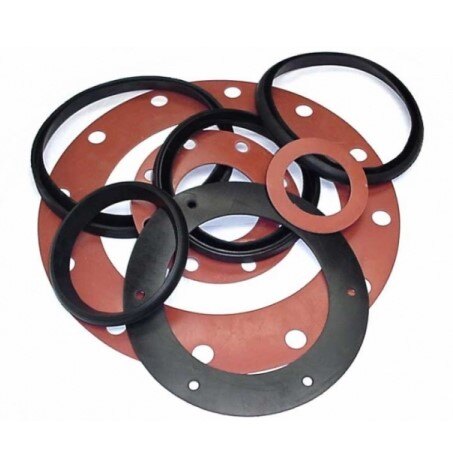
- High Sealing Efficiency: Rubber gaskets provide excellent sealing performance across a wide range of pressures and temperatures. Their ability to deform under compression ensures tight contact with sealing surfaces, even when those surfaces are not perfectly smooth or aligned. This adaptability makes them suitable for both static and semi-dynamic sealing applications.
- Environmental Resistance: Different rubber compounds exhibit resistance to various environmental factors, including heat, cold, chemicals, ozone, and UV radiation. This makes rubber gaskets highly versatile across industries. By selecting the correct elastomer, engineers can ensure long-term durability even in aggressive operating conditions.
- Vibration Damping and Shock Absorption: Rubber materials naturally absorb mechanical energy. As a result, gaskets also function as vibration isolators and shock absorbers. This reduces mechanical stress on connected components, minimizes noise, and extends equipment lifespan. In automotive and heavy machinery systems, this feature is particularly valuable.
- Cost-Effectiveness and Easy Installation: Rubber gaskets are relatively inexpensive compared to metallic sealing systems. They are also easy to install, replace, and maintain. Their simplicity reduces labor costs and downtime during maintenance operations. Additionally, their long service life contributes to overall cost efficiency.
- Design Flexibility: Rubber gaskets can be customized in terms of thickness, hardness, geometry, and material composition. This allows engineers to design sealing solutions tailored to specific operating conditions, from low-pressure water systems to high-temperature chemical processing environments.
Selecting the right material is the most important step in gasket design. Each elastomer has unique strengths and limitations.
EPDM is widely used due to its excellent resistance to heat, ozone, steam, and weathering. It performs well in outdoor applications and water-based systems. It is commonly found in HVAC systems, automotive cooling systems, and plumbing networks.
However, EPDM is not suitable for oil-based or hydrocarbon environments. Contact with petroleum products can cause swelling and degradation.
FKM is a high-performance material known for exceptional chemical and heat resistance. It can withstand aggressive fluids such as fuels, oils, acids, and many industrial solvents. It is widely used in chemical processing, oil and gas systems, aerospace components, and high-temperature equipment.
Its limitation lies in poor compatibility with steam, amines, ketones, and certain esters.
NBR is the most commonly used oil-resistant rubber. It performs exceptionally well in petroleum-based environments, including hydraulic systems, fuel lines, and automotive engines. It offers a good balance of mechanical strength and chemical resistance.
However, it is not suitable for ozone, strong acids, or highly oxidizing chemicals.
Neoprene offers balanced resistance to weathering, moderate chemicals, oils, and ozone. It is widely used in marine environments, construction, and industrial sealing applications. It performs well outdoors and provides good durability under fluctuating environmental conditions.
Silicone rubber is known for its outstanding thermal stability, typically operating between -60°C and 200°C. It is chemically inert, making it suitable for medical, pharmaceutical, and food-grade applications.
However, it has relatively poor mechanical strength and limited resistance to fuels and oils.
Natural rubber provides excellent elasticity, tear resistance, and compression recovery. It is suitable for applications requiring flexibility and abrasion resistance. However, it performs poorly in oil, fuel, and solvent environments, limiting its industrial use.
SBR is a synthetic alternative to natural rubber. It is commonly used in water, air, and steam applications. It has good wear resistance but limited chemical and ozone resistance. It is often used in general-purpose sealing applications where extreme conditions are not present.
- Automotive Industry: In automotive systems, rubber gaskets are essential for sealing engines, transmissions, fuel systems, and cooling circuits. They prevent oil and coolant leakage while maintaining system pressure. NBR and FKM are commonly used due to their resistance to fuels and high temperatures.
- HVAC and Water Systems: Heating, ventilation, air conditioning, and water distribution systems rely heavily on rubber gaskets to ensure leak-free operation. EPDM is the preferred material due to its resistance to water, steam, and weather exposure. These systems require long-term durability and stable performance.
- Aerospace Industry: Aerospace applications demand extreme reliability. Rubber gaskets are used in hydraulic systems, fuel systems, and engine components. They must withstand rapid pressure changes and extreme temperatures. FKM and specialized silicone compounds are commonly used.
- Electronics and Household Appliances: Rubber gaskets protect sensitive electronic components from dust, moisture, and electromagnetic interference. In appliances such as refrigerators, washing machines, and air conditioners, they improve sealing efficiency and energy performance.
- Pharmaceutical and Food Processing: These industries require hygienic and non-toxic sealing solutions. Silicone rubber is widely used because it meets strict regulatory standards such as FDA compliance. It ensures product purity and prevents contamination.
- Oil and Petrochemical Industry: Rubber gaskets play a critical role in sealing pipelines, valves, and processing equipment in oil and gas systems. They must resist high pressure and aggressive chemicals. FKM and NBR are commonly selected materials.
- Marine Industry: In marine environments, rubber gaskets are exposed to saltwater, UV radiation, and mechanical stress. They are used in hatches, doors, and piping systems. NBR and neoprene are widely used due to their resistance to seawater and oils.
- Operating Conditions: Temperature, pressure, and chemical exposure are the primary selection criteria. For example, silicone is preferred for extreme temperature ranges, while FKM is chosen for high chemical resistance. Pressure levels may require reinforced gasket designs.
- Chemical Compatibility: Material compatibility with the working medium is critical. Incompatible materials may swell, crack, or degrade, leading to sealing failure. Engineers must evaluate fluid composition carefully before selection.
- Mechanical Properties: Important parameters include hardness, tensile strength, and compression set. Softer materials offer better surface conformity, while harder materials provide greater mechanical stability. Low compression set ensures long-term sealing performance.
- Design Requirements: Proper sizing and geometry are essential. Gasket thickness, width, and shape must match flange design. Standards such as ASME B16.20 define minimum contact requirements for reliable sealing under different pressure conditions.
- Regulatory Compliance: Industries such as food, pharmaceuticals, and aerospace require strict compliance with safety and quality standards. Material selection must meet relevant certifications and regulatory approvals.
- Cost and Lifecycle Considerations: While initial cost is important, long-term durability and maintenance frequency often determine total cost of ownership. High-performance materials may offer better long-term value despite higher upfront costs.
Rubber gaskets are produced using several manufacturing techniques, including die cutting, injection molding, extrusion, compression molding, and precision cutting methods such as laser or waterjet cutting.
Each method serves different production needs. For example, die cutting is ideal for flat gasket shapes, while injection molding is suitable for complex geometries and high-volume production.
During installation, surface preparation is critical. Contact surfaces must be clean, dry, and within acceptable roughness limits. Bolted joints should be tightened gradually in a cross-pattern sequence to ensure uniform compression and avoid uneven loading. Over-tightening can damage the gasket, while under-tightening may lead to leakage.
Rubber gaskets may appear to be simple components, but they are fundamental to the safety, efficiency, and reliability of modern engineering systems. Their ability to adapt, seal, and protect makes them indispensable across virtually every industrial sector.
From automotive engines and aerospace systems to food processing equipment and petrochemical pipelines, rubber gaskets ensure operational stability under diverse and demanding conditions. By carefully selecting the appropriate material, design, and installation method, engineers can achieve long-lasting and dependable sealing performance.
Ultimately, the effectiveness of a sealing system often depends not on complexity, but on the correct application of this small yet vital component.
